


Maths Books for 1st Graders
Every child deserves stories that spark curiosity and build a foundation for lifelong learning. Discover engaging maths books for 1st graders ages 5-6. Our children’s books feature counting, shapes, and number adventures perfect for beginning readers. These picture books and storybooks build reading confidence while teaching early maths concepts.
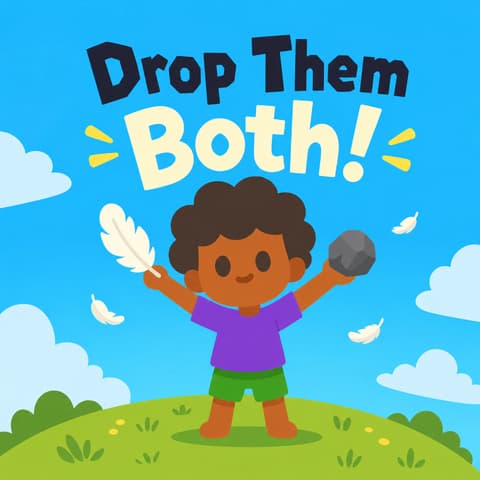
Drop Them Both!
A rock and a feather, one in each hand - which one do you think will hit the ground first? The Boy is sure he knows the answer, but then he starts to wonder just how much heavier that smooth stone really is. With scales, flasks, and a very patient elephant, can he and Dad figure out the mass of almost anything, from a raindrop to the whole planet? This decodable reader practises the ’th’ sound in words such as ‘both,’ ‘smooth,’ ’think,’ and ’thrusts.’
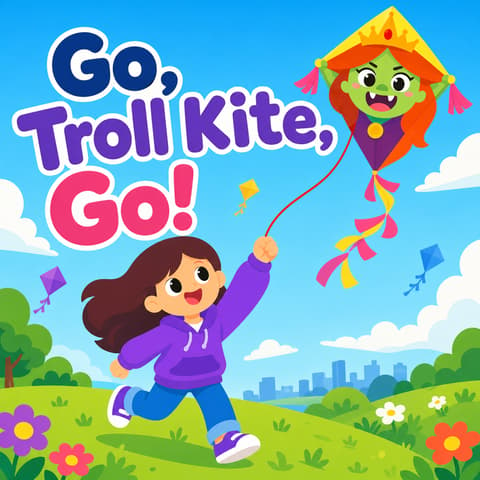
Go, Troll Kite, Go!
Rain, rain, and more rain - will the sky ever clear? When the sun finally breaks through, it’s time to race outside with a homemade kite and a very special secret weapon painted right on the front: a troll queen with a golden crown and the biggest smile around. Can she soar higher than the monster kite and the fish kite too? Get ready to cheer! This decodable reader practises silent e words such as ‘kite,’ ‘glide,’ ‘shape,’ ‘smile,’ and ‘pride.’
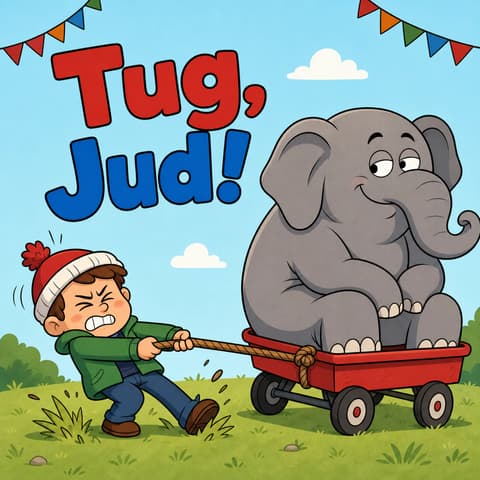
Tug, Jud!
One huge elephant, one tiny red cart, and it will NOT budge - can you help push? As the day unfolds, there are eggs to count, bubbles to blow, a giant ant to ride, and a sparkly spider waiting in its web. Will Child ever reach ten? And what about that stubborn elephant back at the start? This decodable reader practises short u with j, v, y in words like ‘jump,’ ‘just,’ ’tug,’ and ‘fun.’
Frequently Asked Questions
Why do maths books help 1st graders become stronger readers?
Maths books for 1st graders strengthen reading by giving children a meaningful reason to decode text. When a story involves counting or shapes, first graders must read carefully to follow the problem, which reinforces the phonics patterns they are learning such as CVC words, blends, and digraphs. Research on systematic phonics instruction (Ehri et al., 2001) confirms that applying decoding skills across varied content accelerates word recognition. On Bookbot, maths picture books for first grade use decodable text matched to 1st grade phonics levels, so children practise reading and numeracy at the same time.
How can counting books for 5 year olds build vocabulary beyond numbers?
Counting books for 5 year olds introduce words for shapes, comparisons, and spatial relationships alongside number vocabulary, broadening a child’s language base. Stanovich’s Matthew Effect research (1986) shows that children who encounter diverse vocabulary through reading develop stronger comprehension over time. Bookbot’s maths books for beginning readers pair this rich vocabulary with decodable text, with many titles free to read on the Bookbot website. For tips on reading together, see our guide on the benefits of reading aloud.
What makes Bookbot's maths books suitable for children at the initial reading stage?
First graders are at what Chall (1983) describes as the ‘initial reading and decoding’ stage, where they need text carefully controlled for phonics complexity. Bookbot’s maths books for 1st graders follow a structured scope and sequence that aligns stories with specific phonics patterns, from simple CVC words to consonant blends. This means children can focus on mathematical ideas like addition or patterns without being blocked by words they cannot yet decode.
How can parents use maths picture books for first grade during read-aloud time?
Parents can read a maths picture book aloud first, discussing the illustrations and maths concepts, then let the child re-read independently to practise decoding. Research from the University of Chicago found that shared digital reading significantly improves literacy skills in young children. On the Bookbot website, many maths books are available to read online, with select titles offering word-by-word highlighted read-aloud, making it easy to model fluent reading before handing the book to your child. For more strategies, see our guide on laying the foundations for a love of reading.