




If your child speaks two languages and is struggling to read, you have probably asked yourself whether the bilingualism is making things harder. Maybe a well-meaning teacher has suggested dropping the home language to “focus on English.” Maybe you are wondering whether what you are seeing is dyslexia, or just the normal bumps of learning to read in two languages.
These are real concerns, and they deserve real answers. Can bilingual children have dyslexia? Yes, but here is the part nobody tells you: when I review the research on bilingual reading difficulties, the findings are surprisingly reassuring, and in some cases, genuinely encouraging.
Dyslexia Doesn’t Care Which Language You Speak
Dyslexia is a neurological difference in how the brain processes the sounds of language. It is not caused by bilingualism, and it does not go away if a child only speaks one language. The core difficulty, a weakness in phonological processing (the ability to hear and manipulate the individual sounds in words), shows up regardless of which language a child speaks.
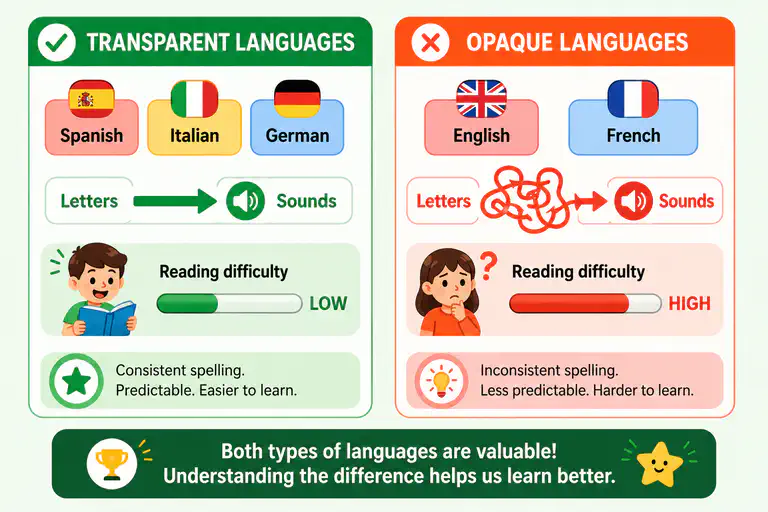
What does change is how that difficulty looks on the surface. Think of it this way: in Spanish or Italian, spelling is predictable. The letter “a” almost always makes the same sound. Children with dyslexia in those languages tend to learn to read words accurately, but slowly. In English or French, spelling is a mess. The letter “a” makes different sounds in “cat,” “cake,” and “father,” which means dyslexia hits harder and shows up as both slow and inaccurate reading. Ziegler and Goswami (2005) mapped out this pattern across languages, and it has held up across decades of research.
How big is the difference? A meta-analysis (a study that combines data from many individual studies) by Carioti et al. (2021) looked at 79 studies and nearly 15,000 children. In languages with unpredictable spelling like English, children with dyslexia showed much larger reading accuracy gaps (an effect size of 2.38, meaning a very large difference) compared to languages with predictable spelling (1.53). But here is the key takeaway: reading speed was affected in every language, making it one of the most reliable red flags no matter what language your child reads in.
The Bilingual Advantage Nobody Talks About
Here is something that surprised me when I first found it in the data: bilingual children with dyslexia may actually have a cognitive edge over monolingual children with the same condition.
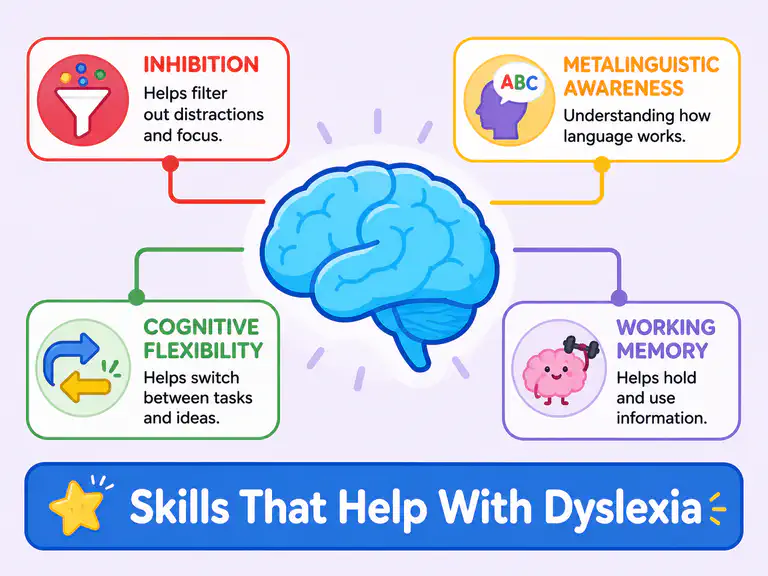
Vender et al. (2019) tested 108 children in four groups: monolingual typical readers, bilingual typical readers, monolingual children with dyslexia, and bilingual children with dyslexia. The bilingual kids with dyslexia consistently outperformed the monolingual kids with dyslexia. On some tasks, they performed at the same level as children without dyslexia at all. They were faster and more accurate when asked to focus on one thing while ignoring distractions, a skill that matters enormously for reading.
Why would speaking two languages help? Every time a bilingual child switches from one language to another, their brain practises filtering, selecting, and controlling information. That builds up mental muscles like focus and flexibility. A systematic review by Giovannoli et al. (2020), covering 53 studies of children aged 5 to 17, found the strongest evidence for a bilingual advantage in exactly these skills. And these are the same skills that help children with dyslexia find creative workarounds for their reading difficulties.
This does not mean bilingualism is a cure for dyslexia. But it does mean that speaking two languages gives a child additional cognitive tools to draw on.
Why Bilingual Children Get Misdiagnosed
The real challenge with dyslexia bilingual children face is not that they are more likely to have dyslexia. It is that they are more likely to be diagnosed too late, or not at all.
When a bilingual child struggles with reading, teachers and parents often assume the difficulty comes from learning two languages. And it is an understandable assumption. Slow reading, spelling errors, difficulty sounding out unfamiliar words: these look like dyslexia, but they also look like a child who is still getting comfortable in a new language. So how do you tell the difference?
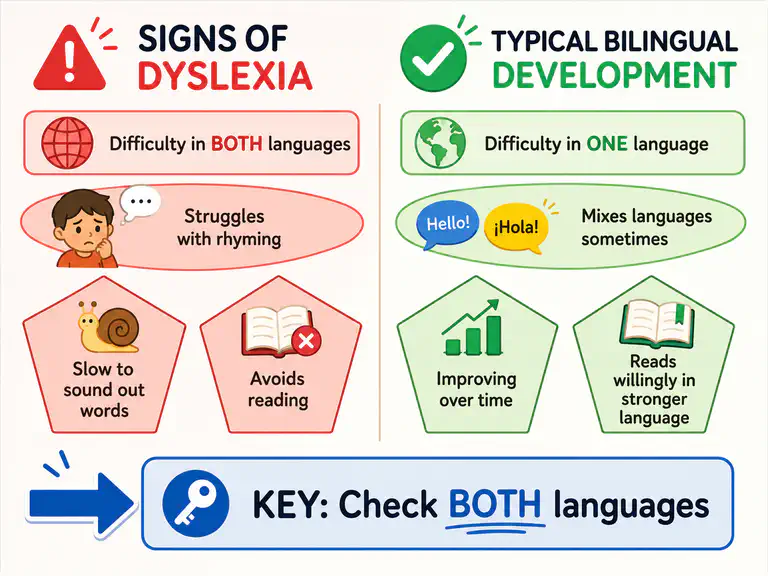
Taha et al. (2022) studied 72 children and found a reliable answer. Tasks like phonological awareness (can your child hear that “cat” has three sounds: /k/ /a/ /t/?) and nonword repetition (can they repeat a made-up word like “glistrop”?) predicted reading ability equally well in bilingual and monolingual children. These tasks cut through the language confusion because they test the core sound-processing skill that dyslexia disrupts, no matter how many languages a child speaks. Knowing these signs of dyslexia in a bilingual child is the first step toward getting help early.
The key is assessing in both languages. If a child shows the same pattern of difficulty across both, that points to dyslexia rather than a language exposure gap.
What You Can Do
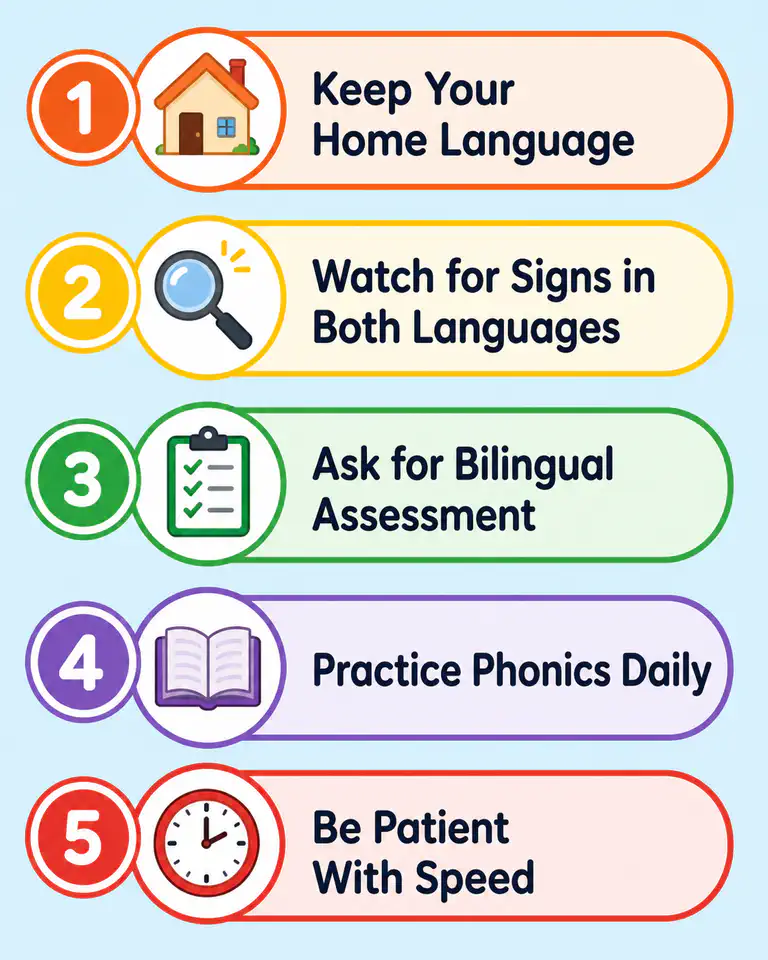
Keep speaking your home language. Research consistently shows that first-language literacy supports second-language reading development. Oshchepkova et al. (2023) reviewed 50 studies and found that “becoming literate in one’s first language helps with literacy development in the second language and vice versa.” Dropping a language only removes a cognitive resource your child needs.
Watch for signs across both languages. If your child is slow to sound out words, avoids reading, or struggles with rhyming in both languages, not just the one they know less well, talk to a reading specialist. The pattern across languages is the strongest clue.
Ask for assessment in both languages. A dyslexia assessment conducted only in the school language can miss the full picture. Phonological awareness tasks and nonword repetition are effective indicators regardless of language background (Taha et al., 2022).
Focus on phonics-based practice. Structured, explicit phonics instruction works for dyslexia and second language learning alike. At Bookbot, we work with children across multiple language backgrounds, and what I see in the reading data is consistent with the research: daily, structured practice with phonics-aligned books makes a measurable difference, no matter how many languages a child speaks at home.
Be patient with reading speed. Even with good instruction, bilingual children with dyslexia may read accurately but slowly. The meta-analysis by Carioti et al. (2021) found that reading speed deficits persist across all orthographies. Progress will come, but it shows up in accuracy and confidence before it shows up in speed.
The Bottom Line
Bilingualism does not cause dyslexia, and it does not make it worse. If anything, the cognitive flexibility that comes from speaking two languages may give children with dyslexia additional strengths to build on.
What bilingualism does do is make dyslexia harder to spot, because the signs overlap with normal second-language learning. That is why assessment in both languages matters, and why it is so important not to dismiss bilingual reading difficulties as “just a language thing.”
At Bookbot and Flinders University, this is something we think about often when we analyze reading data from children with diverse language backgrounds. The science is clear: keep the home language, seek proper assessment, and give your child consistent, structured reading practice. Those are the ingredients that make a difference.
References
Carioti, D., Masia, M. F., Travellini, S., & Berlingeri, M. (2021). Orthographic depth and developmental dyslexia: A meta-analytic study. Annals of Dyslexia, 71(3), 399-423. https://pmc.ncbi.nlm.nih.gov/articles/PMC8458191/
Giovannoli, J., Martella, D., Federico, F., Pirchio, S., & Casagrande, M. (2020). The impact of bilingualism on executive functions in children and adolescents: A systematic review. Frontiers in Psychology, 11, 574789. https://pmc.ncbi.nlm.nih.gov/articles/PMC7573143/
Oshchepkova, E. S., Kartushina, N., & Razmakhnina, A. (2023). Bilingualism and development of literacy in children: A systematic review. Psychology in Russia: State of the Art, 16(2), 43-66. https://pmc.ncbi.nlm.nih.gov/articles/PMC10547117/
Taha, J., et al. (2022). Identifying the risk of dyslexia in bilingual children: The potential of language-dependent and language-independent tasks. Frontiers in Psychology, 13, 935935. https://pmc.ncbi.nlm.nih.gov/articles/PMC9730291/
Vender, M., Krivochen, D. G., Phillips, B., Saddy, D., & Delfitto, D. (2019). Implicit learning, bilingualism, and dyslexia: Insights from a study assessing AGL with a modified Simon task. Frontiers in Psychology, 10, 1647. https://pmc.ncbi.nlm.nih.gov/articles/PMC6677018/
Ziegler, J. C., & Goswami, U. (2005). Reading acquisition, developmental dyslexia, and skilled reading across languages: A psycholinguistic grain size theory. Psychological Bulletin, 131(1), 3-29. https://pubmed.ncbi.nlm.nih.gov/15631549/