


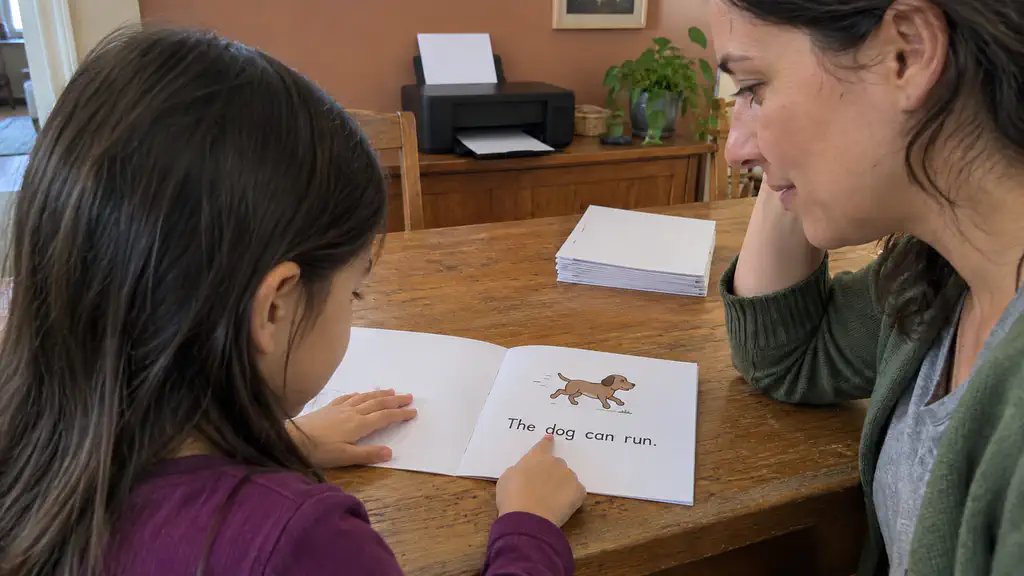

Your child brings home a book, sounds out the first three words, then glances at the picture and guesses the rest. So you search for free decodable books, and twenty minutes later you have fourteen tabs open, each offering a different set of PDFs, none saying which one your child should read tonight.
This is where I see parents get stuck most often. Not motivation. Not time. Matching.
Free decodable books are abundant, including hundreds in Bookbot’s own library. The evidence behind decodable text is also thinner than most publishers imply. Both are worth knowing before you download anything. (If you only want the list, skip to the free books.)
What Makes a Book Decodable
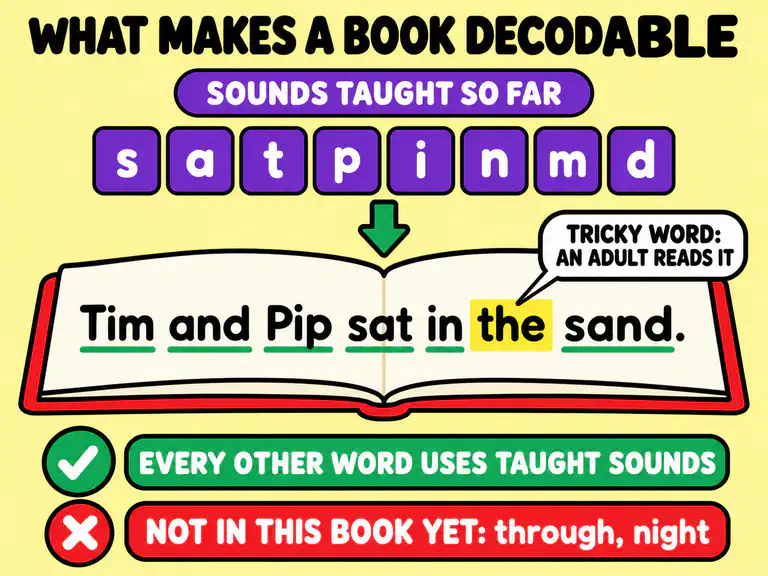
A decodable book contains only the grapheme-phoneme correspondences a child has already been taught. A grapheme-phoneme correspondence is the link between a letter or letter group and the sound it stands for: “sh” in ship is one, “a” in cat is another.
Alongside those it carries a few high-frequency words that break the taught patterns, like the or said. Good publishers flag them so an adult supplies them instead.
That constraint is the whole point. If a child has been taught short vowels and single consonants, tonight’s book should not ambush them with through on page four.
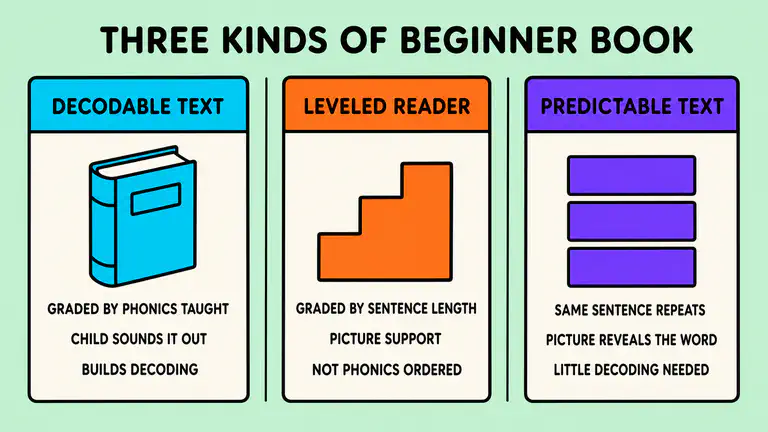
A levelled reader is graded by sentence length, vocabulary and picture support rather than by phonics. A predictable text repeats the same sentence frame and lets the illustration reveal the one word that changes. Predictable books do build confidence with story language. What they cannot do is force decoding practice, because a child can finish one without reading much at all.
What the Research Actually Says About Decodable Texts
Here I have to be honest, because the marketing around decodables often is not.
Cheatham and Allor (2012), reviewing the field in Reading and Writing, concluded that decodability matters: it makes children more likely to decode rather than guess, and it improves accuracy while they read that text. The same review found only seven studies in the literature that isolated decodability as the sole variable, and only two of those followed reading growth over time, neither showing a difference.
Jenkins and colleagues (2004) ran one of the few randomised trials, in Scientific Studies of Reading. They tutored 79 at-risk first graders four days a week for 25 weeks on the same phonics programme, and varied only the storybooks. Across the first 30 lessons one group’s books were 85% decodable, the other group’s 11%. Both tutored groups beat the untutored control on decoding, word reading, passage reading and comprehension.
Neither beat the other on any measure.
Murphy Odo (2024) pooled 16 studies of children without reading disabilities in Literacy and found small to moderate benefits: a Hedges’ g of 0.20 for word reading and 0.30 for decoding invented words. (Hedges’ g is an effect size, meaning how big the gap between two groups is, where 0.20 counts as small and 0.50 as moderate.) Most of those studies carried a moderate to serious risk of bias.
Decodable books give children a clean surface to practise what they have been taught. They are not a magic ingredient.
What This Means for Your Child
The useful question is not which brand wins, but whether tonight’s book sits at the right level of challenge.
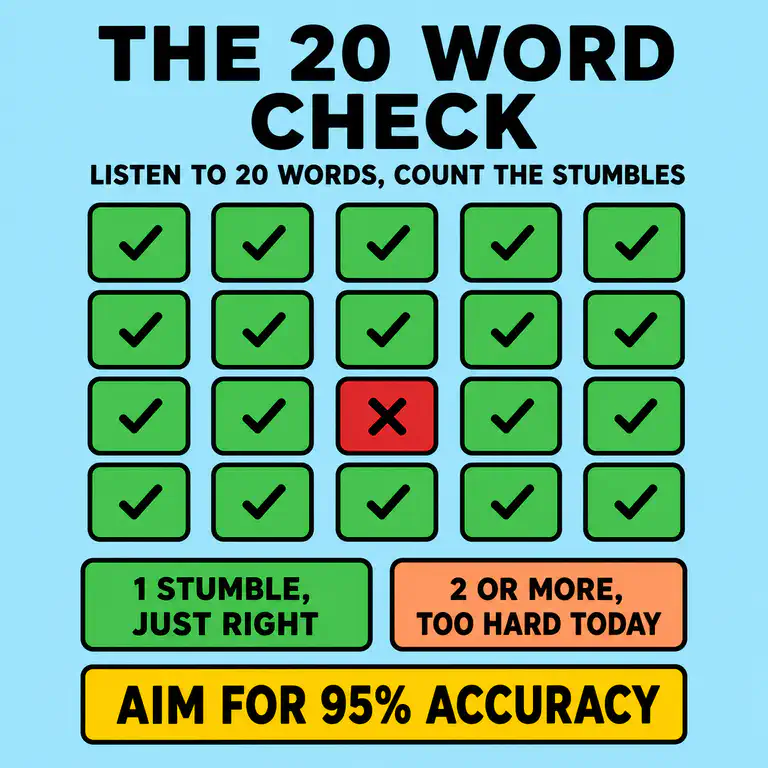
The familiar advice is to aim for 95% accuracy, meaning your child reads about 19 of every 20 words correctly without help. Betts (1946) proposed that figure, and his criteria rested on an unpublished dissertation rather than a controlled trial. The direction is better supported than the number. Amendum, Conradi and Hiebert (2018) synthesised 26 studies in Educational Psychology Review and found that as text difficulty rose, children’s fluency and comprehension generally fell.
This is why Bookbot’s library is organised by phonics stage rather than by age. A seven-year-old still working on consonant digraphs needs the digraph books, not the books for seven-year-olds.
How to Pick the Right Free Decodable Book
- Start with your school’s phonics sequence. Programmes introduce sounds in different orders, so one publisher’s “level 3” is not another’s. Ask your child’s teacher before you download a set.
- Listen to twenty words before you commit. Open the book anywhere and count the stumbles. More than one, and it is too hard for independent practice tonight.
- Do not push through a book that is too hard. Read it aloud instead, or drop back a stage and return in a week.
- Let your child reread the same book. Therrien (2004), a meta-analysis in Remedial and Special Education (a meta-analysis pools results across many separate studies), found repeated reading produced a large gain in fluency, an effect size of 0.83, and a moderate gain in comprehension, 0.67, on the practised passage. Three easy readings beat one hard one.
- Keep it to five or ten minutes. Short and often beats long and occasional, and accuracy is what you are practising, not endurance.
- Supply the tricky words yourself. Words like said and the do not follow the patterns your child has met yet. Say them, so the effort goes on words they can work out.
Where to Find Free Decodable Books
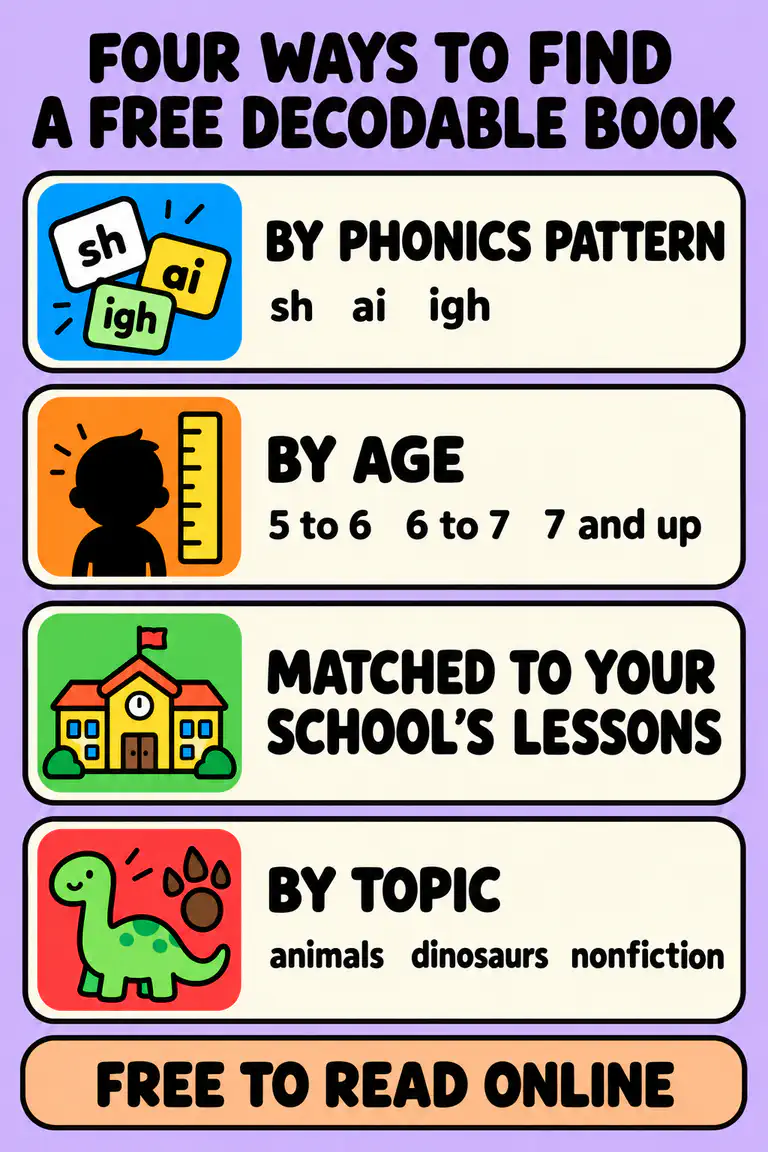
Bookbot’s free library holds decodable readers free to read online. Many also come as a free decodable books PDF to print, and many have read-along audio that highlights each word. There are four ways in.
- By phonics pattern. The library follows one sequence, from CVC words like cat through digraphs, vowel teams and multi-syllable words. Each book names the pattern it practises, such as the gh in ghost, so you can match it to what your child is learning this week.
- By age. Free books for ages 5 to 6, 6 to 7 and 7 and up are a quick start if you do not know your child’s stage yet. Treat age as a first guess, then use the twenty-word check.
- By school programme. If your child’s class uses UFLI Foundations or Jolly Phonics, there are over three hundred free decodable books for UFLI Foundations lessons and over three hundred for Jolly Phonics, grouped lesson by lesson. They are original stories created to align with each programme’s scope and sequence.
- By topic. The free decodables are also sorted by interest, from animals and dinosaurs to nonfiction, African folktales and stories where girls are the heroes.
Whether you want free online decodable books for a tablet or free printable decodable books for the car, finding decodable texts free of charge is not the hard part. Choosing the right one is.
What I Would Tell a Worried Parent
If your child is guessing from pictures, decodable text is the right correction, and it costs nothing. But do not expect the book alone to do the work. Jenkins and colleagues found the tutoring mattered, not the text type.
Pick one source of free decodables, match the stage honestly, keep the sessions short, and let your child read the same book until it sounds easy.
Matching is the problem we spend the most time on at Bookbot. Children rarely stall for want of books. More often, tonight’s book is one stage too hard.
References
Amendum, S. J., Conradi, K., & Hiebert, E. (2018). Does text complexity matter in the elementary grades? A research synthesis of text difficulty and elementary students’ reading fluency and comprehension. Educational Psychology Review, 30(1), 121–151. https://doi.org/10.1007/s10648-017-9398-2
Betts, E. A. (1946). Foundations of reading instruction. American Book Company. https://archive.org/details/foundationsofrea0000emme
Cheatham, J. P., & Allor, J. H. (2012). The influence of decodability in early reading text on reading achievement: A review of the evidence. Reading and Writing, 25(9), 2223–2246. https://doi.org/10.1007/s11145-011-9355-2
Jenkins, J. R., Peyton, J. A., Sanders, E. A., & Vadasy, P. F. (2004). Effects of reading decodable texts in supplemental first-grade tutoring. Scientific Studies of Reading, 8(1), 53–85. https://doi.org/10.1207/s1532799xssr0801_4
Murphy Odo, D. (2024). The use of decodable texts in the teaching of reading in children without reading disabilities: A meta-analysis. Literacy, 58(3), 267–277. https://doi.org/10.1111/lit.12368
Therrien, W. J. (2004). Fluency and comprehension gains as a result of repeated reading: A meta-analysis. Remedial and Special Education, 25(4), 252–261. https://doi.org/10.1177/07419325040250040801
Bookbot is not endorsed by or affiliated with UFLI (the University of Florida Literacy Institute) or Jolly Learning. UFLI, UFLI Foundations and Jolly Phonics are trademarks of their respective owners.