


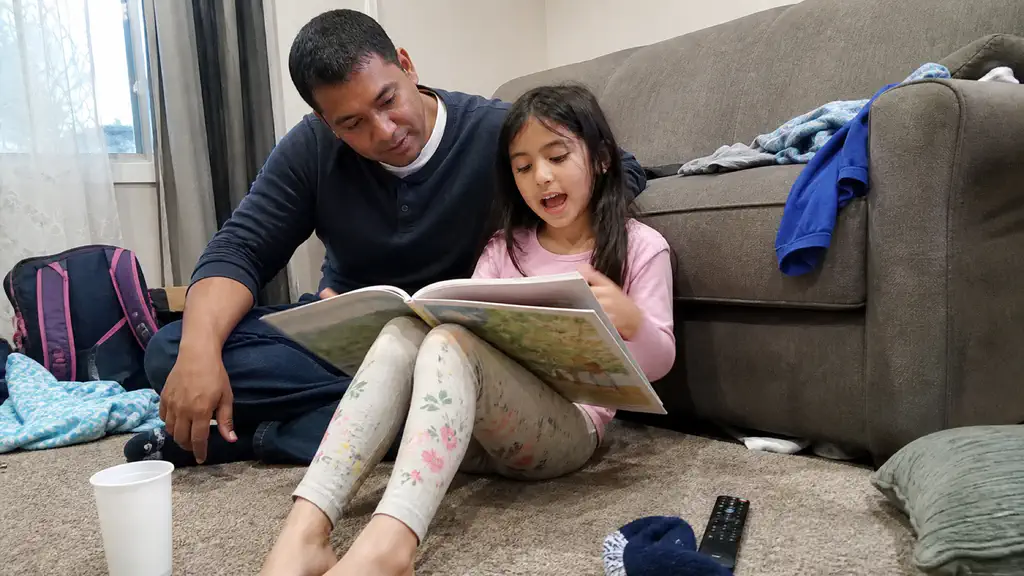

Your child reads to you most nights. She gets the words right, mostly, but each one arrives on its own, separated by a small pause, in the same flat tone as the one before it. By the bottom of the page you have both lost the story.
Then another parent mentions that her son “reads about ninety words a minute,” and you realise you have no idea whether ninety is good.
The question underneath that, how fast should my child be reading, has a real answer with real data behind it. It also has a trap. Here is both.
Fluency Is Three Things, Not One
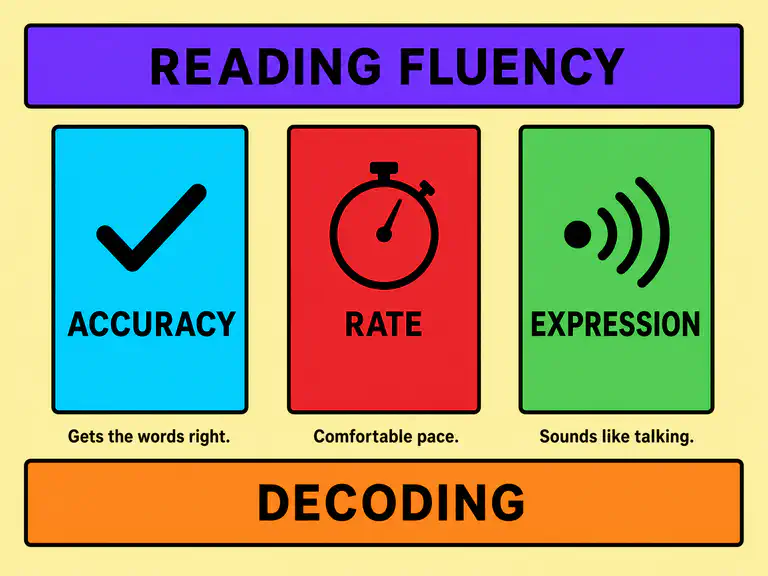
The 2018 National Assessment of Educational Progress oral reading fluency study, which tested a nationally representative sample of over 1,800 US fourth-graders, defined fluency as reading text aloud with speed, accuracy and proper expression (White et al., 2021). Three parts. Most parents only hear about the first one.
The typical fourth-grader in that study read 120 words correct per minute, usually shortened to WCPM, and got 94 percent of them right, about one word wrong in every seventeen.
When I review the research, fluency is never a skill sitting on top of reading. It is what decoding, turning letters into sounds, looks like once it stops costing effort. A child sounding out every third word spends nearly all their attention on the words, leaving little for the meaning. That is the real link between reading fluency and comprehension.
At Bookbot, this is exactly what the app listens for. Speech recognition follows a child word by word as they read aloud, so accuracy and pace are measured continuously rather than once a term.
The Actual Numbers, By Grade
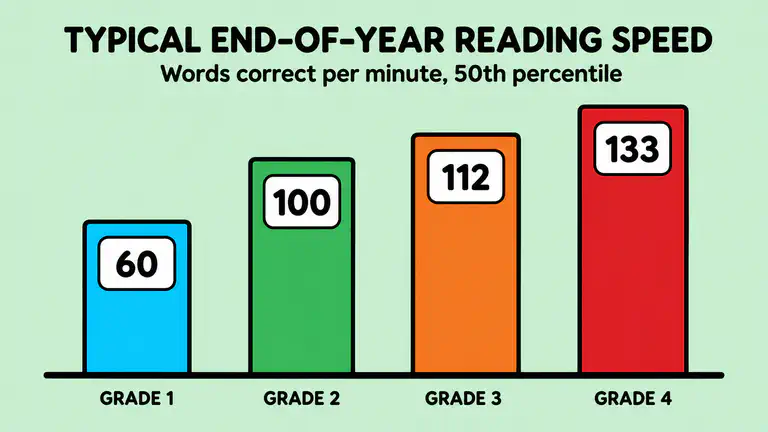
Almost every school works from the oral reading fluency norms Jan Hasbrouck and Gerald Tindal compiled from 6,886,582 scores (Hasbrouck & Tindal, 2017). Below are the typical results, meaning the 50th percentile, where half of children score higher and half lower.
| Grade | Fall | Winter | Spring |
|---|---|---|---|
| 1 | not assessed | 29 | 60 |
| 2 | 50 | 84 | 100 |
| 3 | 83 | 97 | 112 |
| 4 | 94 | 120 | 133 |
Words correct per minute, 50th percentile (Hasbrouck & Tindal, 2017).
Two things surprise parents. The first is how wide the normal range is. At the end of Grade 2, a child at the 25th percentile (meaning 75 children out of 100 score higher) reads 72 WCPM, and one at the 90th reads 148. Both sit inside one ordinary classroom.
The second is how fast the numbers move. Between winter and spring of Grade 1, the typical child roughly doubles, from 29 to 60.
To calculate words correct per minute at home, have your child read an unpractised passage aloud for a minute, then subtract the words they missed. It is a screening signal, not a target. Hasbrouck and Tindal’s rule of thumb, which they set out for Grades 2 and up, is that a score within ten words either side of the 50th percentile is the normal, expected range. Further below that is worth a closer look (Hasbrouck & Tindal, 2006).
Why Speed Alone Is the Wrong Goal
Here is the trap. A child can be trained to hit a WCPM target and get worse at reading.
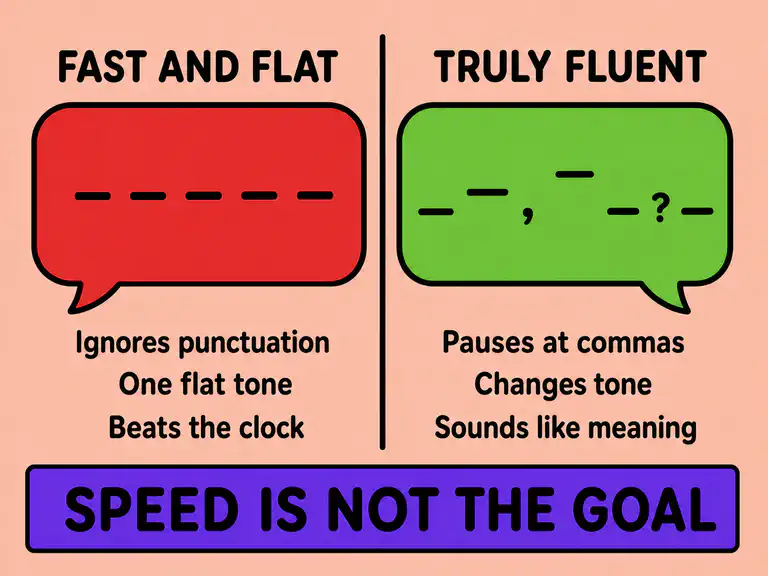
When I analyse data from children coached toward a speed target, the pattern is easy to spot. Punctuation goes first, then phrasing, then expression. What is left is a fast, flat monotone that scores well on a stopwatch and communicates nothing.
That expressive layer has a name: reading prosody, the rhythm, phrasing and intonation that make read-aloud text sound like speech rather than a list. A meta-analysis (a study that pools results from many separate studies) of 35 studies covering 9,349 children in Grades 1 to 9 put the link between prosody and comprehension at .51, a moderate correlation: children who read with more expression tend to understand more (Wolters et al., 2022).
Accuracy matters just as much. When the National Reading Panel (2000) pooled the research on guided repeated oral reading, the biggest gain was in accuracy, at an effect size of 0.55 (a measure of how far a practice moves children compared with those who skip it, where 0.5 is moderate and 0.8 is large), ahead of 0.44 for fluency itself and 0.35 for comprehension.
So the honest answer is this. Use words correct per minute to check whether decoding has become effortless. Do not make it the thing you train.
What Actually Builds Fluency
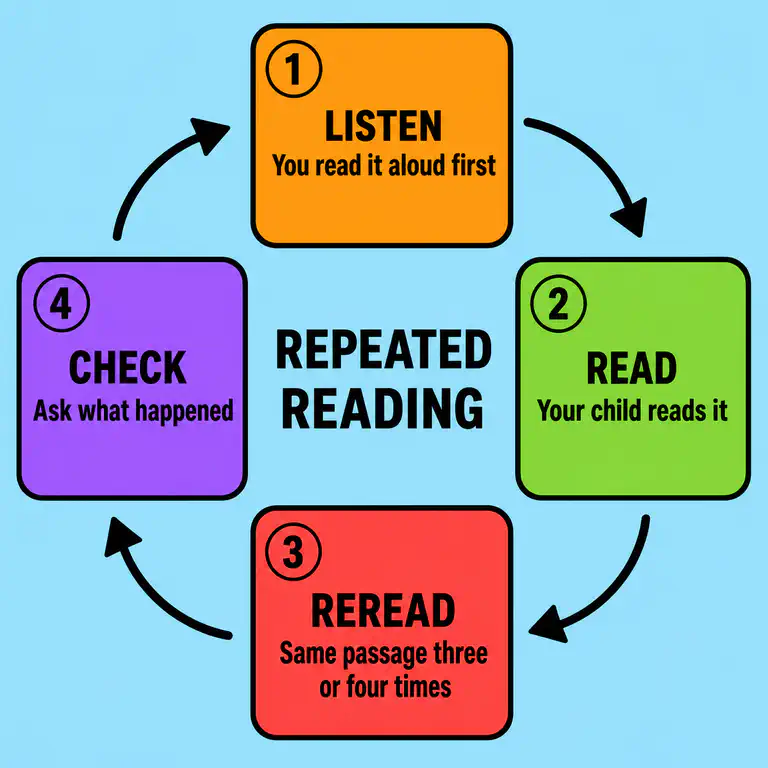
- Model the passage first. Read it aloud before your child does. Across 34 repeated reading studies with children who have reading disabilities, a listening preview was the one added ingredient that reliably helped, and repeated reading itself worked best in the elementary grades (Lee & Yoon, 2017).
- Use repeated reading, three or four passes. The same short passage, reread across a few days, is the most tested fluency practice there is: the National Reading Panel (2000) put its weighted average effect size at 0.41.
- Keep the text easy enough. If a child misses more than about one word in twenty, the passage is too hard and you are practising struggle. Decodable books matched to what a child has been taught fix most of this.
- Coach expression, and keep reading aloud to them. Ask your child to make a character sound annoyed, or to stop at the period. Children cannot produce expression they have never heard, and the prosody research says this is not decoration (Wolters et al., 2022).
- Time it rarely, and privately. A one-minute oral reading fluency assessment two or three times a term tells you what you need. Weekly stopwatch sessions teach children that reading is a race.
- Ask one question afterwards. If your child cannot say what happened, the speed gain is not real.
That is roughly Bookbot’s practice loop: children read aloud from levelled, phonics-aligned books, get immediate feedback on the words they miss, and reread at a level the app adjusts to them.
The Part Worth Remembering
Disfluent reading is common, and it is not a verdict. The National Reading Panel (2000) reported a national study by Pinnell and colleagues in which 44 percent of American fourth-graders read disfluently even on grade-level stories under supportive conditions.
What I find most encouraging is that fluency is also the most responsive part of reading. That is why Bookbot is built around reading aloud rather than silent practice: the National Reading Panel (2000) found strong evidence for guided oral reading, and not enough for independent silent reading.
If you take one number away, take the 50th percentile for your child’s grade and season, and treat anything within about ten words of it as fine. Then close the chart. The better nightly question is not how fast she read, but whether it sounded like she meant it.
References
Hasbrouck, J., & Tindal, G. A. (2006). Oral reading fluency norms: A valuable assessment tool for reading teachers. The Reading Teacher, 59(7), 636-644. https://doi.org/10.1598/RT.59.7.3
Hasbrouck, J., & Tindal, G. (2017). An update to compiled ORF norms (Technical Report No. 1702). Behavioral Research and Teaching, University of Oregon. https://files.eric.ed.gov/fulltext/ED594994.pdf
Lee, J., & Yoon, S. Y. (2017). The effects of repeated reading on reading fluency for students with reading disabilities: A meta-analysis. Journal of Learning Disabilities, 50(2), 213-224. https://doi.org/10.1177/0022219415605194
National Reading Panel. (2000). Teaching children to read: An evidence-based assessment of the scientific research literature on reading and its implications for reading instruction. Reports of the subgroups, Chapter 3: Fluency. National Institute of Child Health and Human Development. https://www.nichd.nih.gov/sites/default/files/publications/pubs/nrp/Documents/ch3.pdf
White, S., Sabatini, J., Park, B. J., Chen, J., Bernstein, J., & Li, M. (2021). The 2018 NAEP oral reading fluency study (NCES 2021-025). National Center for Education Statistics, U.S. Department of Education. https://nces.ed.gov/nationsreportcard/subject/studies/orf/2021025_orf_study.pdf
Wolters, A., Kim, Y.-S. G., & Szura, J. W. (2022). Is reading prosody related to reading comprehension? A meta-analysis. Scientific Studies of Reading, 26(1), 1-20. https://doi.org/10.1080/10888438.2020.1850733