



Most conversations about the science of reading focus on phonics. Which program to use, how many minutes a day, which letter sounds to teach first. But when I look at the research on how children learn to read, I keep coming back to something simpler: the talking, listening, and conversation a child experiences before they ever pick up a book.
Reading researcher Pamela Snow calls this the “SOLAR” framework, the Science of Language and Reading (Snow, 2021). Her point, backed by decades of evidence, is straightforward. Oral language is not just one piece of the reading puzzle. It is the ground everything else is built on.
The Foundation Beneath the Five Pillars
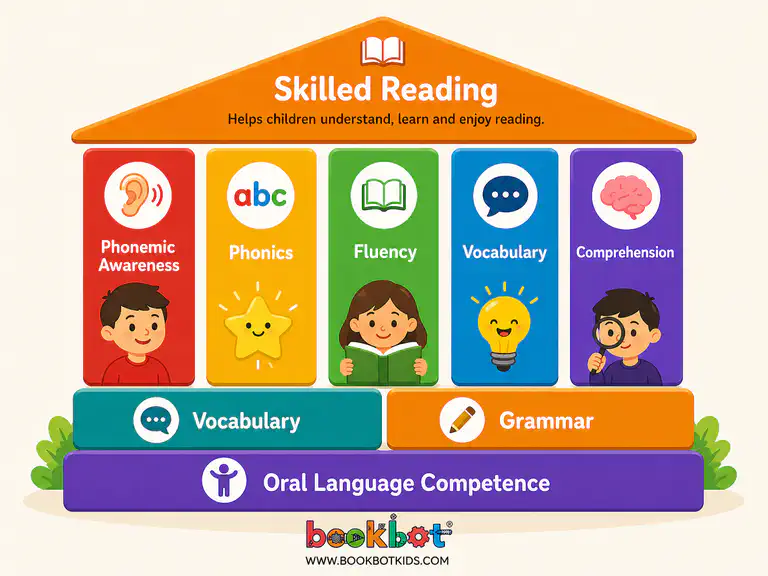
You have probably heard of the five pillars of reading: phonemic awareness (hearing sounds in words), phonics (connecting sounds to letters), fluency (reading smoothly), vocabulary (knowing what words mean), and comprehension (understanding what you read). These come from the National Reading Panel’s 2000 report and form the backbone of most science of reading curriculum frameworks.
But here is what often gets missed. Every one of those pillars depends on oral language.
Think about it this way. A child who has never heard the word “enormous” will not understand it when they sound it out on a page. A child with limited oral language comprehension will struggle to make sense of a story, even if they can read every word. Snow’s Language House framework captures this perfectly: oral language sits beneath the foundations, not alongside the pillars.
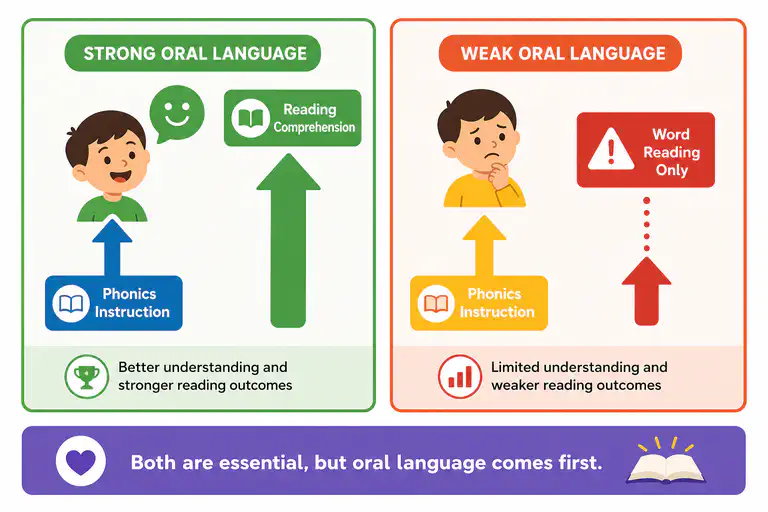
Researchers tested this idea using a computer simulation of how children learn to read (Chang et al., 2020). When the simulated child started with strong spoken language, phonics instruction worked far better for understanding what they read. When spoken language was weak, the same phonics teaching helped with reading words accurately, but the meaning did not stick. Both matter, but oral language comes first.
What the Intervention Studies Found
If oral language really is the foundation, then building it up should make children better readers. That is exactly what two large studies found.
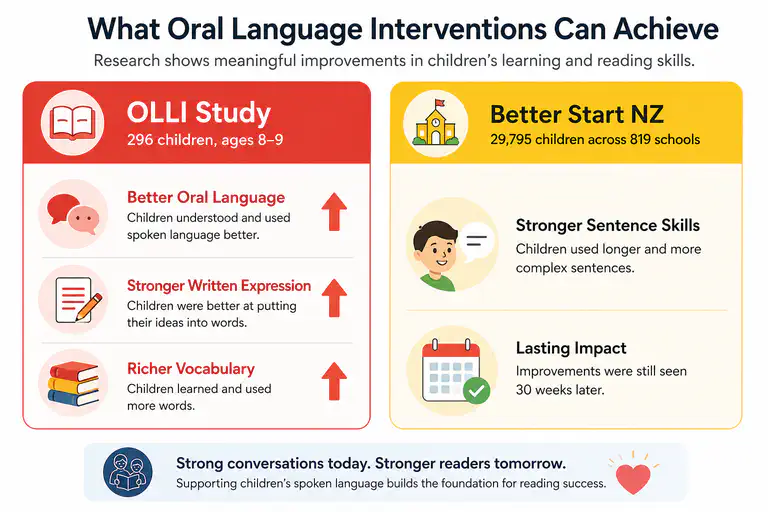
A 2024 trial tested a programme called OLLI (Oral Language for Literacy Intervention) with 296 children aged 8 to 9 across 33 schools (Esposito, Lervag & Hulme, 2024). After three 30-minute sessions per week for 20 weeks, children showed clear improvements in how well they could speak and understand spoken language. Their writing got noticeably better, and they learned and used significantly more words than children who did not receive the programme.
What caught my attention is that these children were 8 and 9 years old, well past the age most people think of for language development. The science of teaching reading does not stop at early phonics. Oral language literacy matters right through primary school.
An even bigger study in New Zealand followed 29,795 children across 819 schools (Gillon et al., 2024). After just 10 weeks of teaching that combined oral language with early reading skills, children were speaking in longer, more complex sentences. Those who needed extra help caught up to their classmates in reading and spelling by week 30.
This is large-scale proof that language development and reading go hand in hand.
Why This Matters for Your Child
When I look at reading data from thousands of children using Bookbot, the same pattern shows up. Children who arrive with strong spoken language, the ones who have been talked to, read to, and asked lots of questions, pick up reading faster. Sounding out words clicks more quickly because they already know those words from conversation.
This does not mean children with weaker oral language are stuck. The OLLI study showed clear improvements even at age 8 or 9. But it does mean phonics on its own is not the whole picture. A science of reading curriculum that skips oral language is like building a house without laying the ground first.
This is one reason Bookbot asks children to read aloud rather than silently tap through screens. Reading aloud is where spoken language and written text meet. The child hears themselves say the words, connecting sounds they already know to the letters on the page.
Practical Strategies for Parents
-
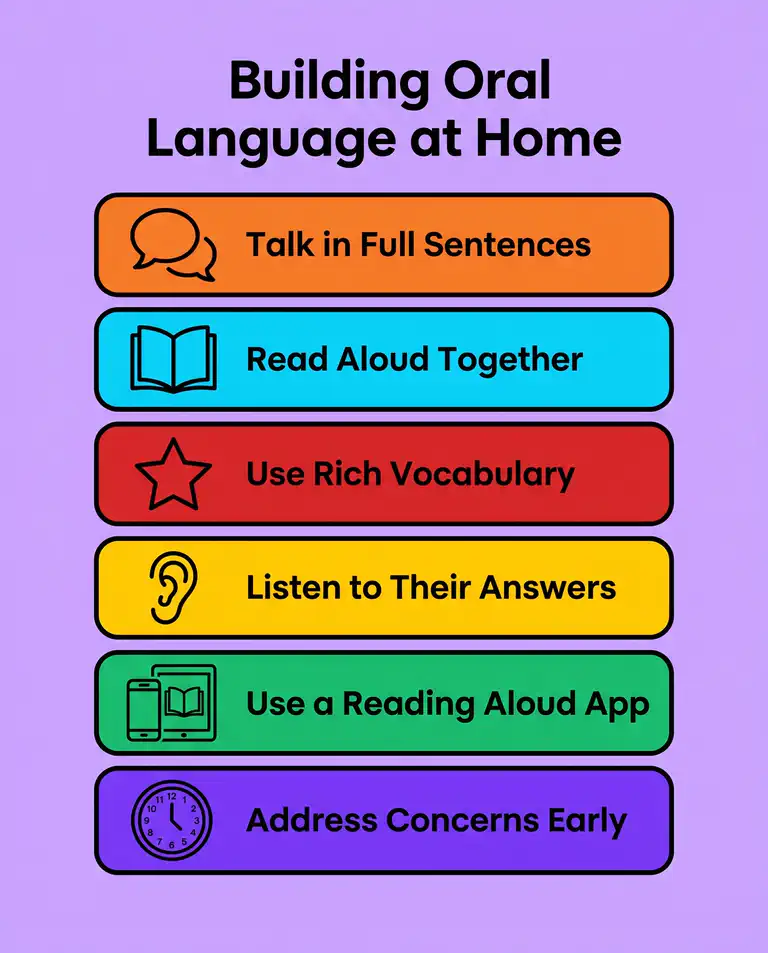
Talk to your child in full sentences, not just instructions. Instead of “Put your shoes on,” try “Can you find your blue shoes? We need to leave soon because we’re meeting Grandma at the park.” More words in, more words out.
-
Read aloud together every day and talk about what you read. The book matters less than the conversation around it. Ask “Why do you think the bear did that?” Questions like these build the thinking skills that reading comprehension depends on.
-
Narrate your day using interesting words. Instead of “Look, a bird,” try “Look at that enormous magpie perching on the fence.” Children pick up vocabulary from everyday moments, and it costs nothing.
-
Let your child talk, and listen. Oral language development is not just about what children hear. They need practice speaking too. Ask open-ended questions and give them time to answer.
-
Use a reading app that requires reading aloud. Look for apps built on the science of reading where your child actually speaks, not just taps and swipes. At Bookbot, the child reads aloud, the AI listens, and feedback happens in real time.
-
Do not wait if something seems off. If your child’s spoken language seems behind their peers, talk to a speech-language pathologist early. Catching it sooner makes a real difference.
What I Keep Coming Back To
When I started my PhD research at Flinders University, I expected the data to point me toward better phonics tools or smarter AI feedback loops. And those things matter. But the finding that keeps showing up, in my own analysis and across the studies I have reviewed here, is simpler than any of that: the children who talk more, read more.
Not because talking is a magic shortcut, but because every conversation a child has is quietly building the vocabulary, the sentence structures, and the understanding of how stories work that reading depends on. Phonics gives children the key to unlock words on a page. Oral language is what makes those words mean something.
That is why at Bookbot we do not just track whether a child can decode a word. We listen to how they read it, whether the rhythm and expression suggest they understand what they are saying. It is a small window into that oral language foundation, and it tells us more about where a child is headed as a reader than any phonics score alone.
The most powerful thing you can do for your child’s reading is also the most ordinary: talk to them.
References
Chang, Y.-N., Taylor, J. S. H., Rastle, K., & Monaghan, P. (2020). The relationships between oral language and reading instruction: Evidence from a computational model of reading. Cognitive Psychology, 123, 101336. https://doi.org/10.1016/j.cogpsych.2020.101336
Esposito, R., Lervag, A., & Hulme, C. (2024). Oral language intervention in the late primary school years is effective: Evidence from a randomised control trial. Journal of Child Psychology and Psychiatry. https://doi.org/10.1111/jcpp.14065
Gillon, G., McNeill, B., Scott, A., Gath, M., Macfarlane, A., & Taleni, T. (2024). Large scale implementation of effective early literacy instruction. Frontiers in Education, 9, 1354182. https://doi.org/10.3389/feduc.2024.1354182
Snow, P. C. (2021). SOLAR: The Science of Language and Reading. Child Language Teaching and Therapy, 37(2), 98–110. https://doi.org/10.1177/0265659020947817