




Picture this: your child is reading aloud, stumbles on a word, and looks up at you. What you do next, whether you jump in with the correct word, wait quietly, or ask a guiding question, may shape far more than that single reading moment. It could influence how your child sees themselves as a reader.
A major systematic review published in the Review of Educational Research (Grønli et al., 2025) examined 52 studies on how teachers respond when young children read aloud. The findings challenge some common assumptions about what “good” reading feedback looks like, and they carry clear implications for anyone listening to a child read.

Two Kinds of Feedback, Two Very Different Effects
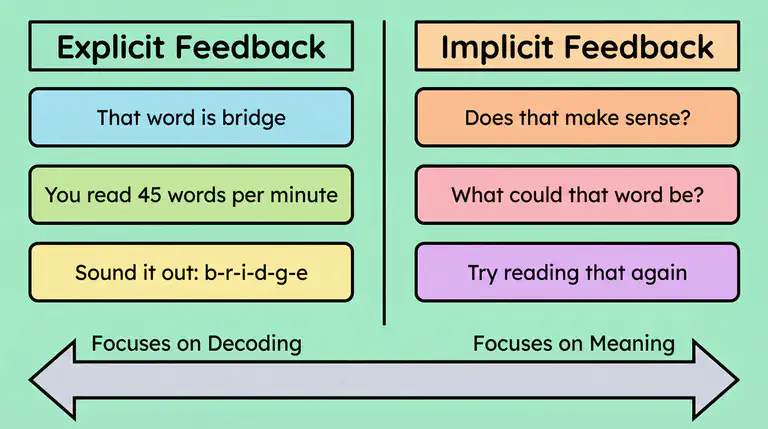
When I review the research on oral reading fluency, one pattern stands out. The review identified 65 distinct feedback practices and mapped them along two dimensions: how feedback is delivered (explicit correction versus implicit prompting) and what it targets (decoding skills versus meaning-making).
Explicit feedback sounds like: “That word is ‘bridge,’ not ‘badge.’” Implicit feedback sounds like: “Does that word make sense in the sentence?” Both have a place. But the research found a striking association: explicit feedback almost always targeted decoding (sounding out words, reading speed, accuracy), while implicit feedback targeted comprehension and meaning.
This matters because the type of feedback a child receives sends a message about what reading is. Constant correction tells children that reading is about getting words right. Questions and prompts tell children that reading is about making meaning.
Why This Matters for Your Child
Here is what I find most encouraging in this research: when children received implicit, meaning-focused feedback, they showed stronger signs of what researchers call “student agency” (Vaughn et al., 2020), meaning they took a more active, independent role in their own reading.
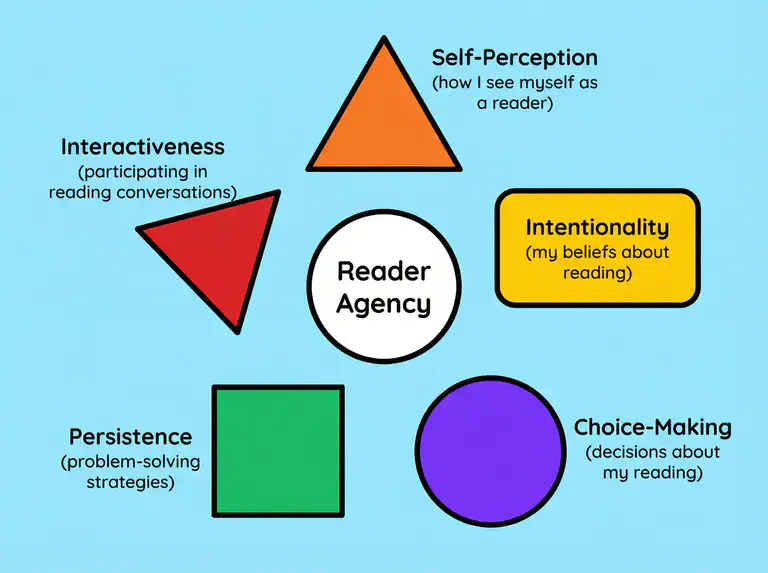
The review scored each of the 65 feedback practices on five dimensions of agency: self-perception as a reader, intentionality, choice-making, persistence, and interactiveness. The 26 highest-scoring practices all shared common features: they involved dialogue, they focused on text meaning, and they encouraged children to think independently before receiving help.
High-agency feedback looked like teachers asking open-ended questions, praising problem-solving strategies, and giving children space to self-correct. Low-agency feedback, by contrast, involved frequent interruptions, closed-ended questions, and teacher-dominated conversations.
Wisniewski, Zierer, and Hattie (2020) confirmed in a meta-analysis of 435 studies that not all feedback is equally effective. High-information feedback, the kind that helps students understand the task, the process, and how to self-regulate, produced effect sizes of 0.99 (meaning students made roughly twice the expected progress). Simple corrective feedback produced much smaller effects at 0.46.
The Equity Problem No One Talks About
But there are other findings in this review that deserve attention.
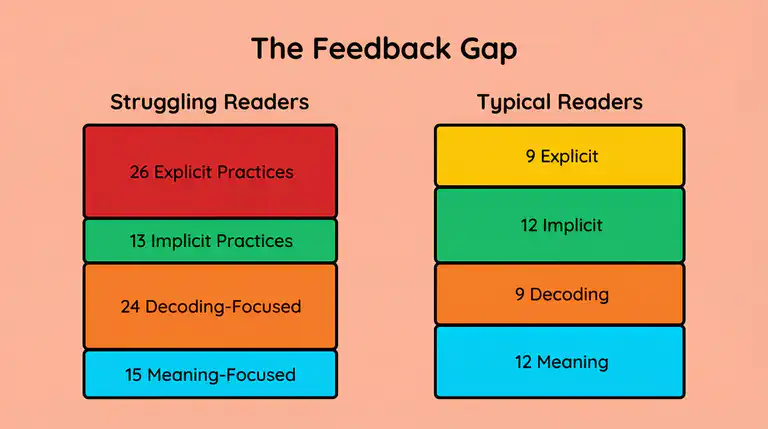
Struggling readers, the very children who need the most support in developing confidence and independence, were overwhelmingly receiving the type of feedback least likely to build those qualities. Of the 39 feedback practices documented for struggling readers, 26 fell on the explicit side and 24 emphasised decoding. Only 13 supported meaning-making.
This creates a troubling pattern: children who already feel uncertain about their reading ability receive feedback that positions them as passive recipients of correction rather than active, capable readers. The review found that children receiving only performance scores and accuracy feedback, with no dialogue or agency support, showed zero growth in reader independence.
At Bookbot, this is something we think about constantly. One advantage of an app is that it is not a person. When Bookbot corrects a word, a child does not feel the same social pressure or judgement they might from a parent or teacher. That changes the equation: direct correction from a tool does not carry the same risk to a child’s reader identity, which frees up the adults in their life to focus more on meaning, encouragement, and conversation.
Practical Strategies for Reading Aloud Together
Research on reading strategies for struggling readers and typical readers alike points to the same principles. Here are evidence-based ways to make reading aloud more effective:
-
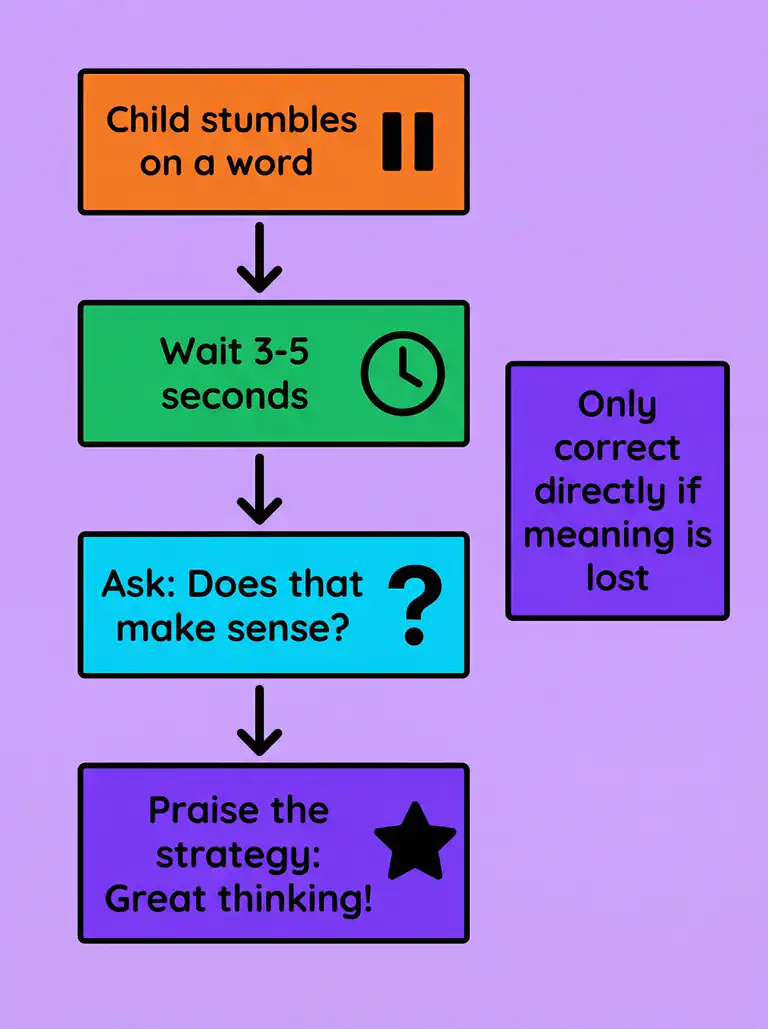
Pause before correcting. When your child stumbles, wait 3 to 5 seconds. Grønli et al. (2025) found that prompts encouraging independent thinking before providing help build persistence and self-correction habits.
-
Ask “Does that make sense?” more than “What does that word say?” Shifting toward meaning-focused questions helps children see reading as more than a decoding exercise.
-
Praise the strategy, not just the result. Saying “I noticed you went back and tried that again” reinforces problem-solving. Saying only “correct” reinforces dependence on external validation.
-
Mix explicit and implicit feedback. The research does not suggest abandoning phonics correction entirely. The most effective teachers in the reviewed studies moved fluidly between explicit instruction and implicit prompting based on what each child needed in the moment.
-
Make it a conversation. Open-ended questions after reading (“What do you think will happen next?” or “Why do you think the character did that?”) build the interactiveness dimension of agency and help children engage with text meaning.
-
Watch for the “correction spiral.” If your child starts looking to you after every word, that is a signal they have become dependent on external feedback. Pull back to prompts and questions to rebuild their confidence in guided oral reading.
This is one reason we built Bookbot the way we did: to provide real-time, supportive reading feedback that adapts to each child, balancing decoding help with encouragement to self-correct and engage with meaning.
Every Response Is a Message
The research is clear: how we respond when children read aloud shapes not just their reading skills but their identity as readers. The goal is not to choose between correcting errors and asking questions. It is to be intentional about the balance, and to make sure that every child, especially those who are struggling, receives feedback that says: you are a capable reader, and your ideas about this text matter.
That is what my work at Bookbot and Flinders University keeps coming back to. Supporting struggling readers means more than teaching them to decode. It means giving them feedback that builds the confidence and independence to keep reading, long after we stop listening.
References
Grønli, K. M., Walgermo, B. R., McTigue, E. M., & Uppstad, P. H. (2025). Feedback practices on young students’ oral reading: A systematic review. Review of Educational Research, 96(2), 391–434. https://doi.org/10.3102/00346543241306070
Vaughn, M., Jang, B. G., Sotirovska, V., & Cooper-Novack, G. (2020). Student agency in literacy: A systematic review of the literature. Reading Psychology, 41(7), 712–734. https://doi.org/10.1080/02702711.2020.1783142
Wisniewski, B., Zierer, K., & Hattie, J. (2020). The power of feedback revisited: A meta-analysis of educational feedback research. Frontiers in Psychology, 10, 3087. https://doi.org/10.3389/fpsyg.2019.03087