


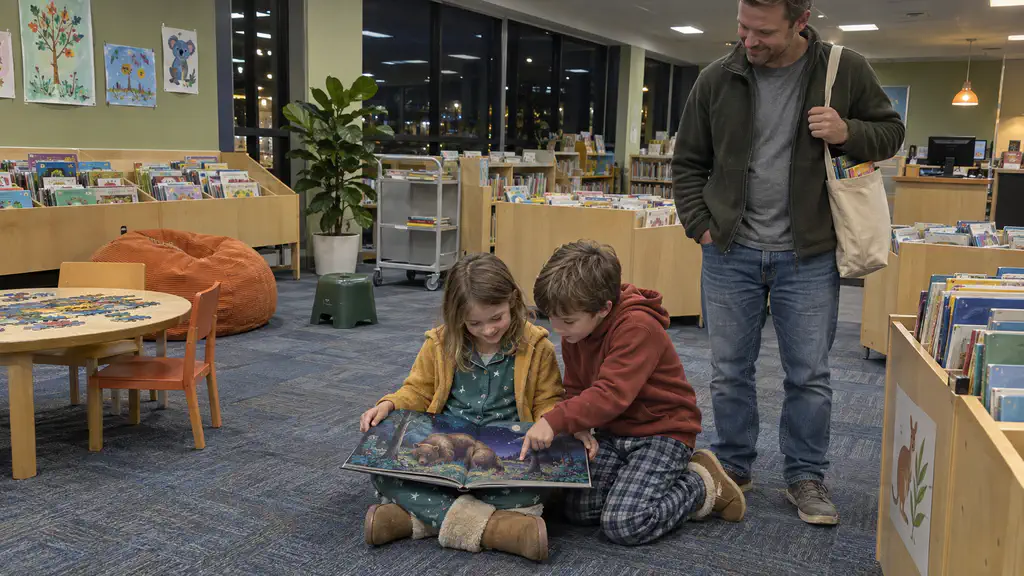

Reading is having a moment. People in their twenties and thirties are starting book clubs, following BookTok and renewing library cards. ABC Radio National’s All in the Mind noticed it too, in a September 2026 episode on the benefits of reading.
The same episode had a less cheerful number. In Australia, about one in three Year 3 students landed in the bottom two of four levels on this year’s NAPLAN reading test (ACARA, 2026).
Both can be true at once. When I review the research behind the episode, one pattern explains it: the benefits of reading are real, but they build slowly and flow mostly to children who read the most.
What the benefits of reading actually are
Start with language. Mol and Bus (2011) ran a meta-analysis, which pools results across studies, of 99 studies and 7,669 people. How much people read explained 12% of the differences in their spoken language skills in preschool and kindergarten, rising to 34% by university.
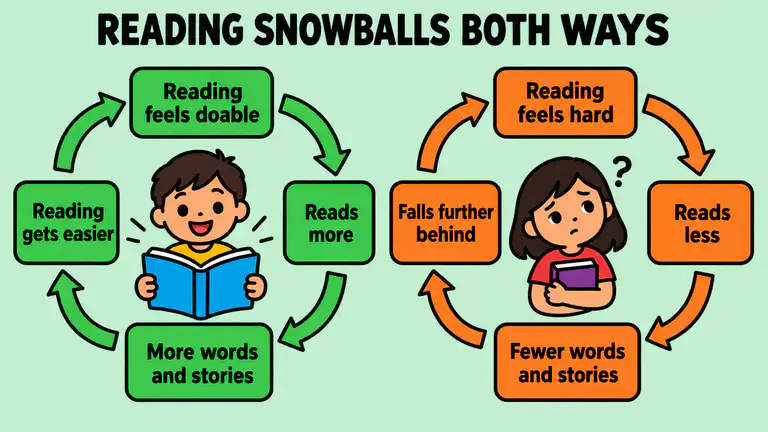
The authors call this an “upward spiral.” Children who read well read more, and reading more makes them better readers each year.
Stories seem to matter most. Raymond Mar, a York University psychologist, told the ABC that fiction is “a much stronger predictor of verbal abilities than non-fiction” (ABC Radio National, 2026).
A study of over 250,000 15-year-olds in 35 countries agrees. Teens who almost never read fiction scored about a quarter of a standard deviation lower in reading than similar teens who read it several times a week (Jerrim & Moss, 2019). A standard deviation measures how spread out scores are, so that’s a modest but real gap.
The benefits of reading fiction reach beyond words, to understanding people. Mar and colleagues (2010) studied 55 children aged 4 to 6, and those exposed to more storybooks were further along in theory of mind, meaning the understanding that other people have thoughts and feelings different from their own. Children’s films showed the same link, but television didn’t.
That’s the heart of the link between reading and empathy: stories let children practice seeing through someone else’s eyes.
There’s a catch. In a recent review, Mar and colleagues note these effects tend to appear with habitual reading, not after a single story (Mar et al., 2027). The benefits of reading books come from reading lots of them, for years.
Why some children miss out
But an upward spiral can also run the other way.
Reading is an invented skill. Writing is only about 5,000 years old, Lili Yu of Macquarie University explained, so the brain borrows systems built for other jobs. That’s why children have to be taught to read, and some need more teaching than others.
Professor Genevieve McArthur, who supports Bookbot’s research translation efforts (turning research into practice), described what can follow. Children are “little comparison machines,” she said, and they quickly work out who finds reading easy (ABC Radio National, 2026).
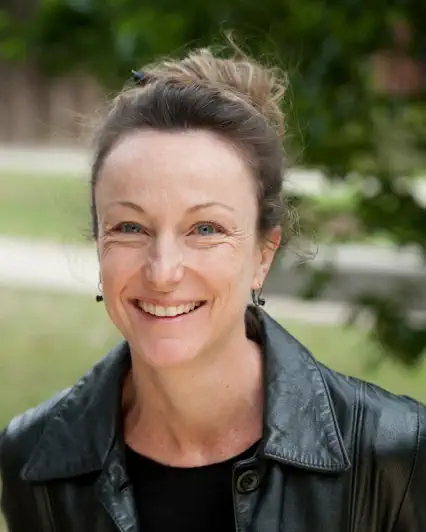
Professor Genevieve McArthur, Australian Centre for the Advancement of Literacy at ACU and Director of Research Translation at the Dyslexia SPELD Foundation.
A struggling child may decide they’re a bad reader. Researchers call this reading self-concept, meaning how a child sees themselves as a reader. Then reading aloud in class starts to feel risky, so they avoid reading, get less practice and fall further behind.
Parts of this cycle have support. Pooling five studies of 2,002 people, McArthur and colleagues (2020) found poor readers rated their reading, writing and spelling far lower than typical readers did, though the evidence was weak. No one has tested the whole loop, and McArthur has called it a hypothesis (McArthur, 2023). Our article on reading anxiety covers the fear side.
What this means for your child
So why is reading important for a child who finds it hard? Because many of the benefits of reading for children don’t have to wait for decoding, meaning sounding out words.
One guardrail first. More reading time won’t fix a decoding problem by itself. Teaching does. A Cochrane review led by McArthur, which pooled the best trials, found phonics training helped struggling readers read words more accurately and more fluently (McArthur et al., 2018).
But words, story knowledge and understanding people come from a story’s content, which a child can take in by listening. As Mar put it, “It’s the content that really matters so much more than the modality,” meaning whether a story is read, heard or watched.
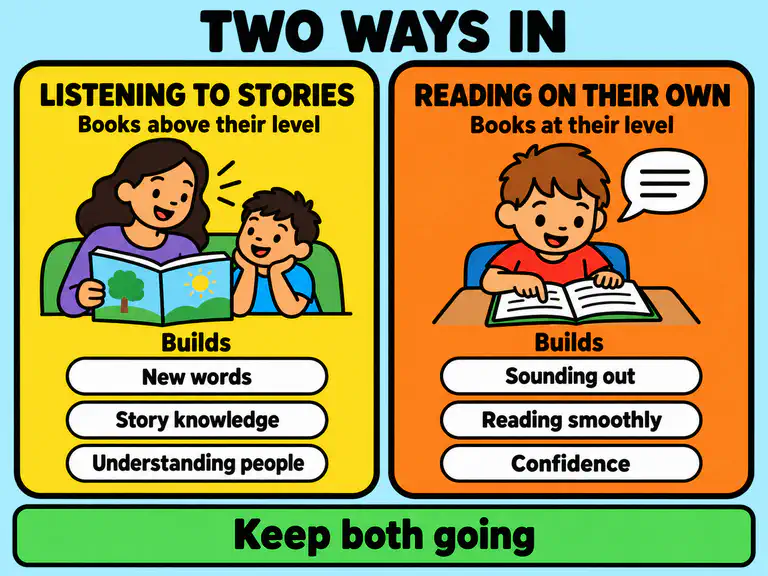
So think of two ways in. Your child listens to stories above their reading level, and practices reading books at their own level. One keeps the benefits flowing. The other builds the skill to collect them on their own.
Bookbot is built to do both jobs. It can read harder books aloud while your child listens, and it listens while your child reads their own level aloud. It doesn’t replace you talking about the story, where some of the strongest evidence sits.
How to help your child get the benefits of reading
- Keep reading aloud, even after your child can read. In 19 randomized trials with 2,594 children aged 1 to 6, coaching parents in book-sharing boosted children’s language skills, a small but real effect (Dowdall et al., 2020). Our guide to reading aloud has more.
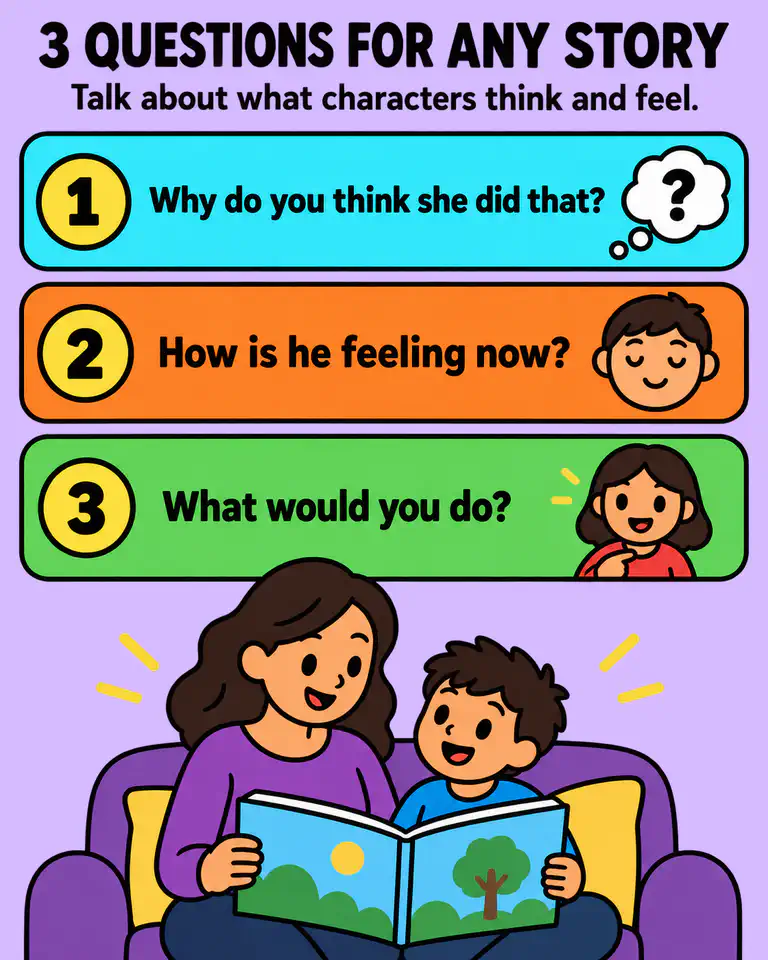
- Talk about what characters think and feel. Ask “Why do you think she did that?” A meta-analysis of 45 studies with 1,529 children found training children to reason about other people’s minds, often using stories and picture books, worked well (Hofmann et al., 2016).
- Let fiction count as real reading. Stories are where the language and empathy benefits look strongest (Mar et al., 2027). Reading for pleasure isn’t time off from learning.
- Count listening and watching stories too. In Mar’s preschool study, children’s films were linked to understanding others too (Mar et al., 2010). An audiobook in the car still delivers the story.
- Compare your child with their past self, not their classmates. Point out what they can read now that they couldn’t last month, and let them practice a page privately before reading it to anyone. Both aim at reading self-concept, which is much lower in poor readers (McArthur et al., 2020).
- Choose books that fit your child’s world. McArthur noted a child in remote Australia may not care about a story set in a city supermarket (ABC Radio National, 2026). A story that connects gives them a reason to read on.
- Ask for help early if decoding is the problem. If your child is still guessing at simple words, ask their teacher about phonics support (McArthur et al., 2018).
Keeping your child on the upward spiral
One story from the episode stayed with me. Growing up in the 1970s, McArthur remembers evenings when the family was already in pajamas after dinner and her dad announced a trip to the library.
Nobody was measuring vocabulary. But that’s how the benefits of reading build: a habit, repeated for years, that makes reading feel normal.
For a child who finds reading hard, that habit can start with listening, and it still counts. Keep building the skill alongside it. If your child is behind right now, the spiral hasn’t decided anything yet.
References
ABC Radio National. (2026, September 25). Trying to read more? Your brain will thank you [Audio podcast episode]. In All in the Mind. https://www.abc.net.au/listen/programs/allinthemind/trying-to-read-more-brain-benefits/107126734
Australian Curriculum, Assessment and Reporting Authority. (2026). NAPLAN national results. https://www.acara.edu.au/reporting/national-report-on-schooling-in-australia/naplan-national-results
Dowdall, N., Melendez-Torres, G. J., Murray, L., Gardner, F., Hartford, L., & Cooper, P. J. (2020). Shared picture book reading interventions for child language development: A systematic review and meta-analysis. Child Development, 91(2), e383–e399. https://doi.org/10.1111/cdev.13225
Hofmann, S. G., Doan, S. N., Sprung, M., Wilson, A., Ebesutani, C., Andrews, L. A., Curtiss, J., & Harris, P. L. (2016). Training children’s theory-of-mind: A meta-analysis of controlled studies. Cognition, 150, 200–212. https://doi.org/10.1016/j.cognition.2016.01.006
Jerrim, J., & Moss, G. (2019). The link between fiction and teenagers’ reading skills: International evidence from the OECD PISA study. British Educational Research Journal, 45(1), 181–200. https://doi.org/10.1002/berj.3498
Mar, R. A., Dunk, R. J., & Shoemaker, L. H. (2027). The benefits of reading narrative fiction. Current Opinion in Psychology, 73, 102368. https://doi.org/10.1016/j.copsyc.2026.102368
Mar, R. A., Tackett, J. L., & Moore, C. (2010). Exposure to media and theory-of-mind development in preschoolers. Cognitive Development, 25(1), 69–78. https://doi.org/10.1016/j.cogdev.2009.11.002
McArthur, G. (2023, October 20). Some kids with reading difficulties can also have reading anxiety: What can parents do? The Conversation. https://theconversation.com/some-kids-with-reading-difficulties-can-also-have-reading-anxiety-what-can-parents-do-215438
McArthur, G., Sheehan, Y., Badcock, N. A., Francis, D. A., Wang, H.-C., Kohnen, S., Banales, E., Anandakumar, T., Marinus, E., & Castles, A. (2018). Phonics training for English-speaking poor readers. Cochrane Database of Systematic Reviews, (11), CD009115. https://doi.org/10.1002/14651858.CD009115.pub3
McArthur, G. M., Filardi, N., Francis, D. A., Boyes, M. E., & Badcock, N. A. (2020). Self-concept in poor readers: A systematic review and meta-analysis. PeerJ, 8, e8772. https://doi.org/10.7717/peerj.8772
Mol, S. E., & Bus, A. G. (2011). To read or not to read: A meta-analysis of print exposure from infancy to early adulthood. Psychological Bulletin, 137(2), 267–296. https://doi.org/10.1037/a0021890