


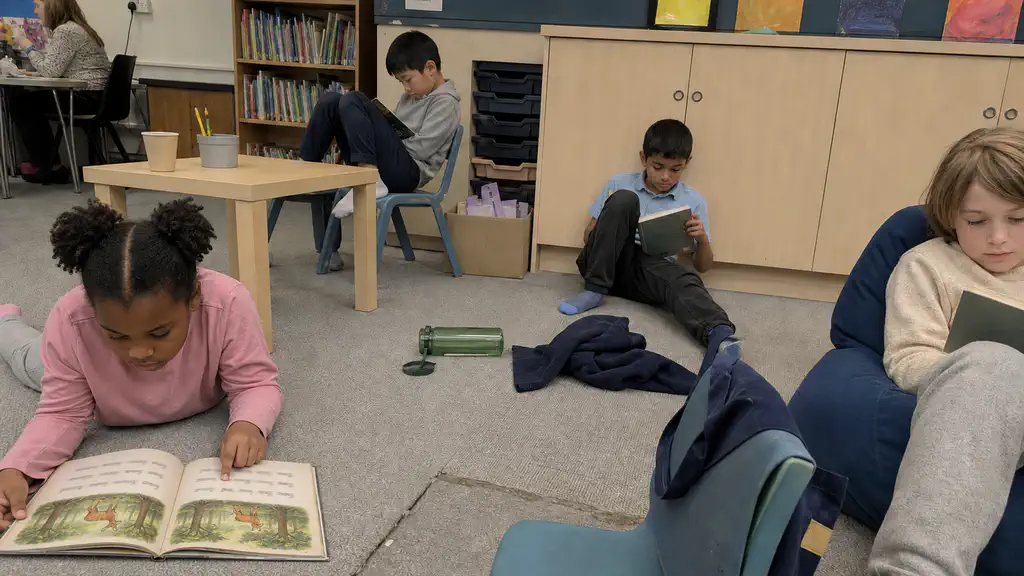

Somewhere in your child’s school bag there is a reading log. Twenty minutes a night, signed by a parent, handed in on Friday. At school there is a block of sustained silent reading after lunch, and a poster that says Drop Everything And Read.
Both rest on one assumption: that quiet reading, in enough quantity, turns children into readers. I wanted to know whether that assumption survives contact with the evidence.
Only partly. How it falls short is more interesting than a simple yes or no.
What 47 Studies Found
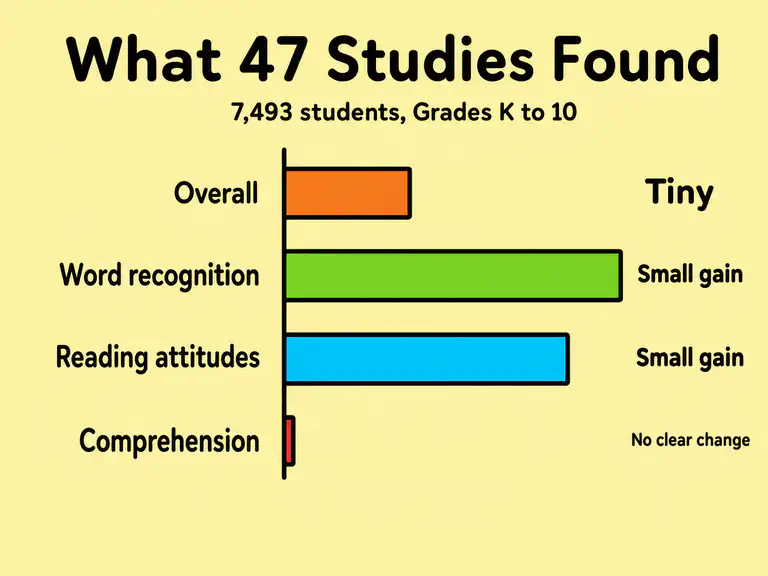
Adriana Bus, Yi Shang and Kathleen Roskos published a meta-analysis in AERA Open in 2024. A meta-analysis pools many earlier studies into one combined answer. Theirs covered 47 studies of in-school independent reading, 7,493 students from kindergarten to Grade 10, running from 1970 to 2020.
The overall effect size was .08. An effect size measures how much difference a practice made, and .08 is very small. The average child in a silent reading block finished barely ahead of one who was not.
Then the picture splits.
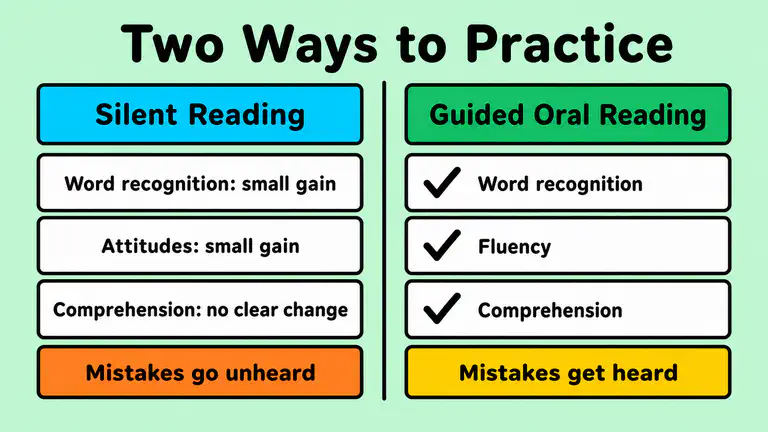
Word recognition, meaning how accurately and fluently a child reads words, improved by .21. Reading attitudes improved by .18. Both gains are small, and both held up statistically, so they are unlikely to be chance. Children read words a little better, and liked reading a little more.
Comprehension moved by -.014, which the authors describe as approximately zero. It was also the outcome the studies measured most often. The one result schools most want from silent reading time is the one it did not deliver.
That is not a new finding, which is what makes it worth taking seriously. The National Reading Panel (2000) reviewed 14 studies of programmes encouraging large amounts of independent reading and “was unable to find a positive relationship” with reading achievement, including fluency. Its separate meta-analysis of 16 studies of guided repeated oral reading, where a child reads aloud and gets feedback from a teacher, parent or peer, found gains in word recognition, fluency and comprehension.
Reading aloud is the moment a difficulty becomes visible. A child reading silently can sit on one page for ten minutes and nobody will know.
Where the Twenty Minutes Came From
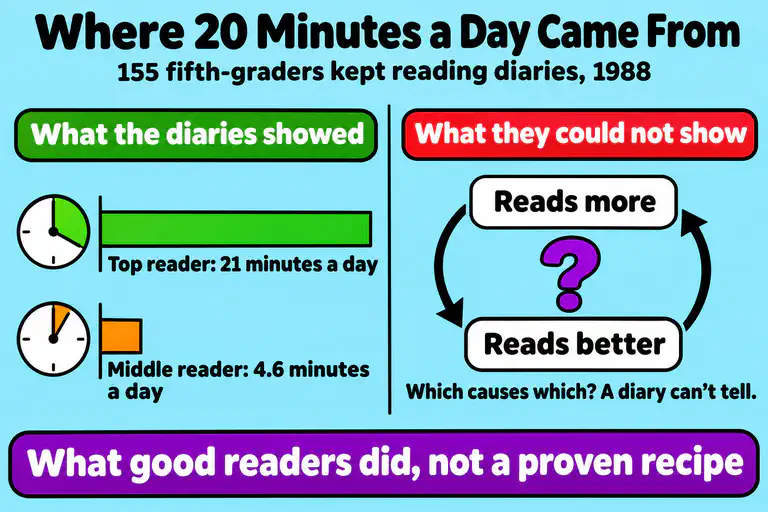
The number is usually traced to one study. Richard Anderson, Paul Wilson and Linda Fielding (1988) had 155 fifth-graders keep daily diaries of their out-of-school time for 8 to 26 weeks. Of everything they did, time spent reading books was the best predictor of reading achievement, including growth from Grade 2 to Grade 5. The child in the middle of the group read books for 4.6 minutes a day. The child at the 90th percentile, ahead of nine in ten classmates, read for about 21.
That study is correlational, meaning it shows two things moving together rather than one causing the other. Strong readers read more. Reading more may also be what made them strong. A diary cannot tell you which way the arrow points. Yet a description of what the best readers did became a homework instruction on a chart.
Here is the part I think schools and parents both slide past. Reading 20 minutes a day is where a child consolidates skills they already have, not where those skills get built. If a child cannot yet decode the words, meaning sound them out reliably from the letters, then 20 quiet minutes buys 20 minutes of practice at guessing.
My reading of why word recognition improved in the Bus meta-analysis and comprehension did not: reading volume rehearses the mechanics. Comprehension runs on vocabulary, background knowledge and language, which arrive through talk, teaching and being read to, not through minutes on a timer.
What to Do With Those Twenty Minutes
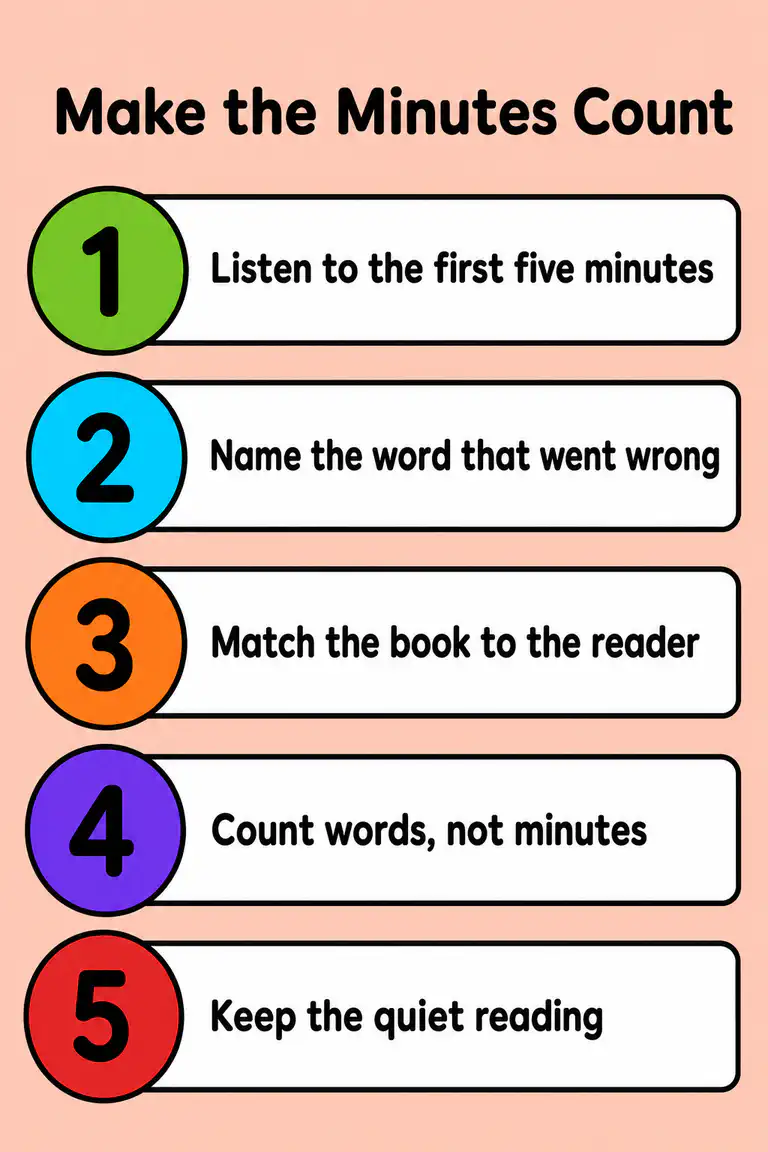
Listen to the first five minutes. Guided oral reading with feedback is the practice the National Reading Panel (2000) found moved word recognition, fluency and comprehension together. Five minutes of listening shows you which words are still hard, something the silent minutes never will.
Name the word that went wrong. Bai, Hubers, Cucchiarini, van Hout and Strik (2025) compared two kinds of feedback in a speech-recognition reading tutor used by 525 Dutch first-graders across 44 schools. Both helped accuracy. Explicit feedback, which shows a child exactly which words they misread, helped more with reading sentences accurately, though gains in accuracy tended to come with slower reading. Bookbot uses the same kind of speech recognition to listen while a child reads aloud.
Match the book to the reader. My rule of thumb: if your child stumbles over more than a few words on a page, that book is too hard to read alone. Save it for reading together, and keep an easier one for the quiet minutes.
Count words, not minutes. The gain Bus and colleagues found was in word recognition. My reasoning is that this only comes from words a child actually reads, so a child gazing past an open book can fill in the log correctly and gain nothing.
Keep the quiet reading. Reutzel, Fawson and Smith (2008) ran a 36-week randomised trial with 72 third-graders. Scaffolded silent reading, where teachers helped children pick books at the right level, held short conferences and checked what they had read, did about as well as guided repeated oral reading on fluency and comprehension. The study had no plain silent reading group, but my reading is that the structure earned that result. Add the benefits of sustained silent reading that Bus et al. (2024) did find, small gains in word recognition and attitudes, and a child who enjoys books is a finding, not a consolation prize.
Quiet Reading Still Belongs
Nothing here says stop reading with your child. It says stop expecting unsupervised silent reading time to do a job it has never been shown to do.
The research on sustained silent reading has run for more than fifty years, and its verdict is consistent: quiet reading is a fine place to practise and a poor place to learn. Drop Everything And Read is not the problem. Drop Everything And Read as the whole plan is.
So if you have 20 minutes tonight, spend the first five listening to your child read aloud, then give the rest back with a book they can genuinely read. That is my best reading of what those 47 studies, and the panel before them, point to.
References
Anderson, R. C., Wilson, P. T., & Fielding, L. G. (1988). Growth in reading and how children spend their time outside of school. Reading Research Quarterly, 23(3), 285-303. https://doi.org/10.1598/RRQ.23.3.2
Bai, Y., Hubers, F., Cucchiarini, C., van Hout, R., & Strik, H. (2025). Learning to read in first grade through a reading tutor that employs automatic speech recognition. Technology, Knowledge and Learning, 31(3), 1741-1761. https://doi.org/10.1007/s10758-025-09860-8
Bus, A. G., Shang, Y., & Roskos, K. (2024). Building a stronger case for independent reading at school. AERA Open, 10. https://doi.org/10.1177/23328584241267843
National Reading Panel. (2000). Teaching children to read: An evidence-based assessment of the scientific research literature on reading and its implications for reading instruction. National Institute of Child Health and Human Development. https://www.nichd.nih.gov/publications/pubs/nrp/findings
Reutzel, D. R., Fawson, P. C., & Smith, J. A. (2008). Reconsidering silent sustained reading: An exploratory study of scaffolded silent reading. The Journal of Educational Research, 102(1), 37-50. https://doi.org/10.3200/JOER.102.1.37-50