


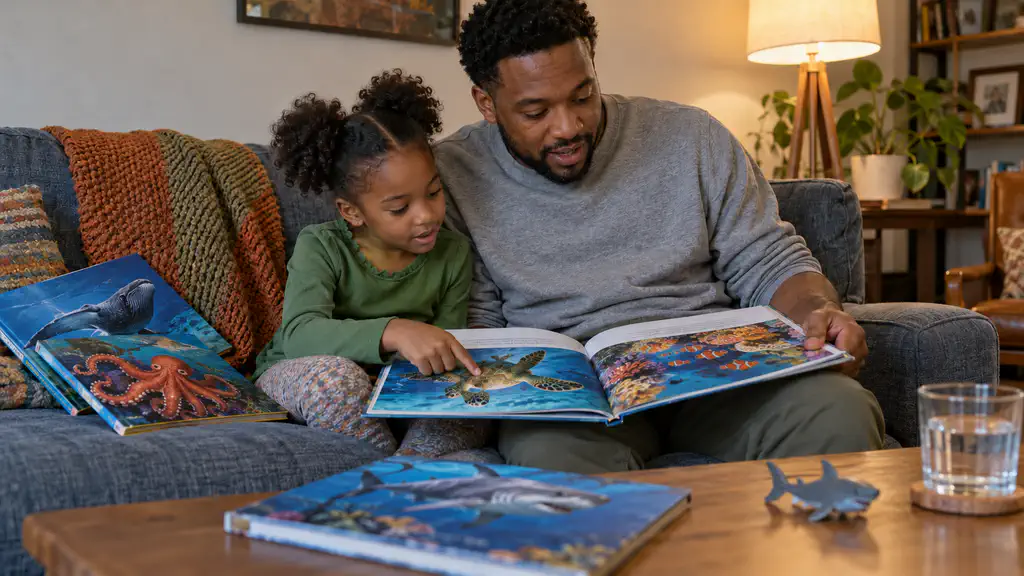

Your child reads every word on the page correctly. You ask what it was about, and you get a shrug.
Most advice for that gap is a list of reading comprehension strategies: predicting, summarising, hunting for the main idea, practised again and again. But when I work through the trial evidence, the biggest lever is not practice at all. It is what a child already knows before the book is opened.
Comprehension is less a muscle you train than a lens you build, one fact at a time.
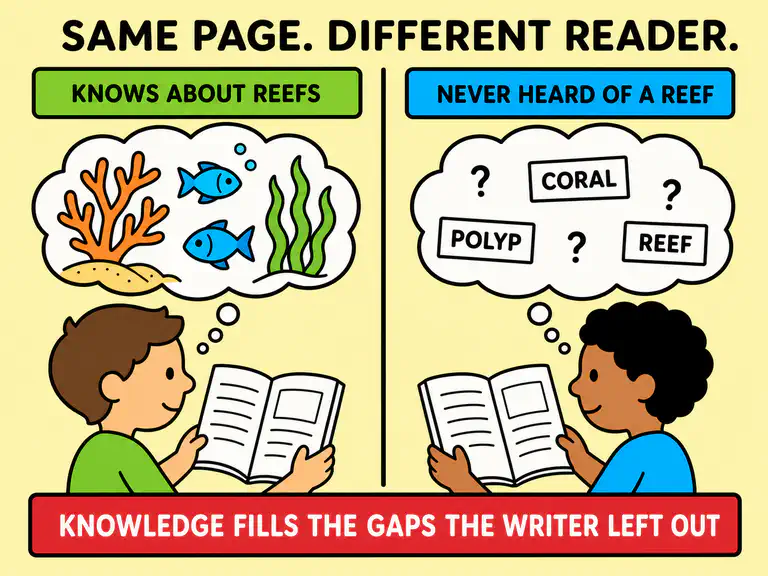
The cleanest demonstration is nearly forty years old. Recht and Leslie (1988) gave 64 junior high students the same account of half an inning of baseball. Weak readers who knew baseball recalled it better than strong readers who did not.
Bigger samples find the same shape. O’Reilly, Wang and Sabatini (2019), in Psychological Science, tested 3,534 high school students on ecology knowledge, then on an ecology passage. Below a threshold of topic knowledge, knowing more barely helped. Above it, the two rose together strongly. Those were teenagers, so it shows how comprehension works, not what to do in Year 1.
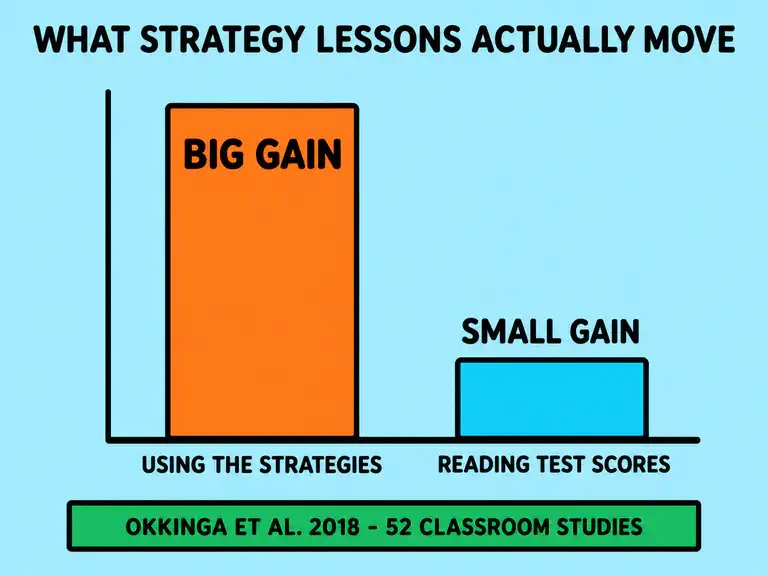
Now set that beside the evidence for drilling. Okkinga and colleagues (2018) pooled 52 whole-classroom studies in Educational Psychology Review. Strategy instruction lifted children’s use of the strategies by an effect size of 0.786 (an effect size measures how large a difference is; 0.8 counts as large), but only 0.186 on standardised comprehension tests, which is small. Children got much better at the strategy, only slightly better at reading.
So if drilling comprehension strategies is not the big lever, what is?
What Actually Moves Reading Comprehension Skills
Two large school studies point the same way.
The first is a working paper, not peer reviewed, so treat it as promising rather than settled. Grissmer and colleagues (2023) followed 14 oversubscribed kindergarten lotteries at Core Knowledge charter schools, which teach history, science, geography and art in a deliberate sequence. Because the 2,310 applicants were sorted by lottery, winning a place came down to luck. Across Grades 3 to 6, children offered a place scored 0.24 standard deviations higher on reading and English tests (a standard deviation is the normal spread of scores in a class), and 0.47 among those who actually attended. Those figures leave out four lotteries and the youngest applicants, where losing families dropped out of the data; with all fourteen included the reading effect is 0.14.
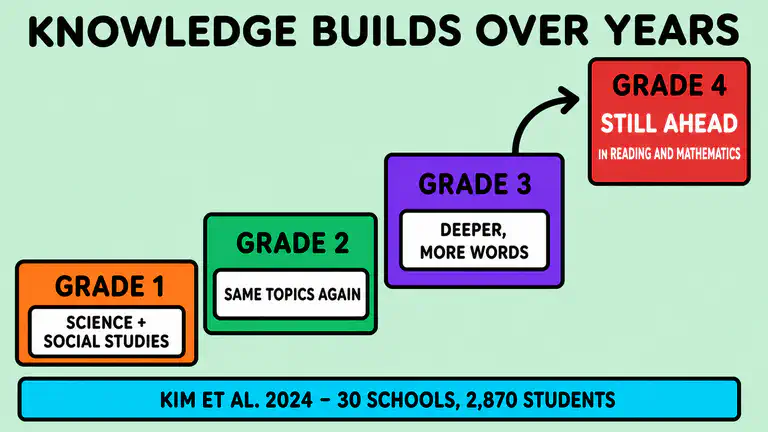
The second is peer reviewed. Kim and colleagues (2024), in Developmental Psychology, ran a randomised trial across 30 schools and 2,870 students in one urban school district in the southeastern United States. One group got content literacy lessons on linked science and social studies topics in Grades 1 to 3, plus summer reading on the same themes; the other got them only in Grade 3. By the end of Grade 3 the sustained group led on science reading (0.14), general reading comprehension (0.11) and, without anyone teaching it, mathematics (0.12). Fourteen months later the advantage still showed in Grade 4 reading (0.12) and mathematics (0.16).
Those numbers are small. They are also durable, and they leaked into a subject the programme never taught. Hwang, Cabell and Joyner (2022) pooled 35 such studies in Scientific Studies of Reading: 0.91 on vocabulary overall, 0.89 on content knowledge, 0.25 on standardised comprehension tests.
This answers the objection I hear most about decodable books: that they are content free. Many are, and that is the point. A decodable book has one job, making letters and sounds automatic so attention is freed for meaning. Background knowledge in reading has to come from somewhere else. Decoding and reading comprehension are different jobs, and the mistake is using decodables alone.
Practical Strategies for Parents and Teachers
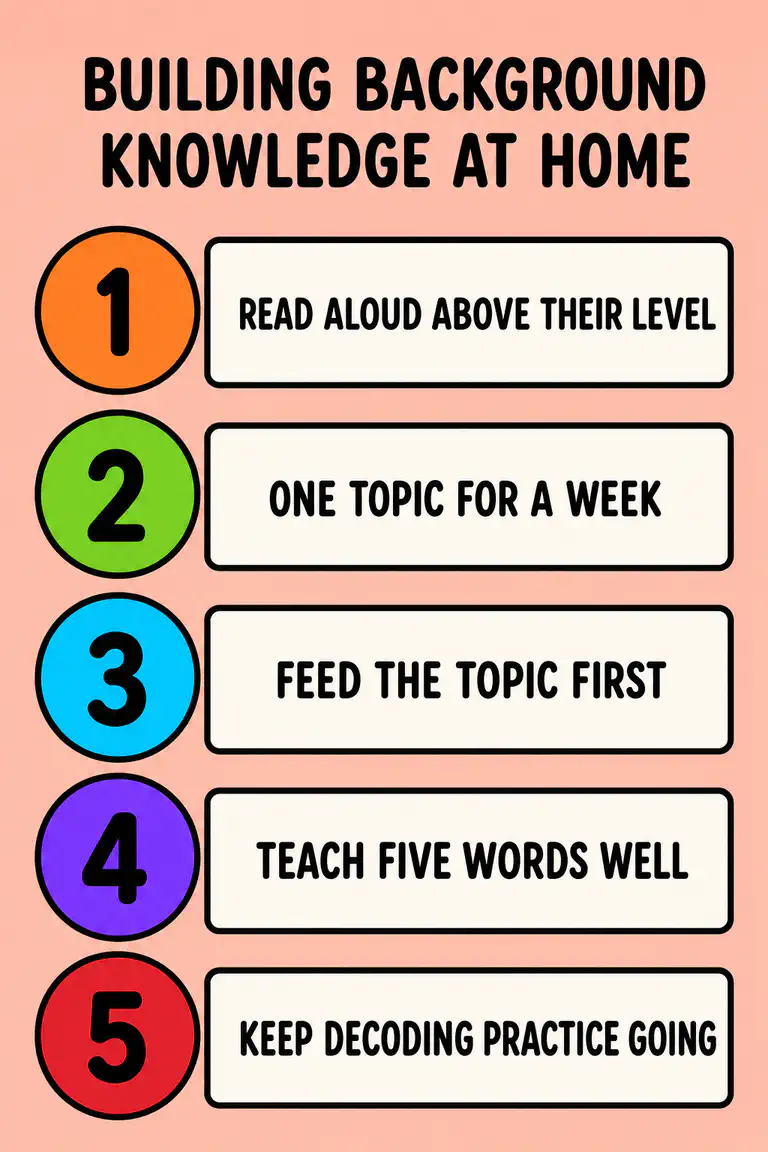
- Read aloud well above your child’s own reading level. Knowledge and vocabulary arrive through the ear years before the eyes can fetch them. In Kim et al. (2024), the read-aloud books were information books written at a harder level than the mostly story books read in the comparison classrooms.
- Stay on one topic for a week, not one book a night. The programme in Kim et al. (2024) was built on returning to the same topics across years. My rule of thumb from that: three ocean books beat three unrelated ones.
- Feed the topic before the text. I like a two-minute warm-up: a photo, a map, a short clip. That is activating background knowledge, and in my experience it helps at the margin. It will not carry a child over the threshold in O’Reilly et al. (2019) on its own; that takes the slower build of a week on one topic.
- Teach five words properly rather than thirty in passing. Vocabulary showed the largest effect of all in Hwang et al. (2022). Use each new word again across the week: at dinner, in the car, in the next book.
- Keep decoding practice going, and keep strategy work short. Okkinga et al. (2018) shows children learn to use the strategies well, but the payoff in reading scores is small. In Bookbot, a child can do both: read aloud while the app listens, and listen while it reads a harder book.
The Slow Answer Is Still the Right One
If your child decodes accurately and still cannot tell you what happened, that is rarely a missing technique. It is usually a missing world.
What I find encouraging is how ordinary the remedy is. Teaching reading comprehension well looks like teaching everything else: science, history, geography, art, and a lot of talk about it.
It is a slower way to improve reading comprehension than a strategy poster, but Grissmer tracks children into Grade 6 and Kim’s effects were still there a year later. Knowledge keeps paying out long after the practice sheet is recycled.
References
Grissmer, D., White, T., Buddin, R., Berends, M., Willingham, D., DeCoster, J., Duran, C., Hulleman, C., Murrah, W., & Evans, T. (2023). A kindergarten lottery evaluation of Core Knowledge charter schools: Should building general knowledge have a central role in educational and social science research and policy? (EdWorkingPaper No. 23-755). Annenberg Institute at Brown University. https://edworkingpapers.com/ai23-755
Hwang, H., Cabell, S. Q., & Joyner, R. E. (2022). Effects of integrated literacy and content-area instruction on vocabulary and comprehension in the elementary years: A meta-analysis. Scientific Studies of Reading, 26(3), 223–249. https://doi.org/10.1080/10888438.2021.1954005
Kim, J. S., Gilbert, J. B., Relyea, J. E., Rich, P., Scherer, E., Burkhauser, M. A., & Tvedt, J. N. (2024). Time to transfer: Long-term effects of a sustained and spiraled content literacy intervention in the elementary grades. Developmental Psychology, 60(7), 1279–1297. https://doi.org/10.1037/dev0001710
Okkinga, M., van Steensel, R., van Gelderen, A. J. S., van Schooten, E., Sleegers, P. J. C., & Arends, L. R. (2018). Effectiveness of reading-strategy interventions in whole classrooms: A meta-analysis. Educational Psychology Review, 30(4), 1215–1239. https://doi.org/10.1007/s10648-018-9445-7
O’Reilly, T., Wang, Z., & Sabatini, J. (2019). How much knowledge is too little? When a lack of knowledge becomes a barrier to comprehension. Psychological Science, 30(9), 1344–1351. https://doi.org/10.1177/0956797619862276
Recht, D. R., & Leslie, L. (1988). Effect of prior knowledge on good and poor readers’ memory of text. Journal of Educational Psychology, 80(1), 16–20. https://doi.org/10.1037/0022-0663.80.1.16