




Picture this. You are curled up on the sofa reading your six-year-old a chapter of a novel that is technically well above her reading level. She is tracking every twist, asking sharp questions, laughing at the jokes. Ten minutes later you hand her a small book about a cat and a mat, and she stalls on the word “sat.”
What just happened? Nothing is wrong with your child. You are watching the Simple View of Reading in action, and once you understand it, a lot of your child’s reading journey will start to make sense.

The Formula That Changed How We Think About Reading
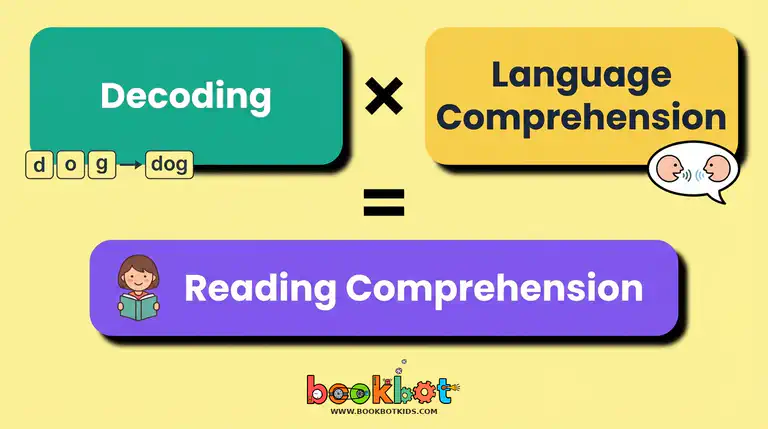
In 1986, two researchers named Philip Gough and William Tunmer published a short paper that quietly reshaped reading science (Gough & Tunmer, 1986). Their idea was almost embarrassingly simple. Reading comprehension, they argued, is the product of two things: decoding and language comprehension. Written as a formula, the simple view of reading looks like this:
Reading Comprehension = Decoding × Language Comprehension
The word that matters most in that equation is the multiplication sign. Gough and Tunmer were not saying decoding and comprehension add up to reading. They were saying they multiply. If your child is at zero on either side, the whole equation collapses to zero. Perfect decoding with no language comprehension gives you a child who can pronounce every word on a page and understand none of it. Rich language comprehension with no decoding gives you a child who can follow any story you read aloud but cannot pick up a book and read it herself.
A replication study of 254 children in Years 2 through 5 a few years later confirmed the multiplicative version fits real children far better than any additive version (Hoover & Gough, 1990). And a 2021 meta-analysis of 267 studies covering nearly 50,000 children across multiple languages found that decoding and language comprehension together explain about 53 per cent of the variance in reading comprehension (Peng et al., 2021). That is a huge chunk of what makes a child a skilled reader, captured in one clean equation.
What Decoding and Comprehension Actually Are
Let us unpack the two sides of the simple view of reading model, because the labels can be slippery.
Decoding is the ability to look at a string of letters and turn them into a word. It is the skill of noticing that the letter b usually makes a “buh” sound, that at sounds like “at,” and that putting them together gives you “bat.” As children practise, decoding gets faster and more automatic, until it happens without any conscious effort. Brain imaging studies show that learning to decode literally rewires a small patch of the left side of the brain called the visual word form area, turning it into a specialist for recognising written words (Dehaene et al., 2015). This region does not exist in people who have never learned to read. It is built, letter by letter, through practice.
Language comprehension is everything else. Vocabulary, grammar, background knowledge, the ability to follow a plot, understand a joke, make an inference. Children start building language comprehension the moment they are born. By the time they meet their first printed word, they have already had roughly five years of intensive training in spoken language. At Bookbot, we think about the Simple View of Reading every time we design a new reading session. Our job is not to build your child’s language comprehension. You are already doing that every time you talk, sing, or read aloud. Our job is to give her the decoding practice that her brain needs to turn that existing comprehension into actual reading.
Why Kids Struggle at Different Ages for Different Reasons
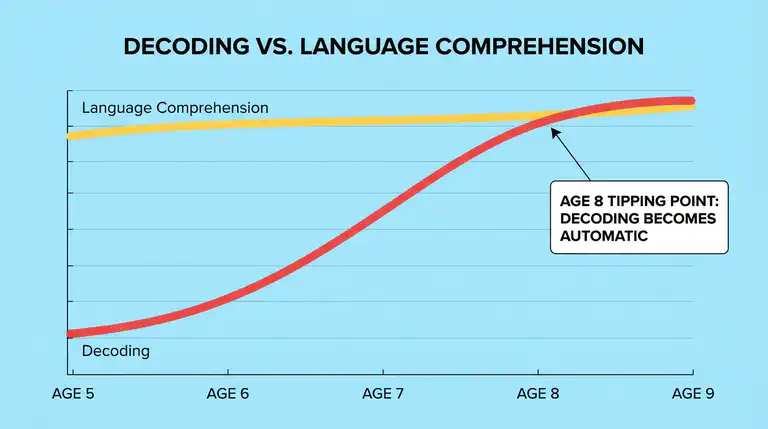
Here is a pattern every parent should know about. In Reception and Year 1, decoding is almost always the bottleneck. Young children understand far more language than they can read, so their reading comprehension is capped by how many words they can successfully sound out (Lervåg et al., 2018). A five-year-old might follow a rich conversation at the dinner table and still stumble through “The cat sat on the mat,” because her decoding has not caught up with her listening.
By around Year 3, something shifts. For most children, decoding has become automatic. They can read almost any word they meet, and now reading comprehension starts to depend more on vocabulary, background knowledge, and the ability to make sense of longer, more complex texts (Lervåg et al., 2018). This is why some children who seemed to be doing fine in early years suddenly hit a wall around age eight or nine. They can read the words, but they do not have the language comprehension yet to make sense of what they are reading. And the flip side is true too. Around 35 per cent of children with reading difficulties have a specific decoding problem, while another 10 to 15 per cent decode well but struggle with comprehension (Catts et al., 2006). Knowing which bottleneck your child is hitting changes what she needs.
What This Means for Your Child
The Simple View of Reading is not just a theory for educators. It is a diagnostic tool you can use at home.
If your child is in Reception, Year 1, or Year 2 and struggles to read simple words, the most likely bottleneck is decoding, not intelligence. Her language comprehension is probably fine. She just needs more practice turning letters into sounds until the process becomes automatic. This is not a failure. It is a completely normal stage of building the reading brain. The visual word form area we mentioned earlier is still under construction, and construction takes time.
If your child is in Year 3 or older, reads words accurately, but does not seem to understand what she is reading, the likely bottleneck is on the comprehension side. She may need more exposure to rich conversation, wider vocabulary, and books that stretch her background knowledge. Reading aloud to her still matters at this age, and so does talking to her about what you are reading together. A lot of parents stop reading aloud once their children can read independently. The Simple View suggests keeping that going as long as she will let you.
Practical Strategies That Actually Fit the Science
Read aloud every day, at any age. Reading to your child is not just a warm ritual. It directly builds the language comprehension side of the equation. Children whose parents read aloud regularly have stronger vocabulary, better inference skills, and more background knowledge by the time they hit school.
Protect short daily decoding practice. Decoding is a skill that responds to repetition, not to intensity. Ten to fifteen minutes of structured phonics practice every day outperforms occasional hour-long sessions. The Ehri meta-analysis of 38 studies found that systematic phonics instruction produced a moderate effect on reading outcomes, and the effects were strongest when practice started early, in Reception or Year 1 (Ehri et al., 2001). Bookbot is built around this exact insight. Short, daily, decoding-focused reading sessions with gentle error correction, which is what the research tells us works.
Match the intervention to the bottleneck. If your child struggles to decode, more bedtime stories will not fix it. If your child decodes well but struggles to understand, a phonics worksheet will not help either. Ask yourself which side of the equation is holding her back, and focus your time there.
Talk about books, not just read them. After a chapter, ask what she thinks will happen next. Why did that character do that? Has anything like that ever happened to her? Conversations like these build the very comprehension skills that the Simple View of Reading predicts will drive success as she gets older.
Resist the temptation to only give her books she can read perfectly. Give her some easy books for decoding practice, but also keep reading her books that are above her reading level. That is where vocabulary and comprehension grow.
Watch for the Year 3 shift. If reading gets harder around ages eight or nine, it is often because the texts themselves have gotten harder, not because your child has suddenly lost ability. The support she needs may have shifted from decoding help to vocabulary and background knowledge.
Two Skills, One Reader
The simple view of reading formula is an invitation to stop treating reading as one mysterious skill and start seeing it as two specific skills working together. Both are learnable. Both respond to practice. And the kind of practice that each one needs is different.
Your child’s brain is actively building itself to read. The visual word form area is wiring up, vocabulary is expanding, inference skills are developing. When decoding finally clicks and becomes automatic, all the language comprehension you have been building through years of conversation and bedtime stories suddenly becomes available to her whenever she opens a book. That moment, when a child stops sounding out and starts reading, is one of the most satisfying things to watch. And it is not magic. It is the Simple View of Reading, finally working the way it is supposed to.
If you want to give the decoding side a daily home, that is exactly what we built Bookbot for. You keep doing the talking, the reading aloud, and the questions at bedtime. We will handle the part where letters turn into words.
References
Catts, H. W., Adlof, S. M., & Weismer, S. E. (2006). Language deficits in poor comprehenders: A case for the simple view of reading. Journal of Speech, Language, and Hearing Research, 49(2), 278–293. https://doi.org/10.1044/1092-4388(2006/023)
Dehaene, S., Cohen, L., Morais, J., & Kolinsky, R. (2015). Illiterate to literate: Behavioural and cerebral changes induced by reading acquisition. Nature Reviews Neuroscience, 16(4), 234–244. https://doi.org/10.1038/nrn3924
Ehri, L. C., Nunes, S. R., Stahl, S. A., & Willows, D. M. (2001). Systematic phonics instruction helps students learn to read: Evidence from the National Reading Panel’s meta-analysis. Review of Educational Research, 71(3), 393–447. https://doi.org/10.3102/00346543071003393
Gough, P. B., & Tunmer, W. E. (1986). Decoding, reading, and reading disability. Remedial and Special Education, 7(1), 6–10. https://doi.org/10.1177/074193258600700104
Hoover, W. A., & Gough, P. B. (1990). The simple view of reading. Reading and Writing, 2(2), 127–160. https://doi.org/10.1007/BF00401799
Lervåg, A., Hulme, C., & Melby-Lervåg, M. (2018). Unpicking the developmental relationship between oral language skills and reading comprehension: It’s simple, but complex. Child Development, 89(5), 1821–1838. https://doi.org/10.1111/cdev.12861
Peng, P., Lee, K., Luo, J., Li, S., Joshi, R. M., & Tao, S. (2021). Simple view of reading in Chinese: A one-stage meta-analytic structural equation modeling. Review of Educational Research, 91(1), 3–33. https://doi.org/10.3102/0034654320964198