




A six-year-old in your class reads the word sheep aloud, and it sounds a lot like ship. By the usual rules of phonics pronunciation, that is a reading mistake. Do you mark it wrong?
It depends on what you are listening for. In Singapore English, Philippine English and East and West African English, ship and sheep can sound alike in everyday speech. Students learning English, whether your school calls them ESL, EAL/D, EAL or English learners, often carry sounds over from their first language in the same way. Either way, the student may have read every letter correctly.
That gap between reading a word and saying it is the subject of a 2026 paper called “The elephant in the phonics room.” It asks: when a child reads aloud to be assessed, are we scoring their reading, or their accent?
One Spelling, Many Right Answers
Hyejeong Ahn of the University of Melbourne and Catherine Sangster of Oxford University Press published the paper in The Australian Journal of Language and Literacy (Ahn & Sangster, 2026). It is a position paper, meaning an argument built from existing evidence rather than a new experiment.
Their main evidence is the Oxford English Dictionary, which now records pronunciations in 19 varieties of English besides British and American, and treats them all as equally valid.
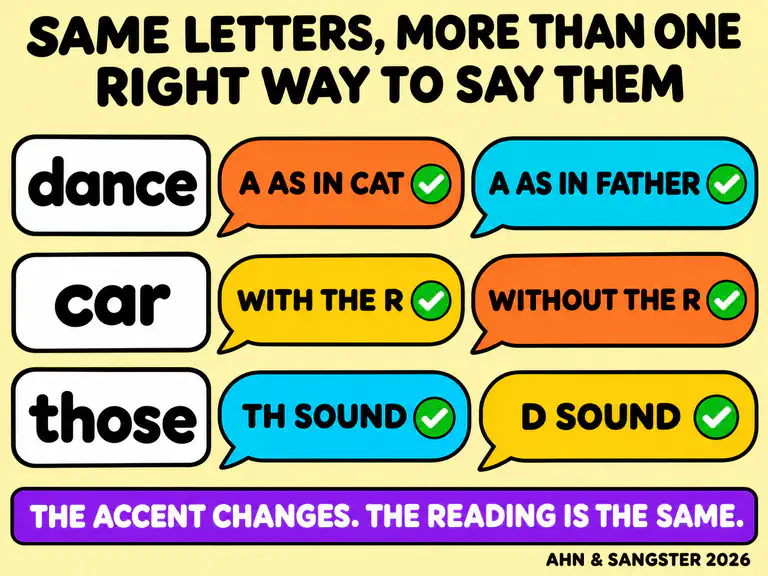
The differences are systematic, not sloppy. In Singapore, Malaysian, Philippine, Hong Kong and East and West African English, ship and sheep share one vowel, as do book and boot. In Irish and Indian English, the th in those often comes out closer to a d. Australia has its own example: the a in dance sounds like the a in cat for some Australians and the a in father for others.
Yet nobody treats an American child who sounds the r in car, or an Australian child who drops it, as making a reading error. A student who says ship and sheep alike may be marked wrong.
Even in England, only about 3 to 5% of people speak Received Pronunciation, the accent many picture as standard.
Where the Phonics Check Draws the Line
In Australia’s Year 1 Phonics Check and England’s phonics screening check, a student reads 40 words aloud to a teacher, half real and half made up. The made-up words can’t be memorised, so the student has to decode them. But the only evidence you get is the sound of their voice.
England’s 2025 scoring guidance allows for regional accents: for made-up words, “all plausible alternative and regional pronunciations are acceptable” (Standards and Testing Agency, 2025). Real words are stricter, and rightly so. The student has to choose the right sound for the letters, so blow read to rhyme with cow is marked wrong. That is a decoding choice, not an accent.
Ahn and Sangster’s concern sits between those two rules. The guidance gives a short list of examples and doesn’t say how they were chosen, so a teacher who meets an unfamiliar accent falls back on their own ear. Very little research has tested whether accents are scored unfairly, so for now it is a question, not a finding.
The US DIBELS 8 screener is more direct. Its manual says students “are not penalized for varied pronunciation due to dialect or articulation,” and calls this a professional judgement based on what the teacher knows of the student’s speech (University of Oregon, 2019).
Machines Hear Accents Too
This matters more as computers start doing the listening. Petscher and colleagues (2026) compared an automated scoring tool with human raters for 429 US kindergarten children reading single words. On light, the tool agreed with people no better than chance. On after and idea, it agreed every time. The authors noted that some words may be scored less fairly for children whose dialect drops final consonants.
This is a problem we work on directly at Bookbot, because the app listens while a child reads aloud. Each word has a list of pronunciations the app accepts, including accent forms, so a child who reads a word correctly in their own accent keeps moving through the book.
Phonics and Pronunciation at School
The research on ESL phonics is more settled than the research on scoring it.
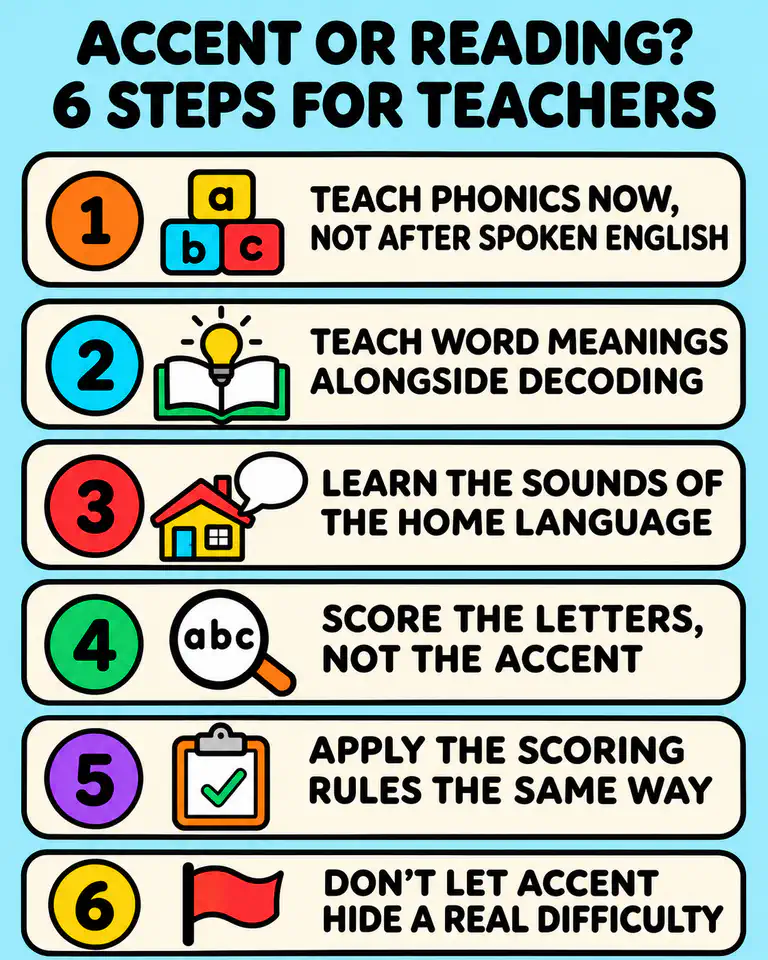
Teach phonics now, not after spoken English. A meta-analysis of 26 studies found large effects of reading interventions on English learners’ reading accuracy, and moderate effects on comprehension (Ludwig et al., 2019). The authors concluded these should not be delayed until oral English is stronger. A second meta-analysis, of 46 studies of phonological awareness and phonics teaching in English as a second language, found a moderate effect on real words and a large one on made-up words (Murphy Odo, 2021).
Teach word meanings alongside decoding. A native speaker who reads sheep as ship often self-corrects, because the sentence stops making sense. An English learner who doesn’t know either word can’t. The Institute of Education Sciences rates vocabulary teaching throughout the day for English learners as strongly supported (Gersten et al., 2007).
Learn the sounds of the home language. A student’s first language shapes which English sounds they hear as different. Ahn and Sangster call this a normal part of multilingual development, not a sign of reading difficulty, as we also explain in dyslexia and bilingualism. Model sounds in your own voice; the paper argues a changed accent isn’t needed for decoding. Where two sounds merge, teach the contrast for spelling, and keep pronunciation work for oral language time, aimed at being understood rather than sounding native (Derwing & Munro, 2005).
Score the letters, not the accent. Ask whether the sound the student chose fits the letters. Reading ship as shop is a decoding slip, because the letter is i. Then look for a pattern. Ahn and Sangster (2026) note that the same difference across similar words may reflect how a student speaks rather than a reading difficulty.
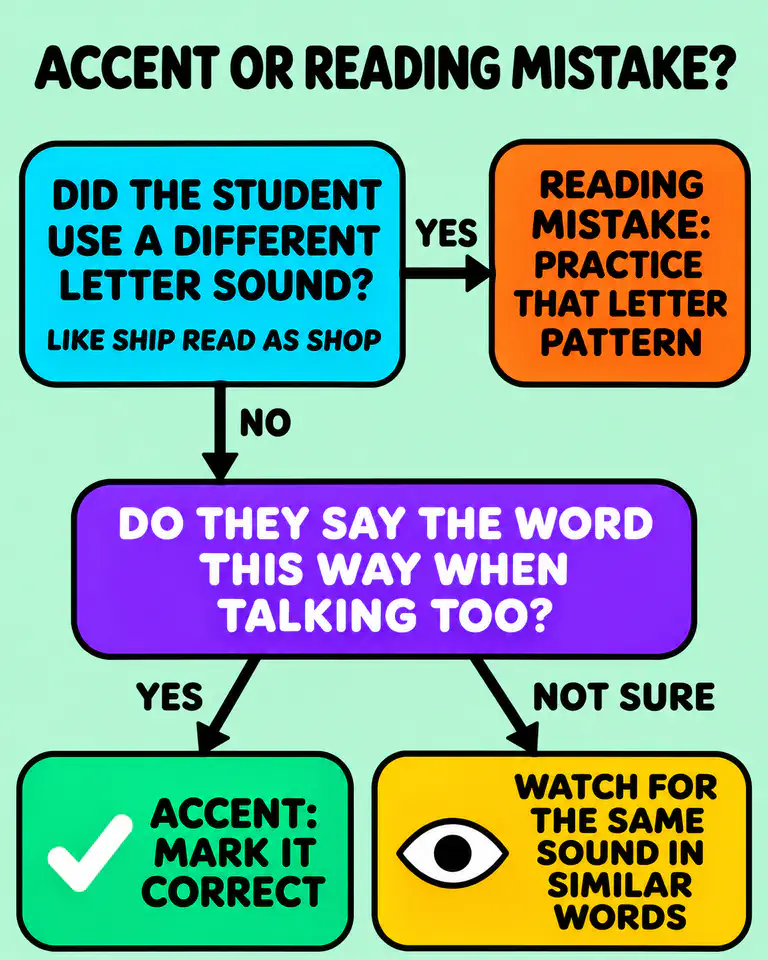
Apply the scoring rules the same way. Follow your phonics check’s official guidance, then agree as a team how you apply it to accents it doesn’t list. Note each student’s consistent sound patterns, so scoring doesn’t rest on one ear. Our phonics screening check guide covers the rest.
Don’t let accent hide a real difficulty. The Institute of Education Sciences guide says English reading screeners work even for students who know little English, and warns against treating below-grade-level reading as “normal” for English learners. Accent doesn’t explain errors across many letter patterns or slow blending. Those students need daily small-group teaching: at least 30 minutes in groups of three to six, the guide suggests, and Ludwig and colleagues found groups of two to five beat larger ones.
Reading Is the Goal
The paper closes by asking why pronunciation should matter in phonics at all, if the goal is understanding what you read.
I would put it slightly differently. Pronunciation does matter to phonics, because it is how we hear what a child has decoded. It just shouldn’t matter which accent it arrives in.
So when a student reads aloud and a word comes out sounding like Manila, Lagos or Glasgow, look at the letters before you mark anything. If the sound fits the letters, that’s reading.
References
Ahn, H., & Sangster, C. (2026). The elephant in the phonics room: Rethinking pronunciation norms in early reading instruction. The Australian Journal of Language and Literacy, 49, 227-241. https://doi.org/10.1007/s44020-026-00106-3
Derwing, T. M., & Munro, M. J. (2005). Second language accent and pronunciation teaching: A research-based approach. TESOL Quarterly, 39(3), 379-397. https://doi.org/10.2307/3588486
Gersten, R., Baker, S. K., Shanahan, T., Linan-Thompson, S., Collins, P., & Scarcella, R. (2007). Effective literacy and English language instruction for English learners in the elementary grades (NCEE 2007-4011). Institute of Education Sciences, U.S. Department of Education. https://ies.ed.gov/ncee/wwc/Docs/PracticeGuide/20074011.pdf
Ludwig, C., Guo, K., & Georgiou, G. K. (2019). Are reading interventions for English language learners effective? A meta-analysis. Journal of Learning Disabilities, 52(3), 220-231. https://doi.org/10.1177/0022219419825855
Murphy Odo, D. (2021). A meta-analysis of the effect of phonological awareness and/or phonics instruction on word and pseudo word reading of English as an L2. SAGE Open, 11(4). https://doi.org/10.1177/21582440211059168
Petscher, Y., O’Sullivan, J., Catts, H. W., Edwards, A., & Fitton, L. (2026). Evaluation of the consistency of a speech verification system with human raters in early literacy screening assessments. Frontiers in Education, 11. https://doi.org/10.3389/feduc.2026.1671946
Standards and Testing Agency. (2025). 2025 phonics screening check: Scoring guidance. Department for Education. https://assets.publishing.service.gov.uk/media/68541ff380329f510de989ed/2025_phonics_screening_check_scoring_guidance.pdf
University of Oregon. (2019). DIBELS 8th Edition administration and scoring guide. University of Oregon. https://amplify.com/pdf/uploads/2022/01/D8_Admin_Scoring.pdf