




Before a child can connect letters to sounds, they need to hear those sounds in the first place. That might seem obvious, but it is one of the most overlooked steps in learning to read.
Phonemic awareness is simply the ability to hear and play with the individual sounds in words. It has nothing to do with letters. It is all about listening. Can your child hear that “cat” has three separate sounds? Can they swap the first sound to make “bat”? That is phonemic awareness, and research consistently shows it is the single strongest predictor of whether a child will learn to read successfully.
When I review the research on early reading, this skill keeps surfacing as the foundation everything else is built on. Without it, phonics lessons do not stick. With it, children have what they need to start connecting sounds to letters and sounding out words on their own.
What Phonemic Awareness Actually Looks Like
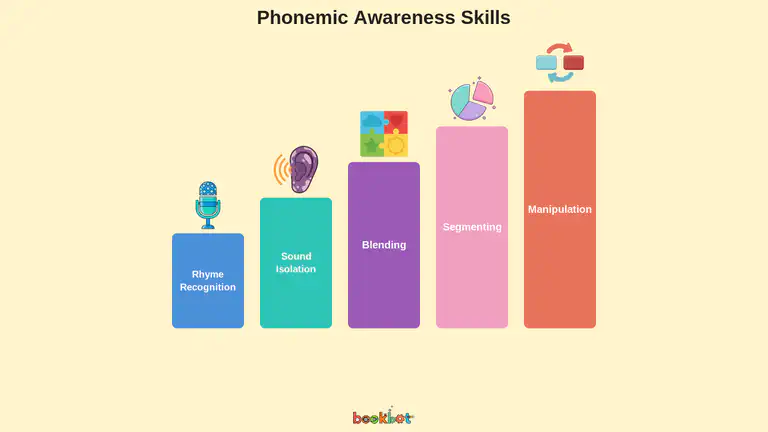
Phonemic awareness is not one skill. It is a set of phonemic awareness skills that children pick up in a natural order, from easy to hard.
First, children learn to spot rhymes. “Do ‘cat’ and ‘hat’ sound the same at the end?” Then they learn to pick out individual sounds: “What is the first sound in ‘fish’?” From there, they start blending sounds together ("/d/ /o/ /g/ makes what word?") and breaking words apart into their sounds (“Tell me every sound in ‘ship’”).
The hardest phonemic awareness skills are dropping and swapping sounds. “Say ‘smile’ without the /s/.” “Change the /k/ in ‘cat’ to /b/.” These are tough for young children, and they are also the ones that best predict how well a child will read later on.
What I find most encouraging is that this order is the same for nearly every child. It gives parents and teachers a clear path to follow.
What Happens in the Brain
Phonemic awareness is not just something we observe in a child’s behaviour. It actually shows up in brain scans.
Kovelman, Norton, and colleagues at MIT used brain imaging to scan children aged 5 to 13 while they worked on rhyming tasks (Kovelman et al., 2012). When children had to think carefully about the sounds in words, a specific area in the front left part of the brain became active. Children with dyslexia showed weaker activity in this same area, which tells us that the ability to hear individual sounds and the brain’s reading wiring are closely linked.
A later study by Preston and colleagues tracked 7 to 9 year olds over time (Preston et al., 2022). They found that early sound-processing activity in the hearing part of the brain actually helped reading improve later on. And as children got better at reading, their brains needed less effort to work with sounds. In other words, the brain was getting more efficient with practice.
This is the kind of finding that connects my two worlds as a researcher. The brain does not just wait around for reading to develop on its own. It actively rewires itself as children practise these sound skills. That rewiring is what makes smooth, easy reading possible.
Phonemic Awareness vs. Phonological Awareness
Parents and teachers sometimes mix up these two terms, but there is a helpful way to tell them apart.
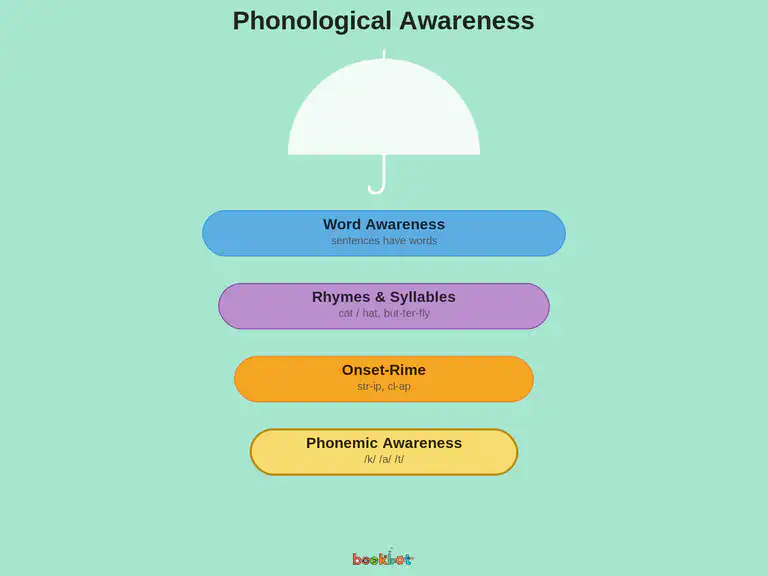
Think of phonological awareness as the big umbrella. It covers all the ways children notice the sound patterns in language: spotting rhymes, clapping out syllables, breaking a word like “str-ip” into its opening sounds and ending. Phonemic awareness is the most detailed skill under that umbrella. It zooms in on individual sounds, the smallest pieces of a word that change its meaning.
Here is a simple test. A child who can clap the syllables in “butterfly” (three claps) is showing phonological awareness. A child who can tell you that “stop” starts with /s/ and ends with /p/ is showing phonemic awareness. Both matter, but phonemic awareness is the one most closely tied to reading success. Ehri and colleagues confirmed this in a large review of studies in 2001, finding that phonemic awareness had a bigger impact on learning to read than the broader sound skills (Ehri et al., 2001).
How Much Practice Is Enough?
Here is something that surprised me. More is not always better.
Erbeli and colleagues reviewed 16 studies in 2024 to find the sweet spot for phonemic awareness practice (Erbeli et al., 2024). The pattern was clear: children improved the most with about 10 total hours of practice. After that point, the benefits actually started to drop off.
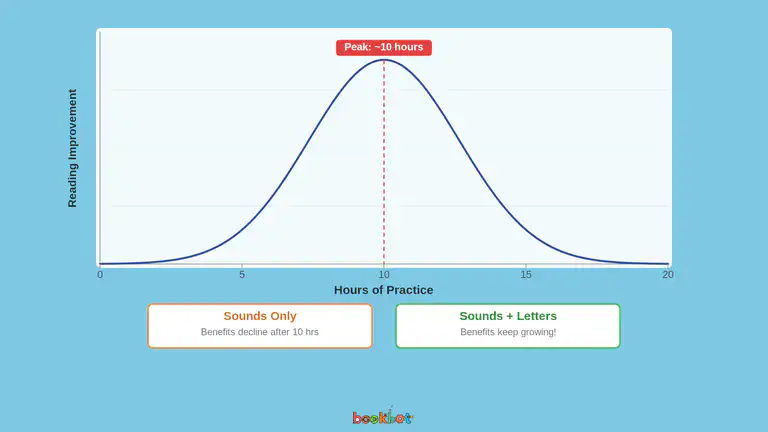
But there was an important catch. When sound practice was paired with letters, connecting what children heard to what they saw on the page, the benefits kept growing well past 16 hours. It was only when sounds were practised completely on their own, with no letter connection, that extra time stopped helping.
The National Reading Panel found something similar back in 2000. Their review of 52 studies showed that phonemic awareness practice worked best in Reception, and that focusing on just one or two skills at a time was far more effective than trying to teach three or more at once.
At Bookbot, this is exactly how we structure our reading sessions. Short, focused, and connected to letters from the start. When I analyse data from thousands of children using the app, the pattern holds: a few minutes of daily practice beats longer, less frequent sessions every time.
Why Starting Early Matters
The research is clear on timing. The National Reading Panel found that phonemic awareness instruction worked best in Reception and Year 1, before children had locked in their reading habits. Children who were already struggling in later year levels still benefited, but the biggest gains came early.
This does not mean older children cannot catch up. They can, and many do. But the easiest time to build this foundation is when the brain’s reading circuits are still forming their first connections.
What I find in my own research at Bookbot and Flinders University supports this. Children who start structured sound practice in the first year of school pick up reading faster and with less frustration than children who start later. Getting this foundation right early makes everything that comes after, phonics, fluency, understanding what they read, much easier.
What Parents Can Do Right Now
You do not need any special training to help your child build phonemic awareness at home. These are simple sound games, and children enjoy them.
Try asking your child to tell you the first sound in their name. Play rhyming games in the car: “What rhymes with ‘dog’?” Stretch out words slowly and ask them to blend the sounds back together: “/m/ /a/ /p/ makes…?” As they get more comfortable, try dropping sounds: “Say ‘stand’ without the /t/.”
The key is doing a little bit every day, not long sessions. Even five minutes of sound play builds the listening skills your child needs. And when that practice connects sounds to letters, as it does in a structured phonics programme like Bookbot, the brain starts building the connections that stick for the long term.
That is what my research focuses on: understanding how those small daily habits add up to real, measurable changes in how a child’s brain learns to read. The science is encouraging. The brain is ready to be wired for reading. It just needs the right kind of practice.
References
Ehri, L. C., Nunes, S. R., Willows, D. M., Schuster, B. V., Yaghoub-Zadeh, Z., & Shanahan, T. (2001). Phonemic awareness instruction helps children learn to read: Evidence from the National Reading Panel’s meta-analysis. Reading Research Quarterly, 36(3), 250-287. https://doi.org/10.1598/RRQ.36.3.2
Erbeli, F., Rice, M., Xu, Y., Bishop, M. E., & Goodrich, J. M. (2024). A meta-analysis on the optimal cumulative dosage of early phonemic awareness instruction. Scientific Studies of Reading, 28(4). https://doi.org/10.1080/10888438.2024.2309386
Kovelman, I., Norton, E. S., Christodoulou, J. A., Gaab, N., Lieberman, D. A., Triantafyllou, C., Wolf, M., Whitfield-Gabrieli, S., & Gabrieli, J. D. E. (2012). Brain basis of phonological awareness for spoken language in children and its disruption in dyslexia. Cerebral Cortex, 22(4), 754-764. https://doi.org/10.1093/cercor/bhr094
National Reading Panel. (2000). Teaching children to read: An evidence-based assessment of the scientific research literature on reading and its implications for reading instruction. National Institute of Child Health and Human Development. https://www.nichd.nih.gov/publications/pubs/nrp/findings
Preston, J. L., Molfese, P. J., Frost, S. J., Mencl, W. E., Fulbright, R. K., Hoeft, F., Landi, N., Shankweiler, D., & Pugh, K. R. (2022). Reciprocal relations between reading skill and the neural basis of phonological awareness in 7- to 9-year-old children. NeuroImage, 237, 118178. https://doi.org/10.1016/j.neuroimage.2021.118178