


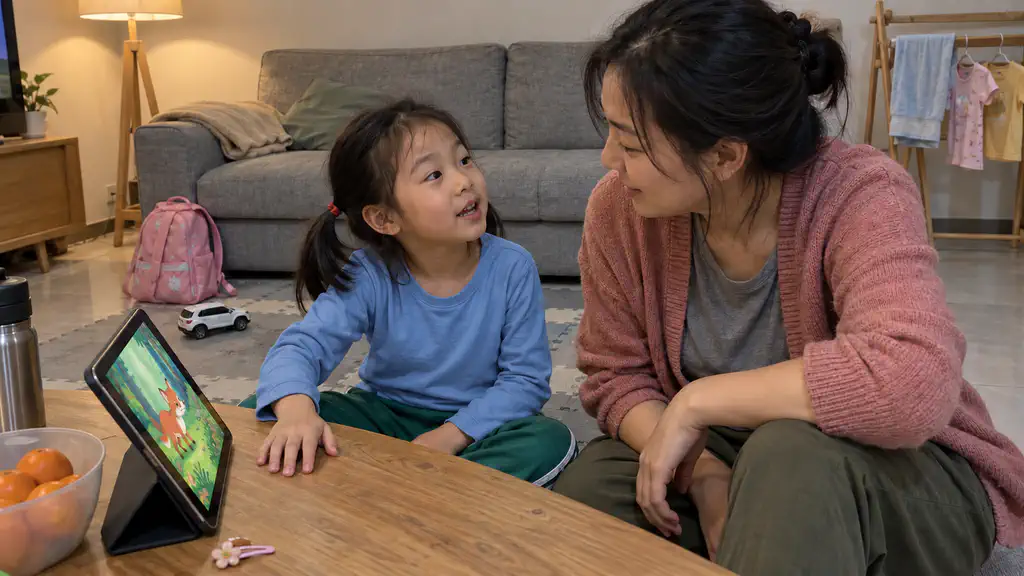

Some nights my patience is thin and the dinosaur book is on its fourth reading. I still say yes. I also work on Bookbot, an AI reading app, so the study I am about to describe is convenient for me. That is exactly why it sat awkwardly with me for a week before I wrote about it.
A randomised controlled trial (a study where children are assigned to groups by chance, so the groups start out comparable) published in the British Journal of Educational Technology sat 67 children aged 5 to 8 down with an English storybook on a tablet. All of them were native Chinese speakers learning English.
Some read the book with a large language model conversational agent, an AI reading tutor that talks back, asks questions and responds to what the child says. The rest read it with their own parent. On reading comprehension, meaning how much of the story the child actually understood, the AI group outperformed the parent group (Xiao, Zou, Lin, Li, & Yang, 2025).
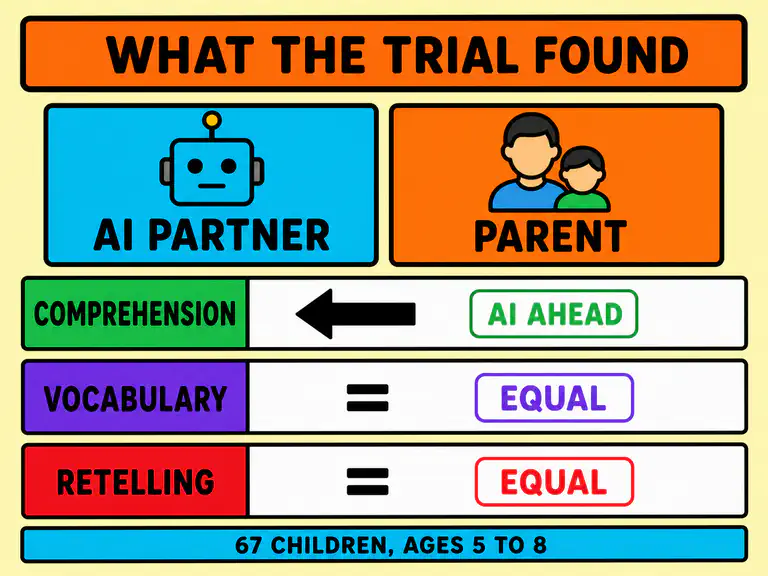
Comprehension was the only outcome that separated the two groups. Vocabulary and story retelling came out equivalent, both on the test straight after reading and on a delayed test later (Xiao et al., 2025). So the honest summary is not “AI is better at reading.” It is narrower: on one measure, in one small trial, the machine asked better questions.
Sixty-seven children is a small sample. The whole trial was one reading session of 20 to 40 minutes with a follow-up test five days later, and the children were reading in a language they were still learning. This trial cannot tell us what happens once the novelty of a talking book wears off. Those limits are real and I am not going to hide them in a footnote.
The result does have company, though more modest than the headline suggests. Xu and colleagues (2022) ran a randomised study with 117 children aged three to six, comparing a conversational agent against a human adult who either asked open questions while reading (dialogic reading) or simply narrated. When both asked questions, story comprehension barely differed by partner. What drove comprehension was the dialogue itself, not who supplied it.
That is “as good as”, not “better than”. I have not found a later trial that repeats the AI’s lead over parents. The only other one I know of ran for 12 weeks with kindergarteners with ADHD (Dong, Chow, Mo, & Zheng, 2026), and I could not read the full paper, so I do not report its results here.
The thread running through these trials is the part I find genuinely useful for building things: the questions matter more than who asks them. At Bookbot, speech recognition listens while a child reads aloud and flags a misread word straight away. It helps for a related, equally dull reason: a patient check, at the right moment, every single time, is a mechanical job. Machines are good at mechanical jobs.
What This Means for Your Child’s Reading Comprehension
Now the half that did not make the headline.
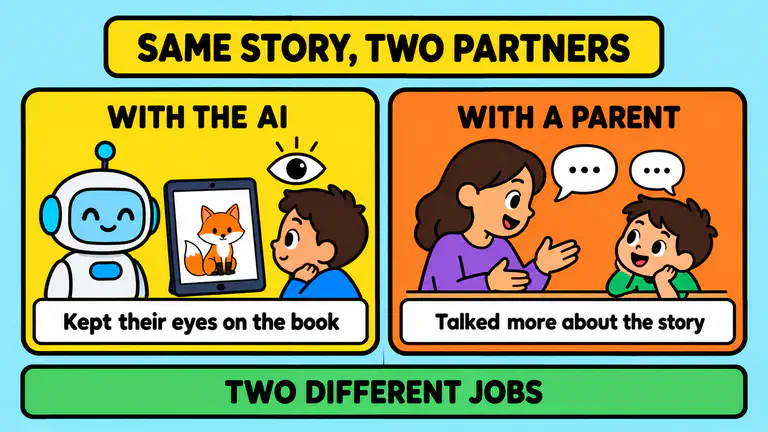
In the same trial, children reading with the AI kept their eyes on the book more and scored higher on the researchers’ overall engagement rating. Children reading with their parent talked more about the story itself, though that gap only just missed the strict bar the researchers set for themselves (Xiao et al., 2025). Xu and colleagues (2022) found the same split clearly in their larger trial: children produced noticeably more story talk with a human partner than with the agent.
One thing I expected did not show up in the numbers. The researchers also scored how much positive emotion children showed, and the AI group came out slightly ahead, though the gap was too small to count once they corrected for running many comparisons at once. The laughter and hugging they describe in the parent group came from their observations of the sessions, not from a score.
Put those results side by side and the picture is clear enough. The machine won the test. The parent won the conversation.
That distinction matters, because engagement with no person attached tends not to survive contact with real life.
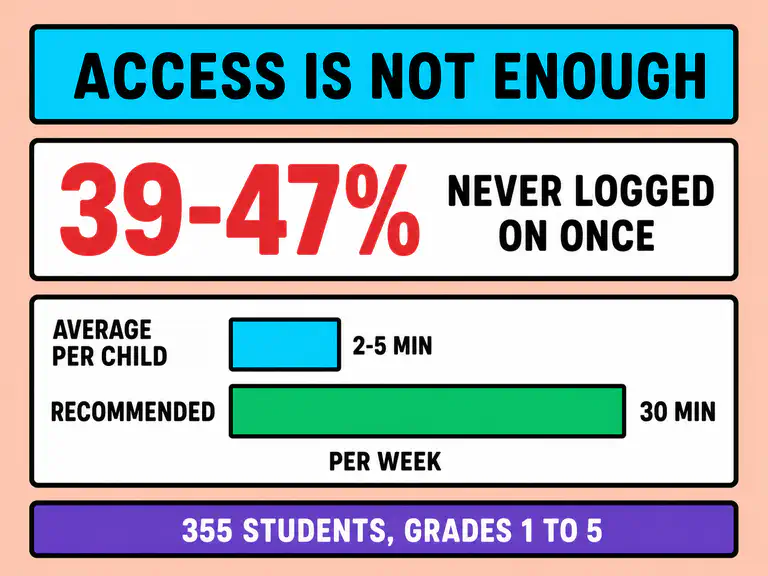
Robinson, Gormley, Ribeiro and Loeb (2026), in an EdWorkingPaper preprint (a paper released before peer review), ran two randomised trials with 355 students in Grades 1 to 5 on an AI literacy platform. In one district only 60.7% of children ever logged on at all and weekly use averaged 2.18 minutes. In the other, only 53.3% did, and use averaged 5.23 minutes, against the platform’s own recommended 30. Both averages include the children who never opened it.
Adding human tutors whose only job was motivation lifted the number of stories children finished each week by 71 to 80%, and platform time by 1 to 4 extra minutes a week. Reading achievement did not move (Robinson et al., 2026).
An AI reading tutor nobody opens produces exactly nothing. The adult is what turns access into use.
Practical Strategies for Using an AI Reading App
- Let the app carry the drills, not the relationship. Xiao et al. (2025) suggests the mechanical practice load, repeated questions, immediate correction, patience at 7pm, can be handed over. Nothing in it says the bedtime story should be.
- Keep asking your own questions, even clumsy ones. Mol, Bus, de Jong and Smeets (2008) meta-analysed (statistically pooled) 16 studies of dialogic reading, and across the nine that measured expressive vocabulary, the words a child can produce rather than merely recognise, the benefit was moderate (Cohen’s d = 0.59, meaning children whose adults asked open questions finished clearly ahead of children whose adults just read the words).
- Check in while the app does its work. In Robinson et al. (2026), what lifted use was a person checking in. At home, that person is you, and it applies to all reading apps for kids.
- Treat comprehension as one skill among several. If you want to know how to improve reading comprehension, the trial evidence points squarely at question-asking, and the best reading comprehension activities are simple: “Why did she do that?” “What happens next?” Reading comprehension skills are trainable. Whether your child wants to read is a separate question with a separate answer.
- Judge it after the novelty wears off. Xiao’s trial was a single sitting. Watch whether your child still opens the app in week six, and whether the two of you still talk about the stories.
Where This Leaves Us
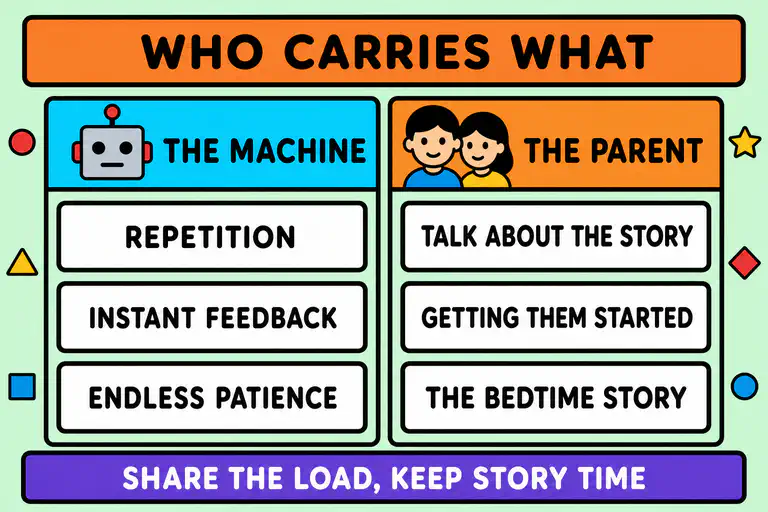
I do not read this research as an argument for replacing parents. I read it as something narrower and more useful: reading practice has a mechanical part and a conversational part, and for years we have asked one tired adult to supply both.
Software can now take a real share of the mechanical part: the repetition, the instant check, the patience at 7pm. What it has not shown it can take is the conversation children had more of with a person in both trials.
So: the machine won the test. Read with your child tonight anyway. On the evidence, that is not sentimentality, it is the half the software still cannot do.
References
Dong, Y., Chow, B. W.-Y., Mo, J., & Zheng, H. (2026). Does shared reading with AI chatbot promote language development in kindergarteners with ADHD. Language and Education, 40(4), 796–814. https://doi.org/10.1080/09500782.2025.2560492
Mol, S. E., Bus, A. G., de Jong, M. T., & Smeets, D. J. H. (2008). Added value of dialogic parent-child book readings: A meta-analysis. Early Education and Development, 19(1), 7–26. https://doi.org/10.1080/10409280701838603
Robinson, C. D., Gormley, D., Ribeiro, A. T., & Loeb, S. (2026). Access is not enough: Human support improves engagement with AI tutoring (EdWorkingPaper No. 26-1451). Annenberg Institute at Brown University. https://doi.org/10.26300/pz7p-p388
Xiao, F., Zou, E. W., Lin, J., Li, Z., & Yang, D. (2025). Parent-led vs. AI-guided dialogic reading: Evidence from a randomized controlled trial in children’s e-book context. British Journal of Educational Technology, 56(5), 1784–1813. https://doi.org/10.1111/bjet.13615
Xu, Y., Aubele, J., Vigil, V., Bustamante, A. S., Kim, Y.-S., & Warschauer, M. (2022). Dialogue with a conversational agent promotes children’s story comprehension via enhancing engagement. Child Development, 93(2), e149–e167. https://doi.org/10.1111/cdev.13708