




You already know the routine. Pyjamas on, teeth brushed, one more story before lights out. Most parents do it because it works: the child calms down, the day has a clear ending, and everyone gets to bed without a fight.
But there’s something else happening during that bedtime story that you probably don’t see. And it has less to do with the book and more to do with what happens after the book is closed.

When we review the research on how children learn to read, the role of sleep keeps coming up in ways that surprise people. We tend to think of reading as something that happens during the day, in classrooms and on couches. But the brain does some of its most important reading-related work at night, while your child is asleep.
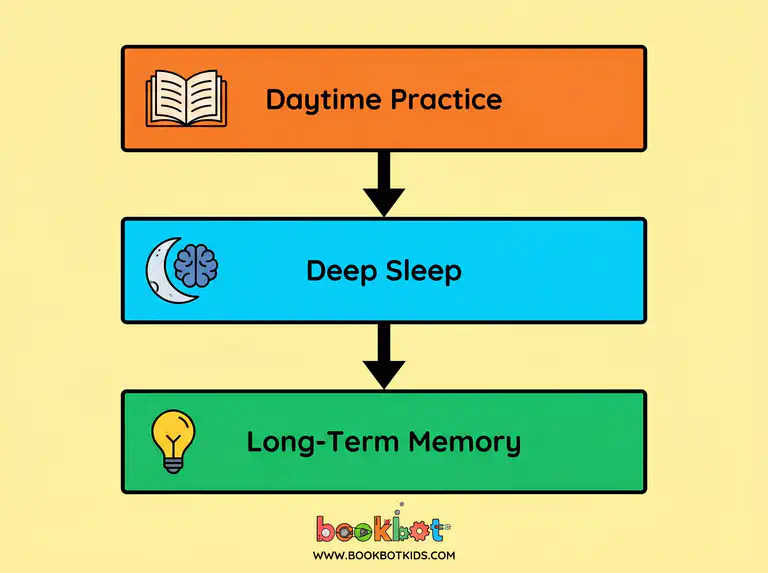
Here’s what that looks like. During the day, a child practises connecting letters to sounds, sounding out words, recognising patterns. All of that new information sits in a temporary holding area in the brain. Then, during deep sleep (a phase researchers call slow-wave sleep), the brain replays and strengthens those connections, moving them from short-term to long-term storage. This process is called memory consolidation, and it’s how practice during the day turns into lasting knowledge.
A 2020 study in Scientific Reports tested this directly. Researchers had 30 children (aged 7 to 12) and 34 adults learn new information, then tested them again after either a night of sleep or a period of wakefulness. The children who slept actually maintained or slightly improved their recall, while the adults who slept showed a decline. The children who stayed awake also declined. In other words, sleep protected learning in children in a way it didn’t for adults (Peiffer et al., 2020). The researchers attributed this to children’s deeper and more abundant slow-wave sleep, the very phase when memory consolidation is strongest.
Why the Bedtime Story Matters More Than You Think
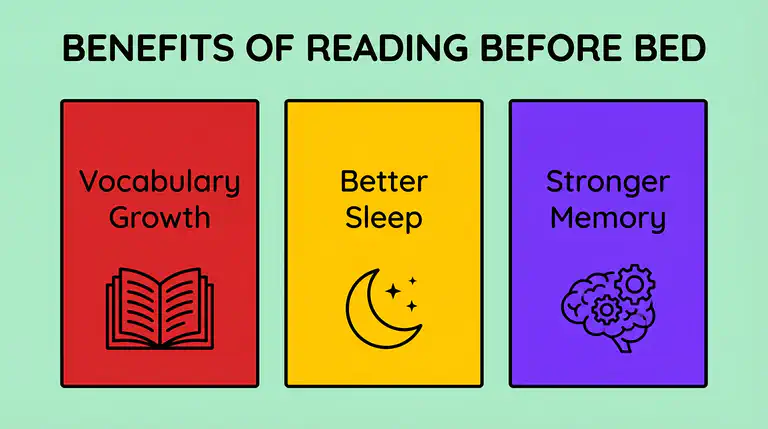
So reading before bed isn’t just a nice way to wind down. It’s placing fresh language, vocabulary, and story patterns right at the front of your child’s brain, just before the brain’s built-in filing system kicks in overnight.
A longitudinal study tracked 4,274 children from age three to age five and found that children whose parents used a language-based bedtime routine (reading, storytelling, or singing) at age three had significantly stronger vocabulary at age five. These children scored meaningfully higher on a vocabulary test than children without that routine, even after accounting for family income, education, and other factors (Hale et al., 2011). They also slept about 10 minutes longer each night, which compounded the benefit.
This is one of those findings that’s easy to overlook because bedtime stories for kindergarten children feel so ordinary. But the effect size was comparable to formal early childhood programmes like Head Start. That’s a remarkable return on 10 minutes of reading before bed.
What Sleep Does for Your Child’s Learning
The connection between sleep and school performance is well established. A meta-analysis of 50 studies covering nearly 50,000 children and adolescents found that sleep quality, sleep duration, and daytime sleepiness all significantly predicted school performance (Dewald et al., 2010). Of the three, sleep quality had the strongest relationship with how children performed.
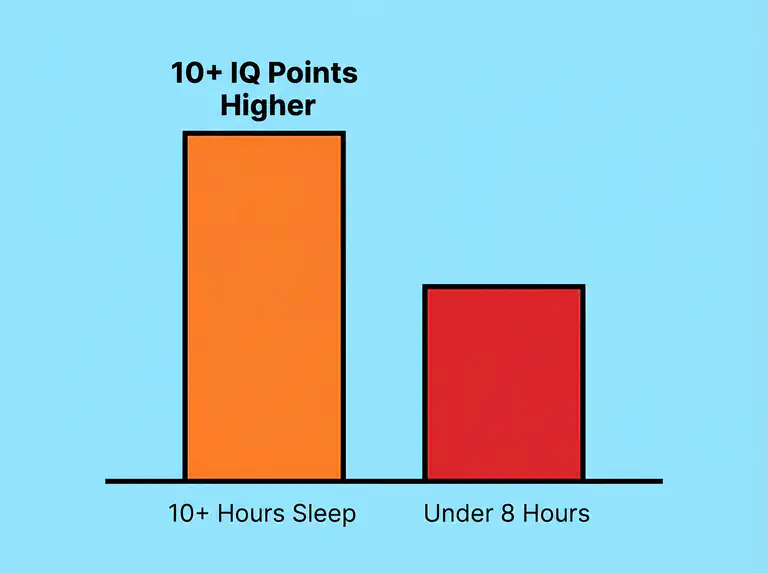
A more recent systematic review looked specifically at children aged 6 to 12 and found that boys who slept 10 or more hours per night scored over 10 IQ points higher on cognitive tests than boys who slept less than 8 hours. Each additional hour of sleep was associated with increased brain activation during working memory tasks (Félix & Candeias, 2025). Working memory is the cognitive skill children rely on most when decoding words, holding a sentence in mind, or following a story.
At Bookbot, we think about this when we analyse reading data from thousands of children. We see enormous variation in how quickly children progress through their reading levels, and while there are many factors at play, the pattern is consistent with what the sleep research suggests: children who practise regularly and get consistent sleep tend to consolidate their gains faster. That’s one reason we designed Bookbot to encourage short, daily reading practice rather than long, infrequent sessions. The goal is to give children something fresh to consolidate each night.
How to Make Bedtime Reading Work Harder
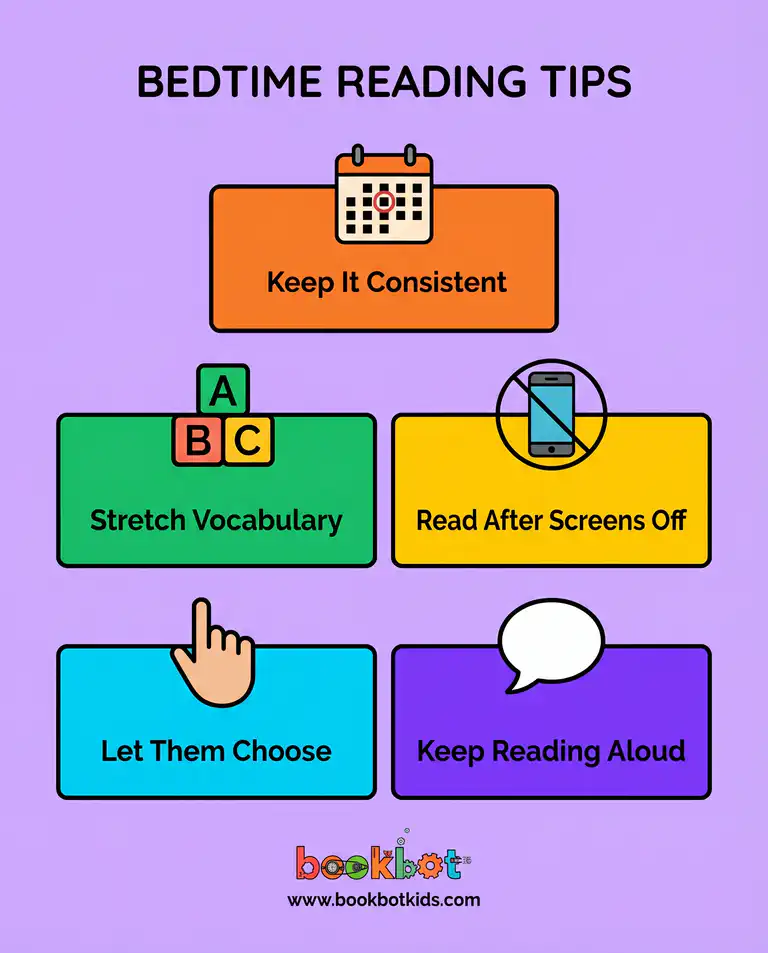
Keep it consistent. The research is clear that frequency matters more than length. Reading together most nights of the week produces stronger outcomes than occasional long sessions. Even five minutes counts. If bedtime stories to read feel like a chore on busy nights, keep a short picture book on the nightstand for exactly those moments.
Choose books that stretch vocabulary. The Hale et al. study found that the benefit was specifically tied to language-based routines. Books with rich, varied language give your child’s brain more to work with during overnight consolidation. Don’t shy away from words your child doesn’t know yet, that’s the whole point.
Read at the right time. Reading helps sleep when it becomes a predictable signal that the day is ending. Try to keep bedtime stories in the same place in the routine, after teeth are brushed and screens are off. The consistency helps the brain transition from alert to sleepy.
Let your child choose the book. Motivation matters. Children who are genuinely interested in the story engage more deeply, which means they process and retain more of the language. If your child wants the same book five nights in a row, that’s fine. Repetition is how young brains build familiarity with sentence patterns and vocabulary.
Don’t stop when they can read independently. Reading before bed has benefits that go well beyond decoding. Hearing a fluent reader model phrasing, expression, and more complex sentence structures supports comprehension skills that children are still developing throughout primary school. It also keeps the routine alive, which keeps the sleep benefits intact.
The Quiet Advantage
What we find most striking about this research is how it reframes something parents already do. Bedtime reading isn’t just a bonding ritual or a calm-down strategy, though it is both of those things. It’s a way of placing new language directly in the path of the brain’s overnight consolidation system.
That’s the quiet advantage of reading before bed. It works even when it doesn’t feel like it’s working. Your child might fall asleep halfway through the page. The story might be the same one you read yesterday and the day before. But underneath, the brain is doing its job: filing away letter patterns, deepening word knowledge, strengthening the connections that will make reading feel a little easier tomorrow.
That’s what our research at Bookbot and Flinders University keeps pointing toward: consistent, daily reading practice paired with good sleep is one of the simplest and most powerful things a parent can do to support their child’s reading development.
References
Dewald, J. F., Meijer, A. M., Oort, F. J., Kerkhof, G. A., & Bögels, S. M. (2010). The influence of sleep quality, sleep duration and sleepiness on school performance in children and adolescents: A meta-analytic review. Sleep Medicine Reviews, 14(3), 179–189. https://doi.org/10.1016/j.smrv.2009.10.004
Félix, A., & Candeias, A. (2025). Sleep as a developmental process: A systematic review of cognitive, emotional, and behavioral outcomes in children aged 6–12 years. Clocks & Sleep, 7(4), 66. https://doi.org/10.3390/clockssleep7040066
Hale, L., Berger, L. M., LeBourgeois, M. K., & Brooks-Gunn, J. (2011). A longitudinal study of preschoolers’ language-based bedtime routines, sleep duration, and wellbeing. Journal of Family Psychology, 25(3), 423–433. https://doi.org/10.1037/a0023564
Mindell, J. A., & Williamson, A. A. (2018). Benefits of a bedtime routine in young children: Sleep, development, and beyond. Sleep Medicine Reviews, 40, 93–108. https://doi.org/10.1016/j.smrv.2017.10.007
Peiffer, A., Brichet, M., De Tiège, X., Peigneux, P., & Urbain, C. (2020). The power of children’s sleep: Improved declarative memory consolidation in children compared with adults. Scientific Reports, 10, 9979. https://doi.org/10.1038/s41598-020-66880-3