



If you have ever searched for “reading apps for kids,” you already know the problem. There are hundreds of options, all claiming to teach your child to read. Some use flashy animations. Others promise results in weeks. But when I look at the actual research, a clearer picture emerges: some types of reading apps genuinely help children learn to read, and others are little more than digital babysitters.
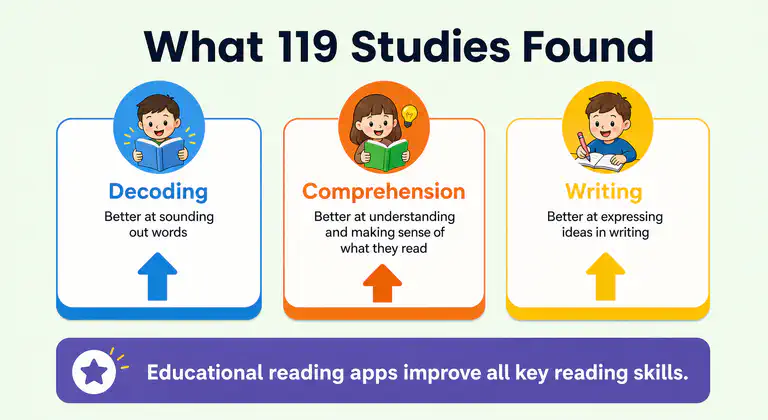
Researchers recently looked at 119 different studies — thousands of kids, dozens of countries — all asking the same question: do these apps actually work? (Silverman et al., 2025). The short answer is yes. But there are important catches every parent should know.
What the Research Found
The Silverman et al. (2025) meta-analysis, published in the Review of Educational Research, is the most comprehensive look at educational technology and literacy we have. It examined studies of children from kindergarten through fifth grade and measured outcomes across four areas. Apps and digital tools improved decoding (sounding out words), language comprehension (understanding what words mean), reading comprehension (understanding what sentences and stories mean), and writing. The improvements were consistent and statistically meaningful across all four areas.
What caught my attention is that decoding showed some of the strongest gains. This matters because decoding is the foundation of reading. A phonics app that systematically teaches letter-sound relationships is doing something fundamentally different from an app that just reads stories to your child.
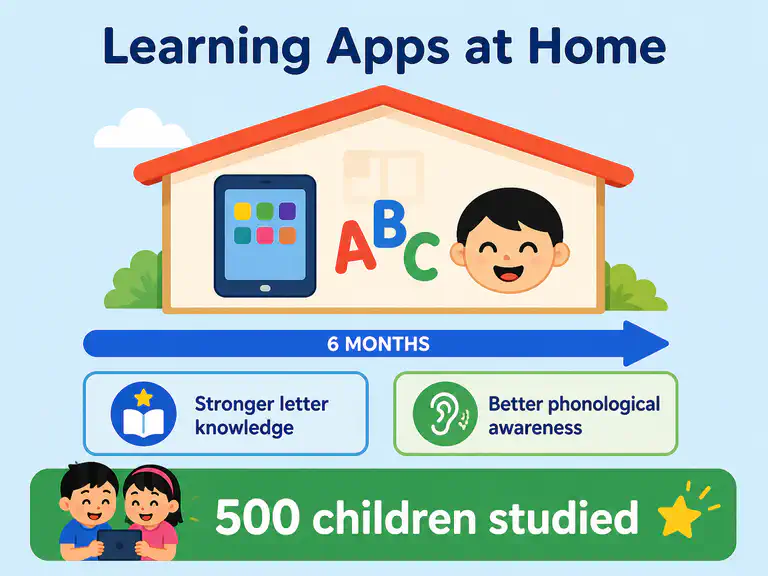
A separate study took this further. Niklas et al. (2025) ran a randomized controlled trial with 500 kindergarten children in Germany. Half the families received tablets loaded with specially designed literacy apps to use at home. The other half did not. After about six months, the children who used the literacy apps showed significantly stronger letter knowledge and phonological awareness, the building blocks of reading. And the more they used the apps, the more they gained.
Not All Apps Are Created Equal
Here is where it gets important. The apps that worked in these studies were not random games with letters sprinkled in. They were designed around how children actually learn to read: systematic phonics, structured practice, and feedback that adjusts to the child’s level.
Schiele et al. (2025) studied 500 preschoolers using game-based literacy apps and found something encouraging. The apps worked regardless of the child’s family background, income, gender, or starting ability. Just 30 minutes per week of structured app-based practice produced measurable literacy gains. That is good news for every family, not just those who can afford tutors or specialist programmes.
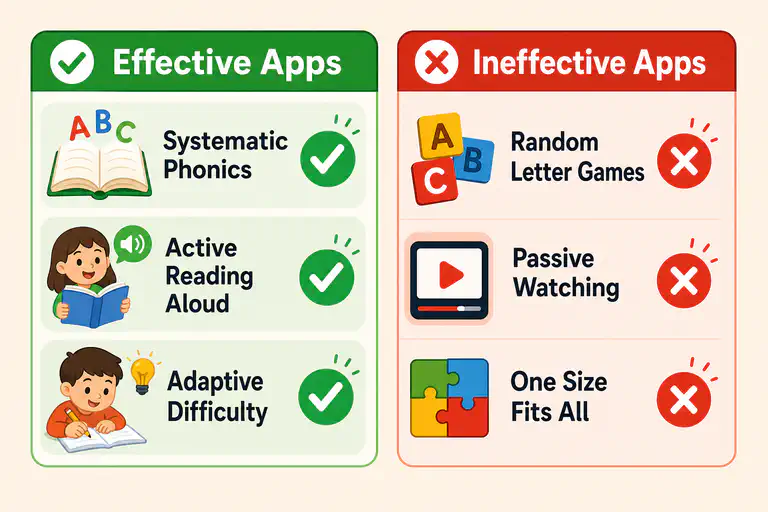
The pattern is clear. The best phonics apps and learn to read games share three things: they teach letter-sound relationships in a logical order, they require the child to actively practise (not passively watch), and they adapt to what the child needs next.
Why Reading Aloud Matters, Even on a Screen
One of the more interesting findings comes from research on AI-powered reading tools. Elmaadaway et al. (2025) tested an AI voice chatbot with 90 primary school students and found that children who practised reading aloud with the AI improved their oral reading fluency significantly more than children in the control group.
This makes sense when you think about how reading works in the brain. Silent tapping and swiping do not build the same connections as saying the words out loud. When a child reads aloud, they are connecting the letters on the screen to the sounds they already know from speech. That connection is what turns decoding into actual reading.
This is one reason we built Bookbot around reading aloud. The app listens as your child reads, gives real-time feedback, and adjusts to their level. It is the same principle the research supports: active reading practice with responsive feedback, delivered in short, focused sessions.
What to Look for in a Reading App
-
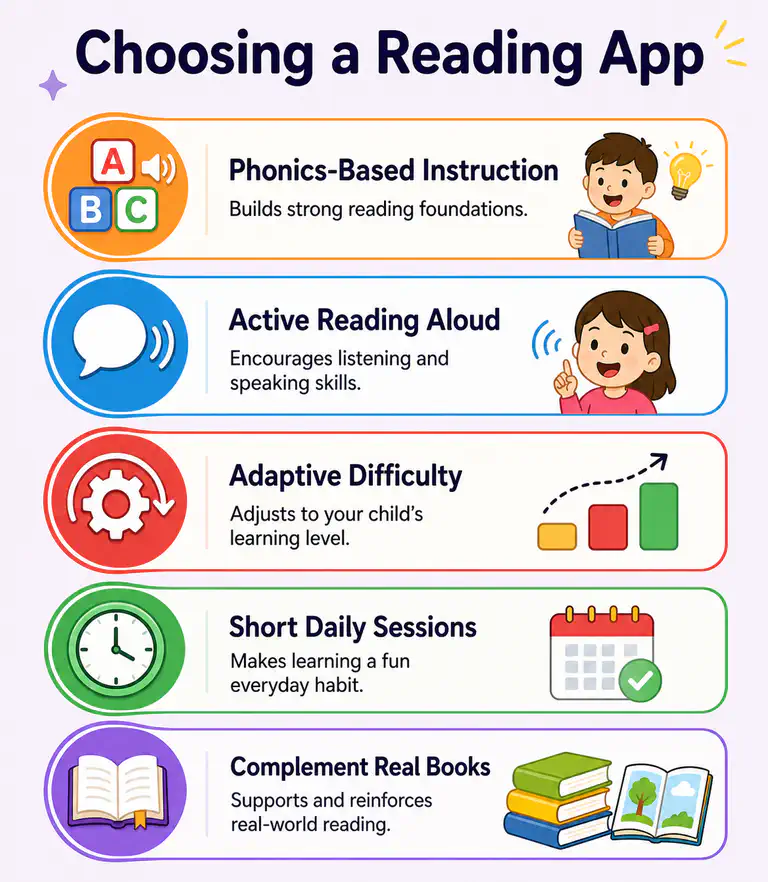
Phonics-based instruction, not just letter recognition. The best reading apps for kindergarten teach sounds in a structured sequence, the same way effective classroom phonics programmes work. Random letter games are not the same thing.
-
Active reading, not passive watching. If your child is mostly tapping, swiping, or watching animations, they are not practising reading. Look for apps that ask them to actually read words and sentences out loud.
-
Adaptive difficulty. A good learning to read app adjusts to your child’s level automatically. If every session feels the same, the app is probably not responsive to what your child needs.
-
Short, consistent sessions over long marathons. The Schiele et al. (2025) study shows that even 30 minutes per week of quality app time improves literacy. Ten to fifteen minutes of focused practice a day is worth more than an hour of distracted screen time.
-
Complementing instead of replacing real books. Apps work best alongside books, conversations, and reading together. They are a tool for extra practice, not a substitute for the rich experience of sharing a story with your child.
What I Keep Coming Back To
When I look at the data across these studies, the message is surprisingly simple. Reading apps can genuinely help children learn to read, but only when they are built on the same principles that make good classroom teaching work: phonics, practice, feedback, and consistency.
The Silverman et al. meta-analysis covers 119 studies and finds positive effects. The Niklas et al. trial shows that home-based app use boosts school readiness. The Schiele et al. study confirms that these benefits reach every child, regardless of background. The technology is not the magic ingredient. The reading science underneath it is.
At Bookbot, I see this in the data every day. The children who make the fastest progress are not necessarily the ones who spend the most time on the app. They are the ones who use it consistently, read aloud, and get the right level of challenge at the right time. That is what the research predicts, and that is what we keep building toward.
No app will ever replace the magic of sitting with your child and reading a story together. But the right app, used the right way, can give your child something powerful: extra practice that actually builds real reading skills. And that is worth every minute.
References
Elmaadaway, M. A. N., El-Naggar, M. E., & Abouhashesh, M. R. I. (2025). Improving primary school students’ oral reading fluency through voice chatbot-based AI. Journal of Computer Assisted Learning, 41(2), e70019. https://doi.org/10.1111/jcal.70019
Niklas, F., Birtwistle, E., Mues, A., & Wirth, A. (2025). Learning apps at home prepare children for school. Child Development, 96(2), 577–590. https://doi.org/10.1111/cdev.14184
Schiele, T., Edelsbrunner, P., Mues, A., Birtwistle, E., Wirth, A., & Niklas, F. (2025). The effectiveness of game-based literacy app learning in preschool children from diverse backgrounds. Learning and Individual Differences, 117, 102579. https://doi.org/10.1016/j.lindif.2024.102579
Silverman, R. D., Keane, K., Darling-Hammond, E., & Khanna, S. (2025). The effects of educational technology interventions on literacy in elementary school: A meta-analysis. Review of Educational Research. https://doi.org/10.3102/00346543241261073