


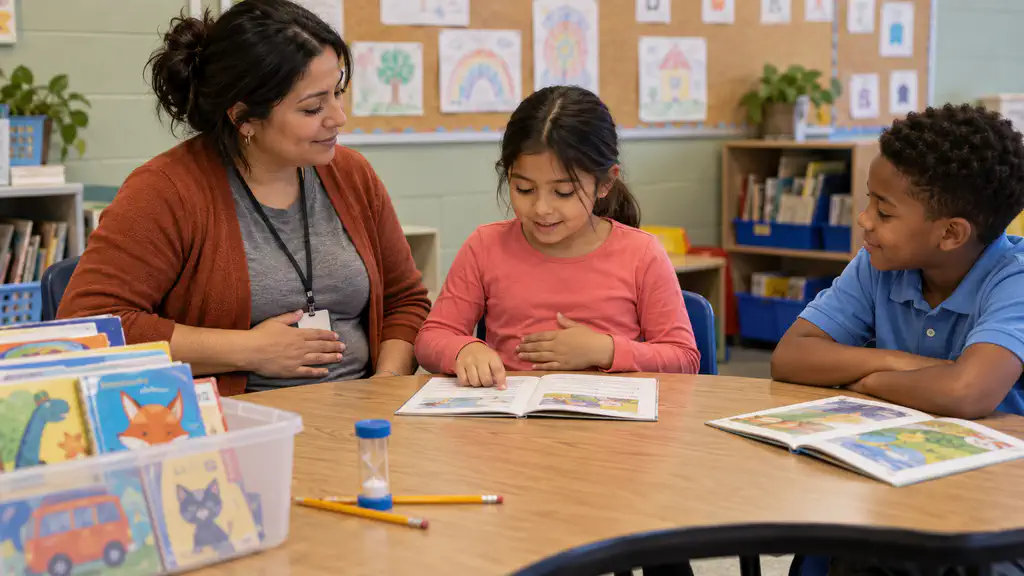

Some children start worrying long before the reading book comes out. Sunday nights turn tense. Spelling tests bring stomach aches. Anxiety and learning difficulties often arrive together, and the child who reads slowly is often the one quietly dreading being asked to read.
Parents face a practical question. Should the help go to the learning difficulty, to the anxiety, or to both? And which kind of anxiety help actually works?
I expected a clear answer from a new systematic review on exactly this question. What I found was more honest, and more useful.
Anxiety Interventions for Students: What the Review Found
Eleni Chatzoglou, Sarah Fishstrom, Kimberly McFadden and Sharon Vaughn (2026) published their review in Learning Disabilities Research & Practice. A systematic review is a study that collects every qualifying study on a question using a fixed, published search method, so nothing is cherry-picked.
The link between learning disability and anxiety is not in doubt. Nelson and Harwood (2011) combined 58 studies and found the average student with a learning disability reported more anxiety than about 7 in 10 classmates without one. We have covered how anxiety and reading skill travel together before; this piece is about what helps.
The team searched for every controlled trial of anxiety help for students with learning difficulties, kindergarten to Grade 12, published from 1991 to 2023. They screened 3,007 records. Eight studies qualified, with 324 students between them.
Eight. For a problem that common.
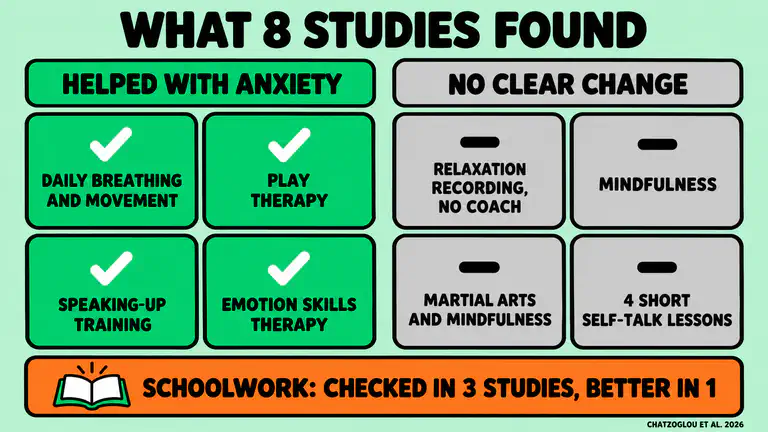
Four of the eight significantly reduced anxiety:
- Daily breathing, concentration and movement exercises led by teachers, 30 minutes a day for 12 weeks (Glanz, 1994)
- Play therapy, one-on-one with a researcher (Goudarzi et al., 2021)
- Assertiveness training, which means practising how to speak up and say no calmly (Mohagheghi et al., 2022)
- Dialectical behaviour therapy, a skills programme for handling strong emotions, aimed here at test anxiety (Uwakwe & Akanbi, 2017)
The other four showed no clear change: a relaxation recording with no teacher to coach it (Dolton, 2015), a mindfulness programme (Malboeuf-Hurtubise et al., 2019), martial arts combined with mindfulness, which gave mixed results (Haydicky et al., 2012), and four 20-minute self-talk lessons for high school students (Weintraub, 1996).
Schoolwork barely got a look in. Only three studies measured it, and only one found improvement, based on parent ratings rather than tests (Goudarzi et al., 2021).
The authors are blunt about limits. Most studies were small, between 22 and 85 students. Where studies reported it, 83% of participants on average were boys. Seven of the eight were quasi-experimental, meaning children were not randomly assigned to groups. Follow-ups lasted three months at most.
What This Means for Your Child
When I review a set of studies this small, I look for patterns rather than a winner, and I hold them loosely.
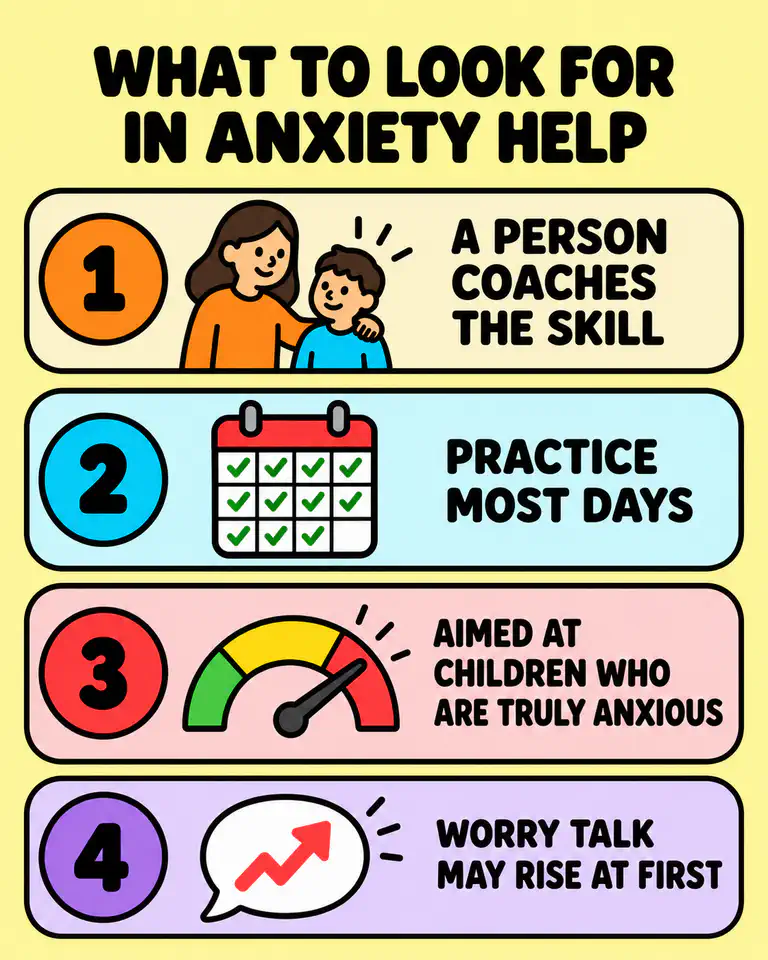
A coach seems necessary, but not enough. The one programme that handed children a recording and left them to it did not help. Yet three of the four that failed had a live instructor, so a person in the room is no guarantee.
Practice looks important. Glanz (1994) ran sessions every school day for 12 weeks, one of the most intensive programmes in the review, and it worked.
The children need to be genuinely anxious to begin with. Only two studies checked that before starting, and both found significant results. A calm child has little room to improve.
The authors add a twist I find reassuring. Three programmes that showed no change taught children to recognise and name their feelings. A child who learns to notice worry may report more of it at first, which can hide real progress on a questionnaire.
Reading Help and Anxiety Help Together
This review left out, on purpose, programmes that combine academic help with anxiety help. Some of the strongest come from the same research group.
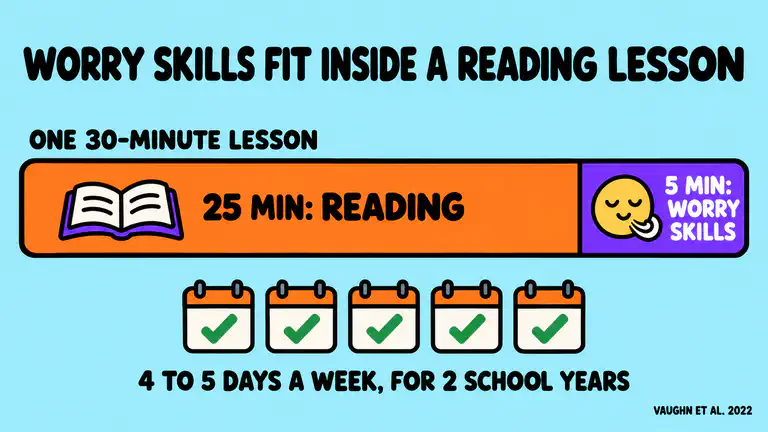
Vaughn and colleagues (2022) randomly assigned 128 struggling readers in Grades 3 and 4 to three groups. Two groups got the same small-group reading lessons, about 30 minutes, four to five days a week, for two school years. In one, about five minutes per lesson taught anxiety skills from the Strong Students Toolbox. In the other, those minutes went to maths facts. The third group continued with usual school support.
On a researcher-built comprehension test, using passages the children had not practised, the anxiety-skills group outperformed usual support with an effect size of 1.22, meaning a large difference in progress. The maths-facts group scored 0.77 against usual support, so the anxiety minutes did at least as well. On standardised reading tests, the groups did not differ. Grills and colleagues (2024) then reported the anxiety results from that trial: promising but not always statistically significant, meaning not always clear of chance. Among children who started with high anxiety, social anxiety had dropped by the end of year two compared with both other groups.
In Australia, a Macquarie University team that included Genevieve McArthur, who supports Bookbot’s research translation efforts, tested a similar combination. Francis and colleagues (2021) gave seven children 12 weeks of the Cool Kids anxiety programme alongside reading lessons. Their reading accuracy and spelling improved and their anxiety dropped. Seven children is far too few to prove anything, but it points the same way.
Practical Strategies
- Keep the learning help going. Chatzoglou and colleagues (2026) stress that anxiety programmes are not meant to replace academic intervention. With dyslexia, anxiety support belongs alongside structured reading teaching.
- Choose support a person coaches. The one programme built on a recording alone did not reduce anxiety (Dolton, 2015). Ask who will coach your child, and how often.
- Look for little and often. The most intensive programme in the review ran every school day (Glanz, 1994). The combined trial used about five minutes, four to five days a week (Vaughn et al., 2022).
- Ask about CBT-based programmes. Cognitive behavioural therapy, or CBT, teaches children to notice worried thoughts, test them, and face hard tasks in small steps. The review’s authors want programmes like Cool Kids adapted for children who find reading hard, so ask whether the materials rely on reading.
- Match the tool to the worry. The authors suggest relaxation for racing hearts and tense muscles, and thinking strategies for children who mainly worry.
- Get more than one view. Anxiety in students, especially young ones, is hard for them to rate themselves. Your observations and the teacher’s count too.
- Expect a wobble. If your child suddenly talks about worry more, that may be the skill working.
A Thin Evidence Base Is Not Bad News
It would be easy to read “eight studies, half worked” as a reason to give up on anxiety support. The authors say the opposite: the research is too thin to show these programmes fail. Programmes with strong track records in general classrooms have barely been tested with these children.
Bookbot is built for the reading half. Children practise reading aloud with an app that listens, so the first stumbles happen with no classmates watching.
If your child is both anxious and struggling, you do not have to choose. Keep the reading help steady, add a few minutes of coached worry skills most days, and give it a full term before you judge it.
References
Chatzoglou, E., Fishstrom, S., McFadden, K., & Vaughn, S. (2026). Systematic review of anxiety interventions for students with learning difficulties: Current evidence and research gaps. Learning Disabilities Research & Practice. https://doi.org/10.1177/09388982261496951
Dolton, M. G. (2015). Teaching relaxation techniques to improve achievement and alleviate the anxiety of students with learning disabilities in an independent school [Doctoral dissertation, Nova Southeastern University]. https://nsuworks.nova.edu/fse_etd/15/
Francis, D., Hudson, J. L., Kohnen, S., Mobach, L., & McArthur, G. M. (2021). The effect of an integrated reading and anxiety intervention for poor readers with anxiety. PeerJ, 9, e10987. https://doi.org/10.7717/peerj.10987
Glanz, J. (1994). Effects of stress reduction strategies on reducing test-anxiety among learning-disabled students. Journal of Instructional Psychology, 21(4), 313.
Goudarzi, A., Mousavi, S., & Sadeghi, F. (2021). The effectiveness of play therapy on anxiety and specific learning disorders of elementary-school students in Isfahan, Iran. International Journal of Pediatrics, 9(11), 14877-14887. https://doi.org/10.22038/IJP.2021.57069.4473
Grills, A. E., Vaughn, S., Bowman, C., Capin, P., Fall, A.-M., Roberts, G., & Barnes, E. D. (2024). Efficacy of a cognitive-behavioral anxiety management program integrated within a reading intervention. International Journal of Cognitive Therapy, 17(3), 549-577. https://doi.org/10.1007/s41811-024-00211-6
Haydicky, J., Wiener, J., Badali, P., Milligan, K., & Ducharme, J. M. (2012). Evaluation of a mindfulness-based intervention for adolescents with learning disabilities and co-occurring ADHD and anxiety. Mindfulness, 3(2), 151-164. https://doi.org/10.1007/s12671-012-0089-2
Malboeuf-Hurtubise, C., Taylor, G., & Mageau, G. A. (2019). Impact of a mindfulness-based intervention on basic psychological need satisfaction and internalized symptoms in elementary school students with severe learning disabilities: Results from a randomized cluster trial. Frontiers in Psychology, 10, 2715. https://doi.org/10.3389/fpsyg.2019.02715
Mohagheghi, M., Pourmohamadreza-Tajrishi, M., Shahshahanipour, S., Movallali, G., & Vahedi, M. (2022). The effectiveness of assertiveness training on anxiety symptoms in children with special learning disabilities of school age. Archives of Rehabilitation, 22(4), 408-429. https://doi.org/10.32598/RJ.22.4.487.15
Nelson, J. M., & Harwood, H. (2011). Learning disabilities and anxiety: A meta-analysis. Journal of Learning Disabilities, 44(1), 3-17. https://doi.org/10.1177/0022219409359939
Uwakwe, C. B., & Akanbi, S. T. (2017). Effectiveness of dialectical behaviour therapy in reduction of test anxiety among students with learning disabilities in Oyo State, Nigeria. IFE PsychologIA, 25(2), 165-179. https://www.proquest.com/openview/5cc24451f9a63d37a42a1b152f8358f8/1
Vaughn, S., Grills, A. E., Capin, P., Roberts, G., Fall, A.-M., & Daniel, J. (2022). Examining the effects of integrating anxiety management instruction within a reading intervention for upper elementary students with reading difficulties. Journal of Learning Disabilities, 55(5), 408-426. https://doi.org/10.1177/00222194211053225
Weintraub, A. J. B. (1996). Learning to spell by high school students with learning disabilities: Performance anxiety, self-efficacy and learning strategies [Doctoral dissertation, City University of New York]. ProQuest Dissertations and Theses Global.