




Your child comes home with a small reading book and a list of sight words to memorize: the, said, come, look. Here, sight words means words learned by heart as whole shapes, before children know the letter sounds inside them. In the sight words vs phonics question, is memorizing a head start, or does it get in the way?
A study of over 90,000 children in France, published online in September 2026, is the best evidence I’ve seen on this. It isn’t the old phonics vs whole language debate. Every classroom in it taught phonics. What differed was how strictly the first books stuck to it.
The strictest classrooms came out ahead. And the children who gained most had started school furthest behind.
What 90,000 children in France showed
Whether to teach phonics is settled. A meta-analysis, which pooled 38 studies, found systematic phonics instruction helped children learn to read, especially when it began early (Ehri et al., 2001).
How to teach it is less settled. A major review by Castles and colleagues (2018) flagged two open questions. Should a child’s very first books be decodable, meaning every word can be sounded out? They leaned yes.
And should children learn a few sight words alongside phonics? They saw no evidence it did harm, though more research was needed. This study tests both.
Paul Gioia, Johannes Ziegler and Jérôme Deauvieau (2027) surveyed more than 9,000 Grade 1 teachers in 17 randomly chosen areas of France and matched their answers to their students’ national reading tests. The final analysis covered 90,265 children in 6,440 classrooms.
They sorted the 34 most common textbooks on those two questions. Were children asked to memorize whole words before learning their sounds? Could at least 95% of the early text be sounded out with letter sounds already taught?
Classrooms that passed both tests were called strict phonics. Most others used mixed phonics: phonics plus memorized words, books children couldn’t fully sound out, or both. Across textbooks, between 42% and 100% of the early text could be sounded out, and children were asked to memorize anywhere from none to 44 words.
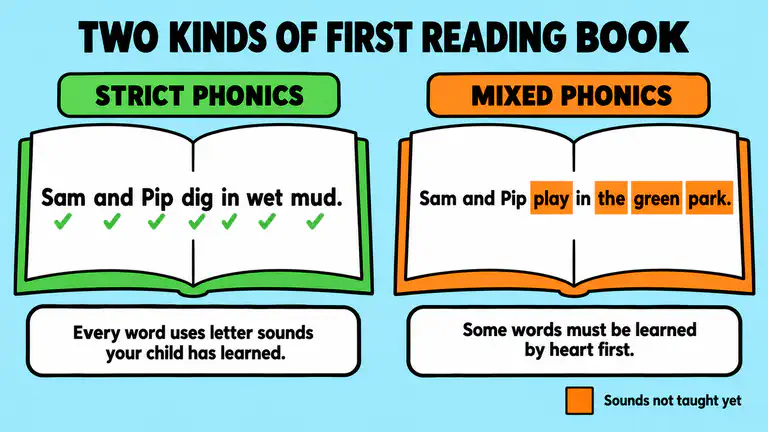
By the middle of Grade 1, children in strict classrooms read more fluently and understood more. The gaps were 0.11 to 0.19 standard deviations. A standard deviation is a yardstick for how spread out children’s scores are, so this is a small but real difference.
A typical child in the model read about 36 words a minute in mid-Grade 1 with strict phonics, against about 32 with mixed. The average child read about 33. The advantage held at the start of Grade 2: about 60 words a minute against 56.
Who gained the most
First, children who started school knowing few letter sounds. The test was simple: hear a word, circle the letter it starts with. For low scorers, the comprehension gap between methods in mid-Grade 1 was 0.28 standard deviations, against 0.17 for strong starters.
Second, children in schools serving poorer neighborhoods. There, the fluency gap between methods was more than twice as big as in wealthier schools.
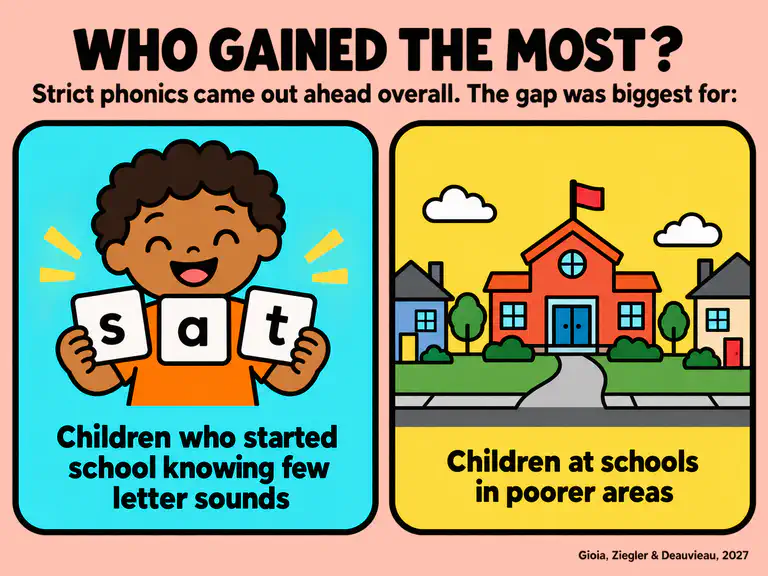
One comparison stood out to me. Holding everything else equal, the model estimated that children taught with strict phonics in a disadvantaged school read 28 words a minute in mid-Grade 1. Children taught with mixed phonics in an advantaged school read 26.
Why decodable text may help your child
This study was observational. Teachers weren’t randomly assigned to methods, so those using strict textbooks could differ in other ways. But teachers who chose a strict textbook themselves got the same results as teachers simply handed one, and adding teaching time to the model didn’t erase the advantage.
Why would it matter? The authors point to the self-teaching idea (Share, 1995). Each time a child sounds out a new word correctly, that word gets a little easier to recognize next time.
A book where every word can be sounded out gives children dozens of these practice runs, and one strategy that works on nearly every word. The authors say this explanation still needs testing.
French spelling is also more regular than English. The words French children memorized were mostly regular words taught before their letter sounds. English has truly irregular high-frequency words, like said and was, and this study can’t settle how best to teach those. So it challenges Castles and colleagues’ view on sight words without overturning it for English.
Still, evidence from England points the same way. After England rolled out synthetic phonics, average gains faded by age 11. But they lasted for children from low-income homes who spoke another language at home (Machin et al., 2018).
This is close to how Bookbot’s books work. They follow a phonics sequence, and the earliest levels are built almost entirely from CVC words (consonant-vowel-consonant words like dog and sit). Your child reads aloud while the app listens, and it tracks which sound-spelling patterns they’ve mastered.
Sight words vs phonics at home
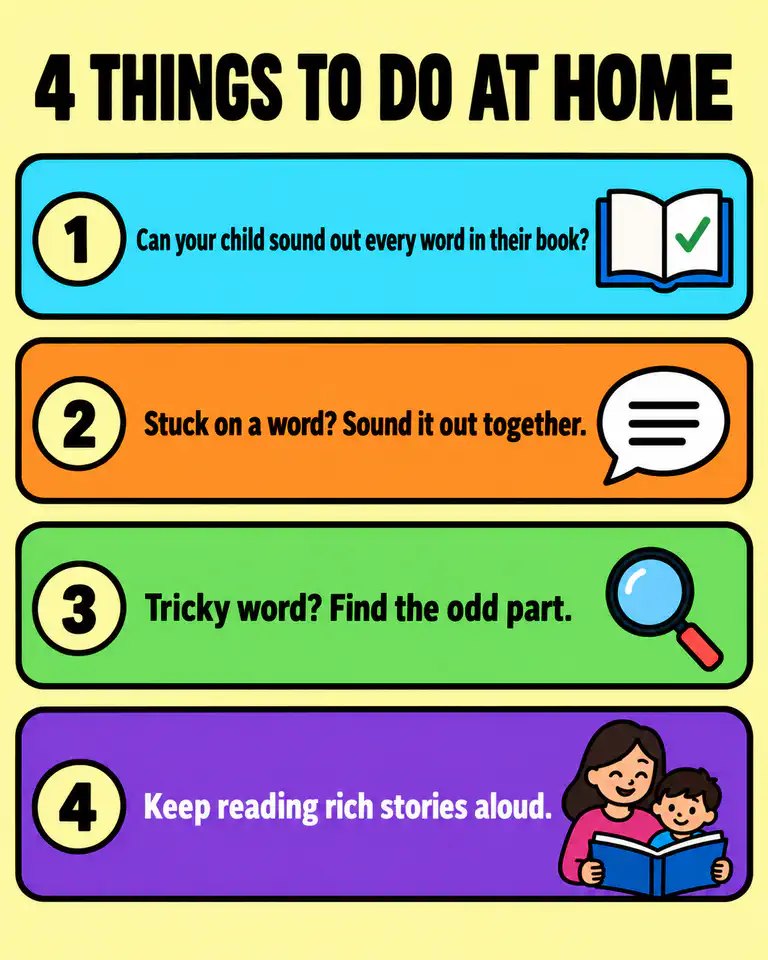
- Check whether your child can sound out the take-home book. Look for words with letter sounds they haven’t learned yet. The strict textbooks in the study kept that under 5% (Gioia et al., 2027). Our guide to decodable books explains more.
- Ask the school two questions. Are early readers matched to the phonics sequence? Are children memorizing words before learning their sounds?
- Help your child blend, not guess. When they get stuck, point to the letters and say the sounds together. England’s reading guidance says to avoid books that expect children to guess from pictures or the first letter (Department for Education, 2023).
- Treat high frequency words as sound puzzles, not shapes. In said, the s and d follow the rules and only the ai is unusual. Point out the regular parts and flag the odd one, as England’s guidance does (Department for Education, 2023). Some teachers call these heart words, because the odd part is learned by heart. This study didn’t test that, but children store words for instant reading by connecting their letters to sounds (Ehri, 2014).
- Play letter-sound games. Ask what sound dog starts with, and which letter makes it. In the authors’ earlier study of 810,328 French first graders, it was a key predictor of reading fluency a year later (Gioia et al., 2026).
- Keep reading richer books aloud to your child. Decodable text is for your child’s own practice. The stories you read to them build the vocabulary and understanding that make up the other half of reading (Castles et al., 2018).
- Don’t panic if the school uses a mixed approach. The gap was about four words a minute for a typical child, and an observational study can’t prove the method caused it.
What I take from this
For years, the argument was about whether to teach phonics at all. That argument is over. This study suggests the next question matters too: do children’s first books let them use what they’ve been taught?
The effect isn’t huge. But it was biggest for the children who can least afford to fall behind. So when I look at a child’s first reading book now, I ask one question. Can they sound out every word on this page?
References
Castles, A., Rastle, K., & Nation, K. (2018). Ending the reading wars: Reading acquisition from novice to expert. Psychological Science in the Public Interest, 19(1), 5–51. https://doi.org/10.1177/1529100618772271
Department for Education. (2023). The reading framework. https://www.gov.uk/government/publications/the-reading-framework-teaching-the-foundations-of-literacy
Ehri, L. C. (2014). Orthographic mapping in the acquisition of sight word reading, spelling memory, and vocabulary learning. Scientific Studies of Reading, 18(1), 5–21. https://doi.org/10.1080/10888438.2013.819356
Ehri, L. C., Nunes, S. R., Stahl, S. A., & Willows, D. M. (2001). Systematic phonics instruction helps students learn to read: Evidence from the National Reading Panel’s meta-analysis. Review of Educational Research, 71(3), 393–447. https://doi.org/10.3102/00346543071003393
Gioia, P., Ziegler, J. C., & Deauvieau, J. (2026). Beyond phonemic awareness: The alphabetic principle predicts reading acquisition in a nationwide longitudinal study. Cognition, 271, 106457. https://doi.org/10.1016/j.cognition.2026.106457
Gioia, P., Ziegler, J. C., & Deauvieau, J. (2027). Strict phonics instruction outperforms mixed phonics: Evidence from a large-scale study. Learning and Instruction, 107, 102463. https://doi.org/10.1016/j.learninstruc.2026.102463
Machin, S., McNally, S., & Viarengo, M. (2018). Changing how literacy is taught: Evidence on synthetic phonics. American Economic Journal: Economic Policy, 10(2), 217–241. https://doi.org/10.1257/pol.20160514
Share, D. L. (1995). Phonological recoding and self-teaching: Sine qua non of reading acquisition. Cognition, 55(2), 151–218. https://doi.org/10.1016/0010-0277(94)00645-2