



Somewhere this month, a six-year-old in Melbourne will come home and announce that her teacher asked her to read words like blan and strom. Words that are not words. Parents in Adelaide are hearing the same thing now, and parents across England had the conversation in June.
The reaction is always the same, and I hear it constantly: why is the school testing my child on nonsense?
I want to make the case that the nonsense is the best part. Those made-up words are the only section of the check that cannot be faked.
What the check actually is
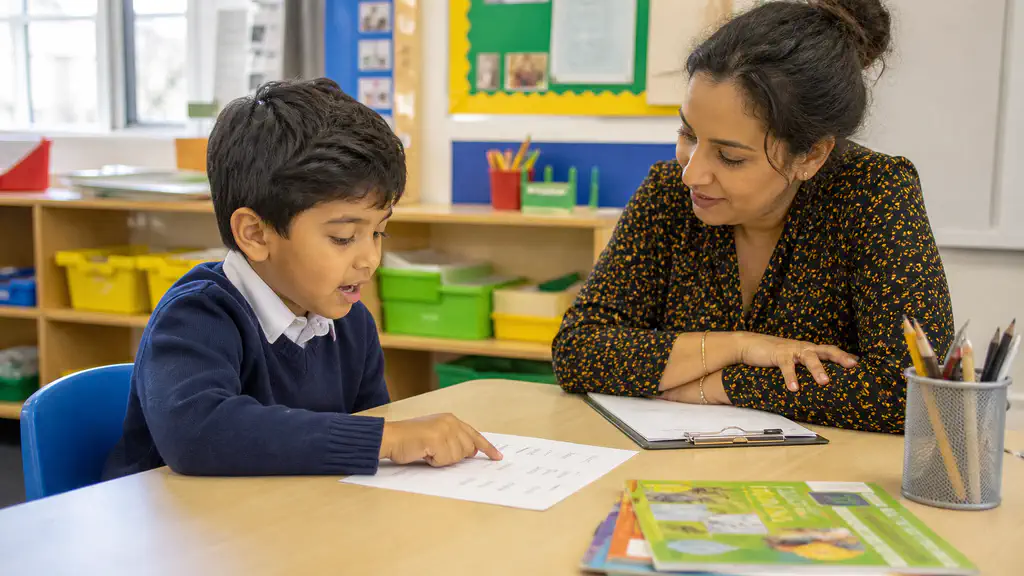
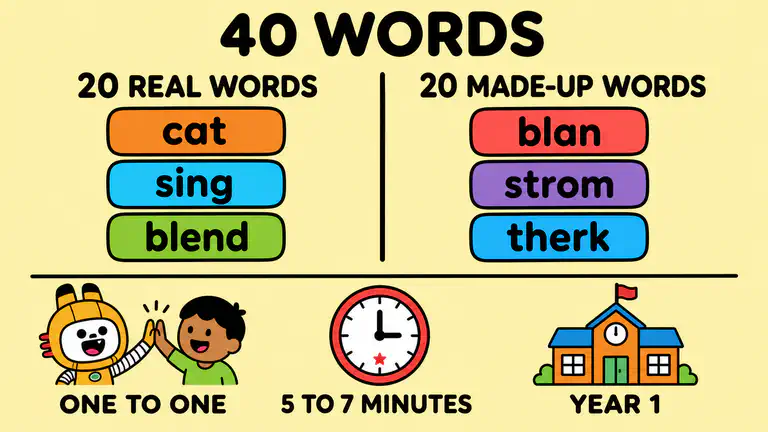
A child sits one to one with their teacher and reads 40 words aloud. Twenty are real. Twenty are pseudo-words, invented strings that follow English spelling patterns but mean nothing. The phonics screening check words are ordered simplest first and grow harder down the list. In Victoria, where it became mandatory this year and is sat in weeks four to six of Term 3, teachers report an average of 6.5 minutes per student.
You will see it called the phonics screening test, the year 1 phonics check, or just the phonics check, depending on where you live. Same instrument. England has run it every June since 2012, South Australia became the first Australian state to check every Year 1 student in 2018, and under the Better and Fairer Schools Agreement every state and territory is now rolling one out.
The pseudo-words are the clever bit. Teachers in England call them the alien words phonics screening materials are best known for, and children see a cartoon alien beside them so they know the word is meant to be unfamiliar.
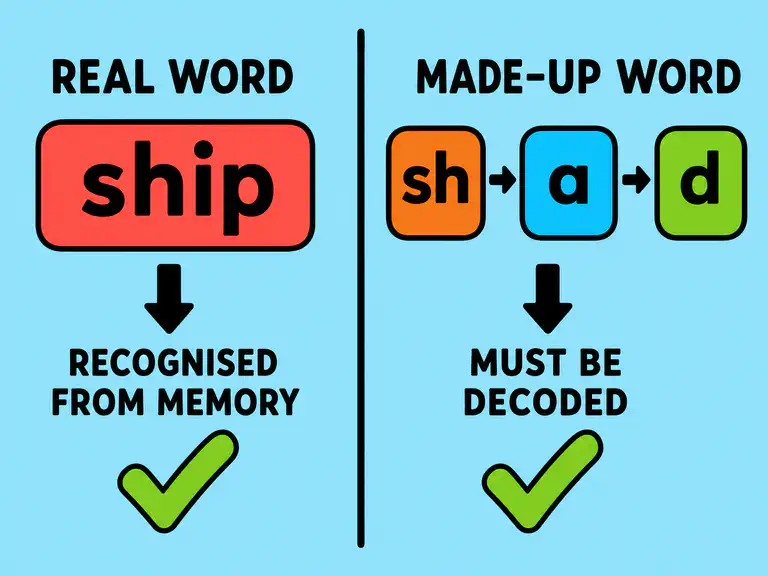
Castles, Rastle and Nation (2018) describe alphabetic decoding as mapping graphemes onto phonemes, which in plain terms means turning letters into sounds and blending them left to right. A word a child has seen a hundred times can be recognized whole, from memory, without any of that machinery running. An invented word cannot.
Duff, Mengoni, Bailey and Snowling (2015) checked whether this holds up. They gave standardized reading assessments to 292 six-year-olds in York and compared the results against their check scores. The check correlated at .75 to .83 with reading accuracy, meaning children who scored well on one scored well on the other. Against vocabulary and math, the correlation fell to .45.
So it measures decoding specifically, not general ability, and not how many books are in the house. It also finds the right children: it flagged 14 of the 16 whom standardized testing had identified as at risk.
At Bookbot I analyze recordings of children reading aloud, and our data shows the same split. A child can sound fluent on a familiar book and stall on an unfamiliar word built from letter patterns they supposedly know.
What the score means, and what it does not
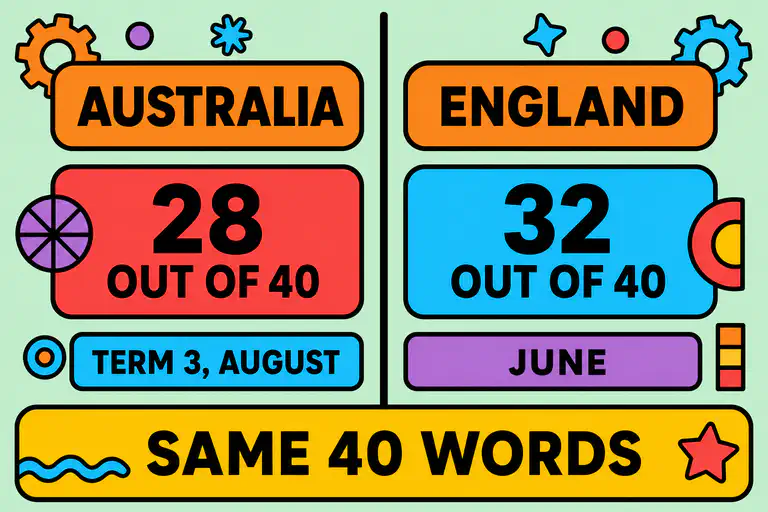
England anchors the expected standard at 32 out of 40. Most Australian states use 28 out of 40, set in 2018 when experts mapped the check words against the Australian Curriculum. The same child could clear the bar in Adelaide and miss it in Aberdeen, which tells you the number is a signpost rather than a verdict.
The results are less frightening than the headlines suggest. In England, 80% of Year 1 pupils met the standard in 2025, and 89% had met it by the end of Year 2 (Department for Education, 2025). In South Australia, 66% of the 11,350 students checked in 2025 reached 28 words, up from 43% when the state began in 2018 (South Australian Department for Education, 2025). In New South Wales, 60% of 62,413 Year 1 students met it in 2024 (NSW CESE, 2024).
Missing the mark the first time is genuinely not the end of the story. Double, McGrane, Stiff and Hopfenbeck (2019) tracked English children through Key Stage 1 and the international PIRLS reading study, roughly one and four years after their first check. Children who missed the standard and then met it on the retake read substantially better later than children who missed it twice, even after accounting for where they started. They did not entirely catch up. But the distance between “struggled, then got support” and “struggled, and did not” was large.
That is the finding I would want every parent to take away. The check is a snapshot of one morning. The year afterwards is what matters.
How to help at home
Most of what is published about the phonics screening check for parents explains policy rather than what to do on a Tuesday night.
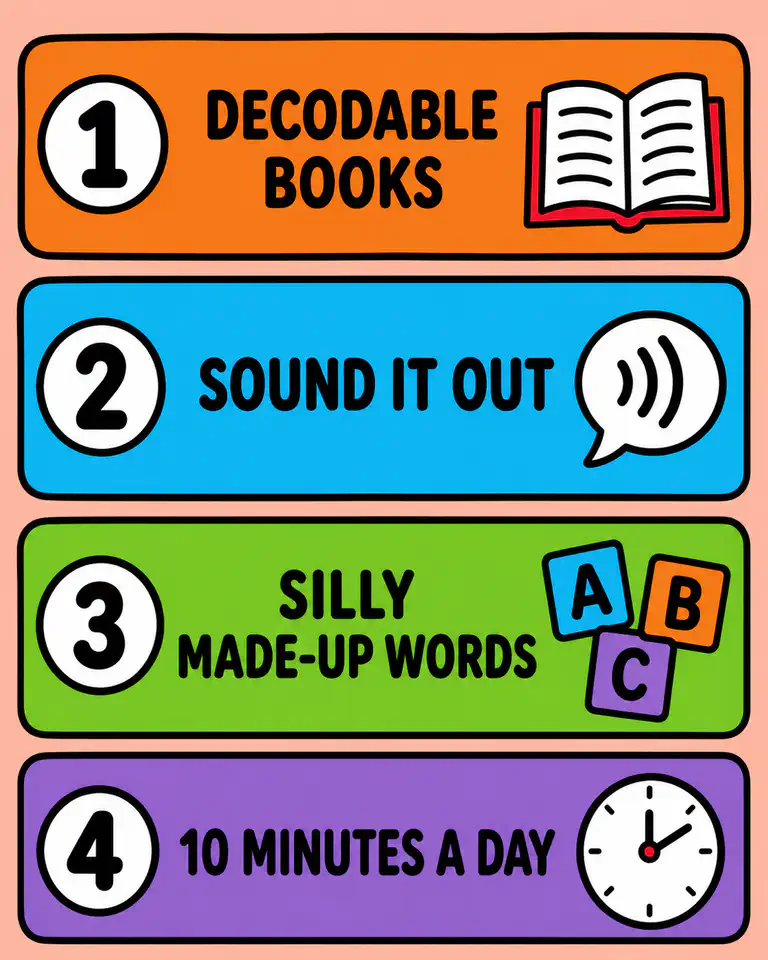
- Practice with decodable books, not leveled readers. Decodable books only use letter-sound patterns your child has already been taught, so every word is solvable by sounding out. Leveled readers often include words a child can only get by guessing from the picture, which trains the habit the check is designed to detect.
- Ask “what sounds can you see?” instead of supplying the word. When your child stalls, the instinct is to say it for them. Wait, point at the first letter group, and let them build it.
- Make up silly words together on purpose. Write chib, plound and therk on a scrap of paper and take turns reading them. Children find this funny rather than stressful, and it is exactly what the pseudo-word half measures.
- Ten minutes most days beats an hour on Sunday. Decoding is built through frequent short practice. It is one reason we built Bookbot around daily reading aloud with immediate feedback, so mistakes are corrected in the moment.
- Watch which sounds fail, not the total. If your child misses shreek, thrash and splog, the issue is consonant blends, not reading in general.
- Do not drill past papers, and do not call it a test. Practice papers train performance without building the skill underneath, and in England the threshold is not published until after the check has been sat, so there is nothing to cram for. Children who think they are being assessed read worse than children who think they are reading words to a grown-up.
If your child does not meet the standard
Roughly one in five children in England will not, and closer to one in three in most Australian states. In a class of 24, that is five to eight children. Your child is not an outlier, and the school is not surprised.
What should happen next is targeted teaching of the sounds your child missed, then a retake the following year. What should not happen is a change in how anyone talks about your child as a reader. The Grattan Institute (2024) estimated that about a third of Australian children cannot read proficiently, and that number is stubborn because of whether children get precise early support, not because of one morning in Term 3.
This is the work I care about at Bookbot: catching the gap while it is still six words wide, when it takes weeks to close instead of years.
So when your six-year-old comes home talking about blan and strom, tell them they did the hard part right. Reading a word nobody has read before is the whole trick.
References
Department for Education. (2025). Phonics screening check attainment, academic year 2024/25
Grattan Institute. (2024). The reading guarantee: How to give every child the best chance of success
South Australian Department for Education. (2025). 2025 phonics screening check summary