




Most parents of early readers get handed the same instruction. Find books at your child’s level. Not too hard, not too easy. Just right.
It is sensible advice, and I am not about to tell you to ignore it. But when I went looking for the evidence underneath it, I found something I did not expect: the rule is far less settled than the confidence with which it gets repeated. And our focus on it can quietly crowd out a second question that matters at least as much.
Here is the number that sent me looking. Among 9 year olds in the United States, the share who read for fun almost every day has fallen from 49% of boys and 58% of girls in 1984 to 37% and 42% in 2022. Over the same period, the share who say they never or hardly ever read for fun has roughly doubled (NCES, 2022).
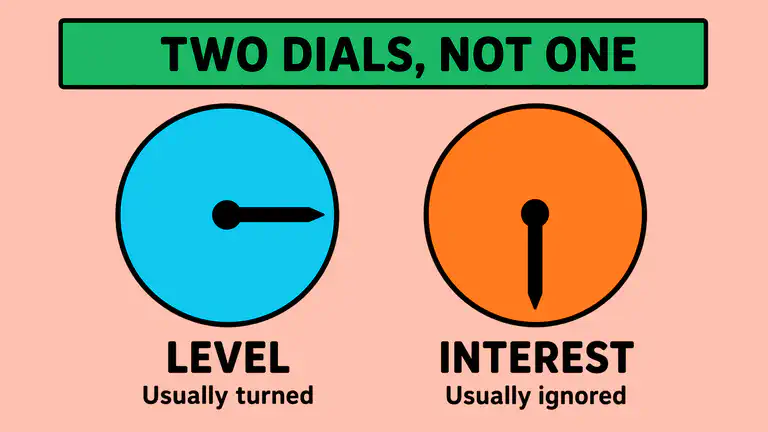
The international picture rhymes. PIRLS 2021, which surveyed fourth graders across 57 countries, found that only 42% say they very much like reading. The children who said they do not like reading averaged 491 on the reading scale, against 513 for those who like it very much (Mullis et al., 2023).
So the question is not only whether your child can read the book in their hands. It is whether they will open it at all.
Where “just right” actually comes from
The familiar benchmark is 95% accuracy, or about one unknown word in twenty. Below roughly 90%, a book is considered too hard. That framework traces back to Emmett Betts in 1946, and nearly every leveling system in use today is built on some version of it (Amendum et al., 2018).
The five finger rule is the kitchen table edition of the same idea. Read a page, put up a finger for each word you cannot read, and if you run out of fingers, put the book back.
What surprises most parents is that there is no universal system sitting behind the numbers on the spine. A level 5 from one publisher can sit several steps away from a level 5 from another, because each company builds its own scope and sequence. My colleague Jenni has written about this in The Confusion of Levels, and it is worth reading before you put much faith in any single number.
There is a related distinction worth knowing. Decodable books are written so nearly every word can be sounded out with patterns the child has already been taught. Leveled readers are graded on broader features like sentence length and picture support, which means they can contain words a beginner has no route into. A meta-analysis by Murphy Odo (2024), meaning a study that pools the results of many studies, found decodable texts gave beginners a small boost in word reading and decoding. The author is candid that most of the underlying studies carried moderate to serious risk of bias.
The evidence is softer than the rule sounds
Start with the case in favor. Amendum, Conradi, and Hiebert (2018) reviewed 26 studies of text difficulty in the elementary grades. On average, harder text was linked to lower reading fluency and lower comprehension, with only a small number of exceptions.
That is a real finding and it makes intuitive sense. Hand a child a book well beyond them and they will read it worse, understand less, and probably enjoy it less.
Then there is the study that complicates things.
O’Connor, Swanson, and Geraghty (2010) ran a randomized controlled trial, which means children were assigned to groups by chance so the groups can be fairly compared. They worked with 123 struggling readers in Grades 2 and 4 over 20 weeks. One group read text at their independent level, 92% to 100% word accuracy. A second group read deliberately harder text, 80% to 90% accuracy, which is well into what most guidance would call too difficult. A third group carried on as usual.
Both reading groups beat the control group on reading rate, word recognition, and comprehension. But between the two difficulty levels, the researchers found no significant difference in growth. None.
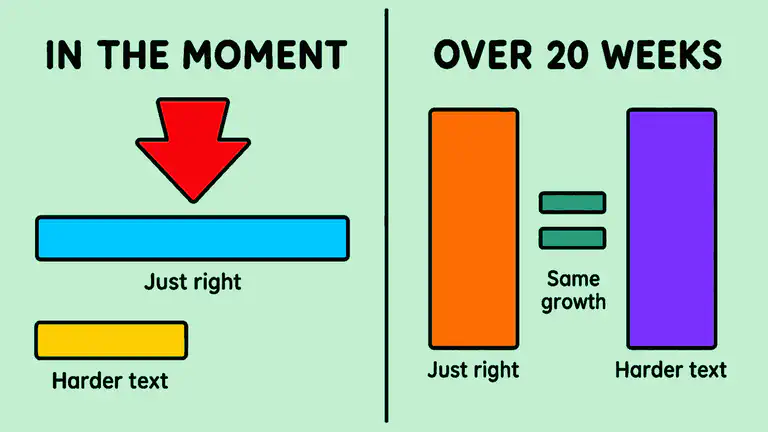
The distinction that resolves this is between performance and growth. Harder text does make reading harder right now, exactly as Amendum and colleagues found. What O’Connor’s trial suggests is that over 20 weeks, it did not slow children down, provided an adult was sitting beside them helping with the words they could not get.
I want to be careful here, because this is genuinely contested ground rather than a settled result. Amendum and colleagues describe the research base on instructional level matching as unclear at best. The honest summary is this: the level of the book matters less than the presence of someone to help with it.
The dial most of us never touch
If level is one dial, choice is the other, and it is the one that tends to go untouched.
Patall, Cooper, and Robinson (2008) pooled 41 experiments on the effects of giving people a choice. Choice raised intrinsic motivation, meaning wanting to do something for its own sake, with an effect size of d = 0.30. An effect size is a way of expressing how big a difference is, and 0.30 is a modest but real shift. Perceived competence, how capable people felt, moved more at d = 0.59. The effect was stronger for children than adults.
Then there is a study I keep coming back to.
Fridkin and Hurry (2025) worked with 110 children aged 8 and 9. Each child was offered two envelopes with different covers, different titles, and different opening pages, and invited to pick one. What the children did not know was that the story inside both envelopes was identical.
The children who chose scored measurably higher on comprehension, at d = 0.52. That is a substantial difference, and it came from a choice that was not real. Same story, same words, same page count. The only thing that changed was whether the child felt they had picked it.
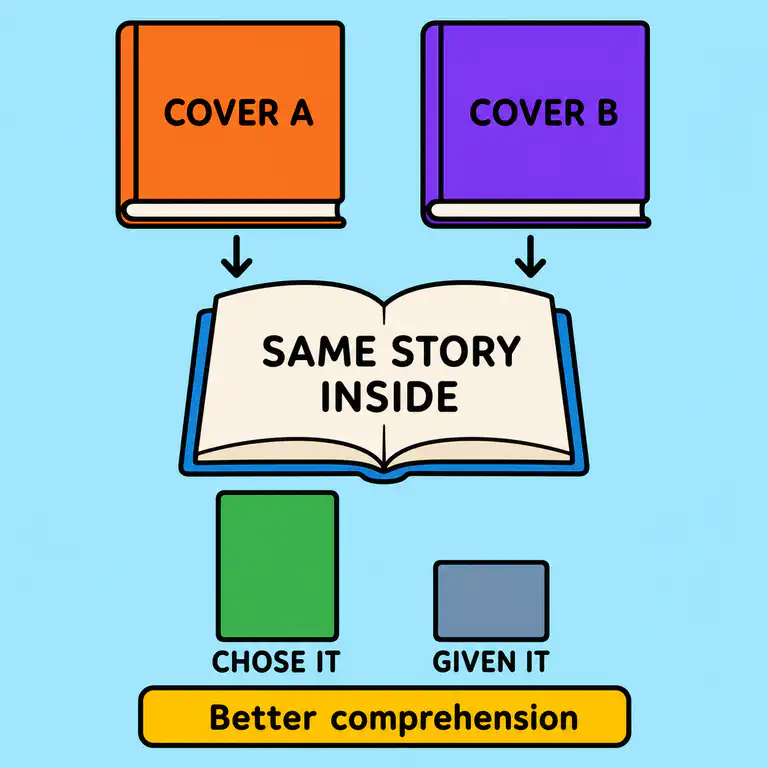
I find that slightly humbling. We spend a great deal of energy getting the level right and comparatively little on whether the child had any say.
Interest is the entry point, not the reward
We tend to treat interest as something that arrives after a child becomes a good reader. The evidence points the other way.
Van der Sande and colleagues (2023) pooled 39 studies of programs designed to build reading motivation. The programs improved motivation with an effect size of d = 0.38 and, importantly, improved reading comprehension at d = 0.27. When the researchers looked at which ingredient did the most work, interventions that set out to trigger the child’s interest produced the largest effects on both motivation and comprehension. The benefits were larger for primary school children than secondary.
The authors do flag that they found signs of publication bias on the comprehension result, meaning studies with positive findings may be more likely to get published. When they corrected for it, the estimate went up rather than down.
This is the part that reframes the bookshelf. Interest is not a nice extra once decoding is solid. It is closer to a precondition for the motivation to arise at all.
Why reading volume is the thing that compounds
None of this matters much unless it translates into a child actually reading more.
Mol and Bus (2011) pooled 99 studies covering 7,669 people to look at print exposure, which is simply how much reading a person does. Across Grades 1 to 12, print exposure correlated with reading comprehension at r = .36, meaning about 13% of the differences between children in comprehension track with how much they read. The relationship strengthened with every stage of schooling. Crucially, they found that weaker readers benefited from independent reading too, which is not always assumed.
I should be straight about the direction of causation, because it is easy to overclaim. Toste and colleagues (2020) pooled 132 studies and found motivation and reading achievement correlate at r = .22. But their longitudinal analysis found that earlier reading skill predicted later motivation more strongly than motivation predicted later skill.
That cuts against a simple story where you motivate a child and the reading follows. Skill feeds confidence, confidence feeds willingness, willingness feeds volume, and volume feeds skill. Both dials turn the same wheel.
At Bookbot, I analyze reading data from thousands of children, and O’Connor’s finding is the one that maps most directly onto what we build. Their result was not that difficulty is irrelevant. It was that difficulty stopped mattering when someone was there to help with the hard words. That kind of support is exactly what is hardest to supply at home every single night, which is why Bookbot uses speech recognition to listen as a child reads aloud and offer help at the moment they stall.
What this means at the bookshelf
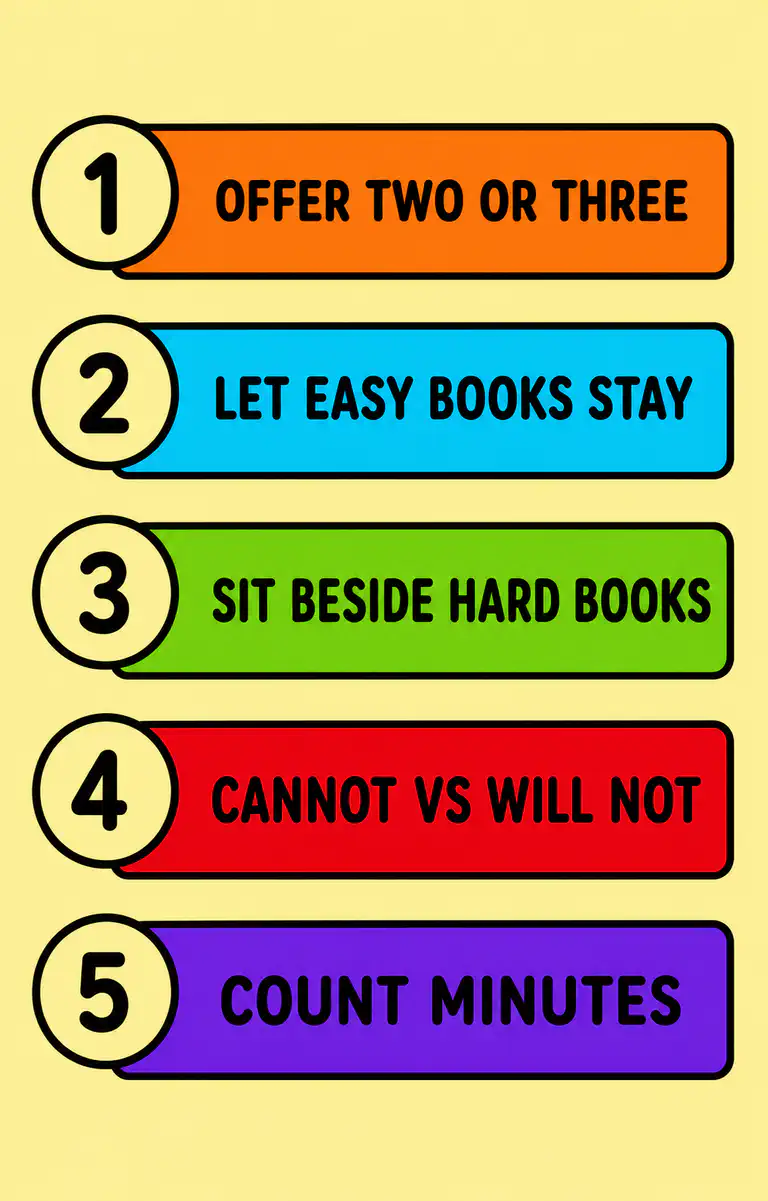
Offer a choice of two or three, not the whole shelf. Fridkin and Hurry’s result suggests the feeling of choosing does real work. Pick a few books you are happy with, then let your child choose between them.
Stop vetoing the easy book. Rereading a book well below level builds fluency and, more to the point, it is often the book a child actually wants. Mol and Bus found the volume itself carries value.
Sit beside the hard book rather than removing it. If your child is set on something ambitious, the trial evidence suggests that is workable when you are there to help. Read alternate pages, or take the tricky words yourself.
Separate cannot from will not. A child stumbling over individual words needs decoding support. A child who reads a page cleanly then avoids books needs something else entirely. The fix is different in each case.
Count minutes, not levels. Levels are a tool for choosing the next book, not a scoreboard.
My own view, after going through these studies, is that the just right rule is a reasonable default that we have quietly promoted into a law. It is a useful starting point for narrowing a shelf. It is not a fence.
The child who reads a slightly-too-hard book about sharks with you on a Tuesday night is doing better than the child who reads nothing at exactly the right level.
References
Amendum, S. J., Conradi, K., & Hiebert, E. (2018). Does text complexity matter in the elementary grades? A research synthesis of text difficulty and elementary students’ reading fluency and comprehension. Educational Psychology Review, 30(1), 121-151. https://doi.org/10.1007/s10648-017-9398-2
Fridkin, L., & Hurry, J. (2025). The effects of manipulating choice on children’s enjoyment and performance in a reading task. Current Psychology, 44(8), 6786-6797. https://doi.org/10.1007/s12144-025-07685-3
Mol, S. E., & Bus, A. G. (2011). To read or not to read: A meta-analysis of print exposure from infancy to early adulthood. Psychological Bulletin, 137(2), 267-296. https://doi.org/10.1037/a0021890
Mullis, I. V. S., von Davier, M., Foy, P., Fishbein, B., Reynolds, K. A., & Wry, E. (2023). PIRLS 2021 international results in reading. IEA / TIMSS & PIRLS International Study Center, Boston College. https://pirls2021.org/results/context-student/like-reading/
Murphy Odo, D. (2024). The use of decodable texts in the teaching of reading in children without reading disabilities: A meta-analysis. Literacy, 58(3), 267-277. https://doi.org/10.1111/lit.12368
National Center for Education Statistics. (2022). NAEP long-term trend assessment: Reading, student experiences, age 9. U.S. Department of Education. https://www.nationsreportcard.gov/ltt/reading/student-experiences/?age=9
O’Connor, R. E., Swanson, H. L., & Geraghty, C. (2010). Improvement in reading rate under independent and difficult text levels: Influences on word and comprehension skills. Journal of Educational Psychology, 102(1), 1-19. https://doi.org/10.1037/a0017488
Patall, E. A., Cooper, H., & Robinson, J. C. (2008). The effects of choice on intrinsic motivation and related outcomes: A meta-analysis of research findings. Psychological Bulletin, 134(2), 270-300. https://doi.org/10.1037/0033-2909.134.2.270
Toste, J. R., Didion, L., Peng, P., Filderman, M. J., & McClelland, A. M. (2020). A meta-analytic review of the relations between motivation and reading achievement for K-12 students. Review of Educational Research, 90(3), 420-456. https://doi.org/10.3102/0034654320919352
van der Sande, L., van Steensel, R., Fikrat-Wevers, S., & Arends, L. (2023). Effectiveness of interventions that foster reading motivation: A meta-analysis. Educational Psychology Review, 35, Article 21. https://doi.org/10.1007/s10648-023-09719-3