


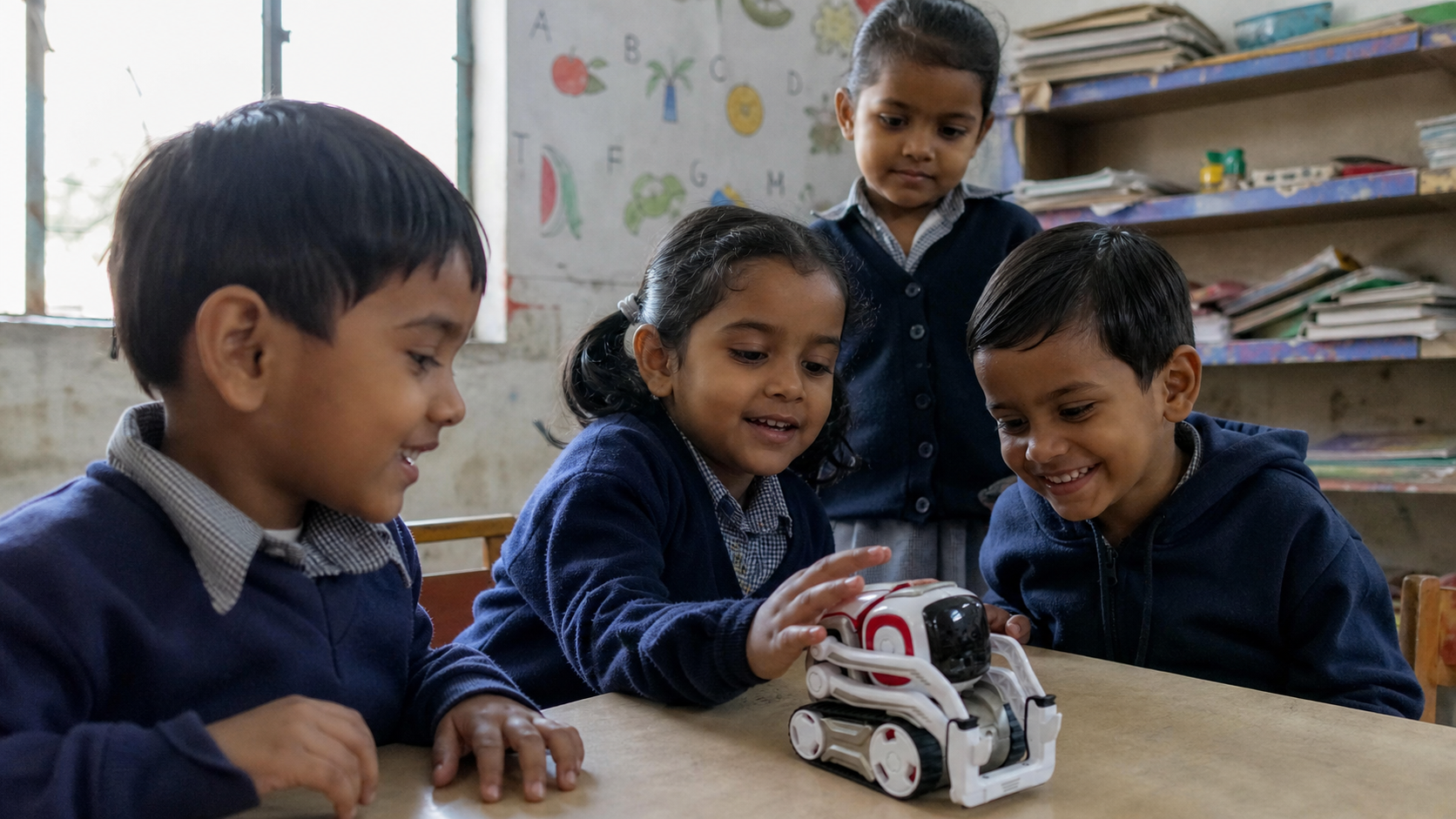

Most parents have had the thought, usually somewhere around the third bedtime book of the night: wouldn’t it be wonderful if something could just teach my child to read for me? The idea of a patient little robot tutor, never tired, never frustrated, sounding out letters until they stick, is genuinely appealing.
A team of researchers in India decided to find out what actually happens when you try it. For five weeks, they placed a small social robot in a kindergarten classroom and let it teach children the alphabet. The results, published in the International Journal of Social Robotics (Singh et al., 2023), are not what the marketing brochures would have you expect, and that is exactly why they are so useful.
This study is one of the most honest things I have read about putting a “robot teacher” in front of real children. Here is what it found, and what it means if you are weighing up an AI reading tool for your own child.
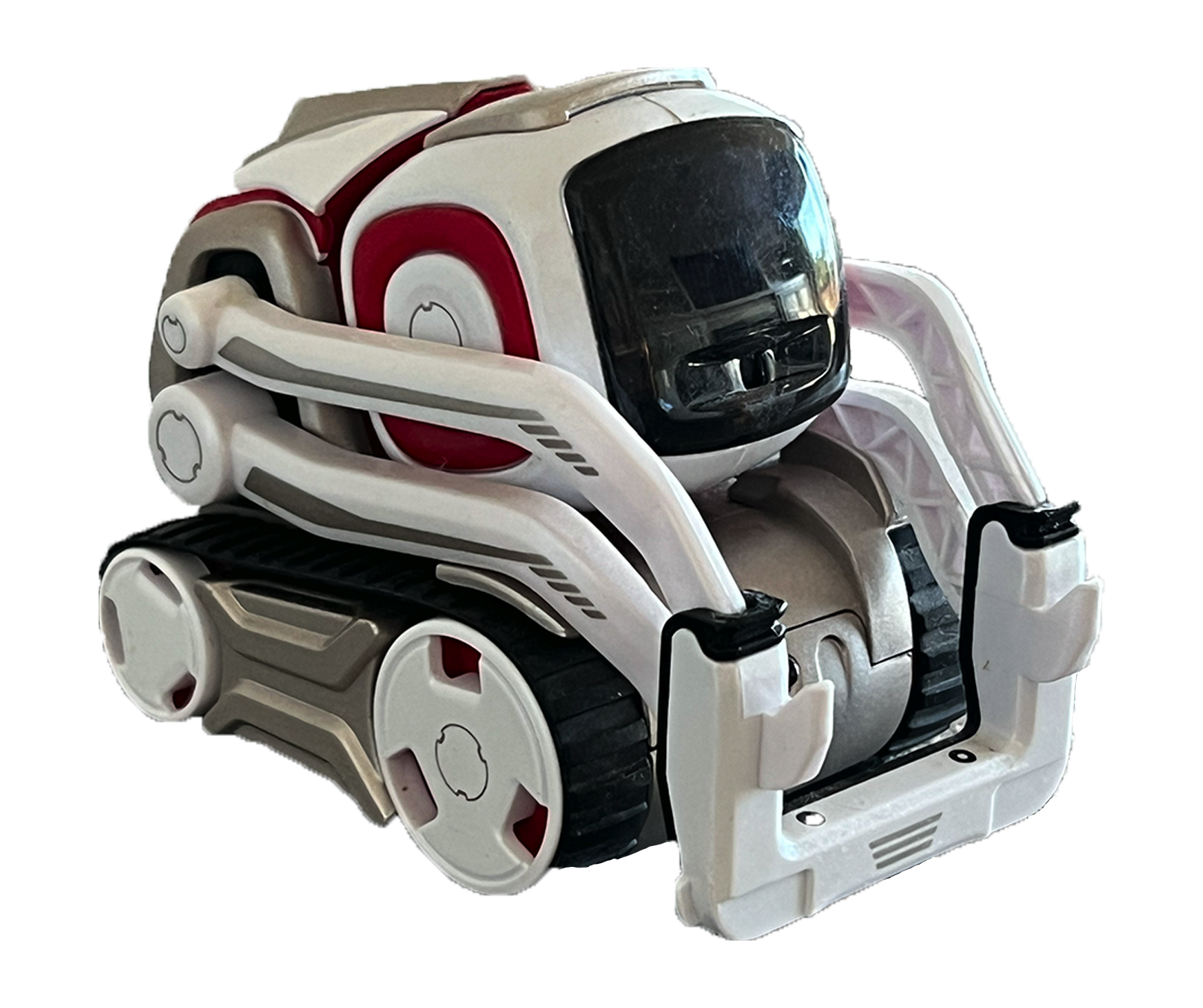
Cozmo, the small social robot used in the study. Photo: DecafPotato, CC BY-SA 4.0.

What the study actually tested
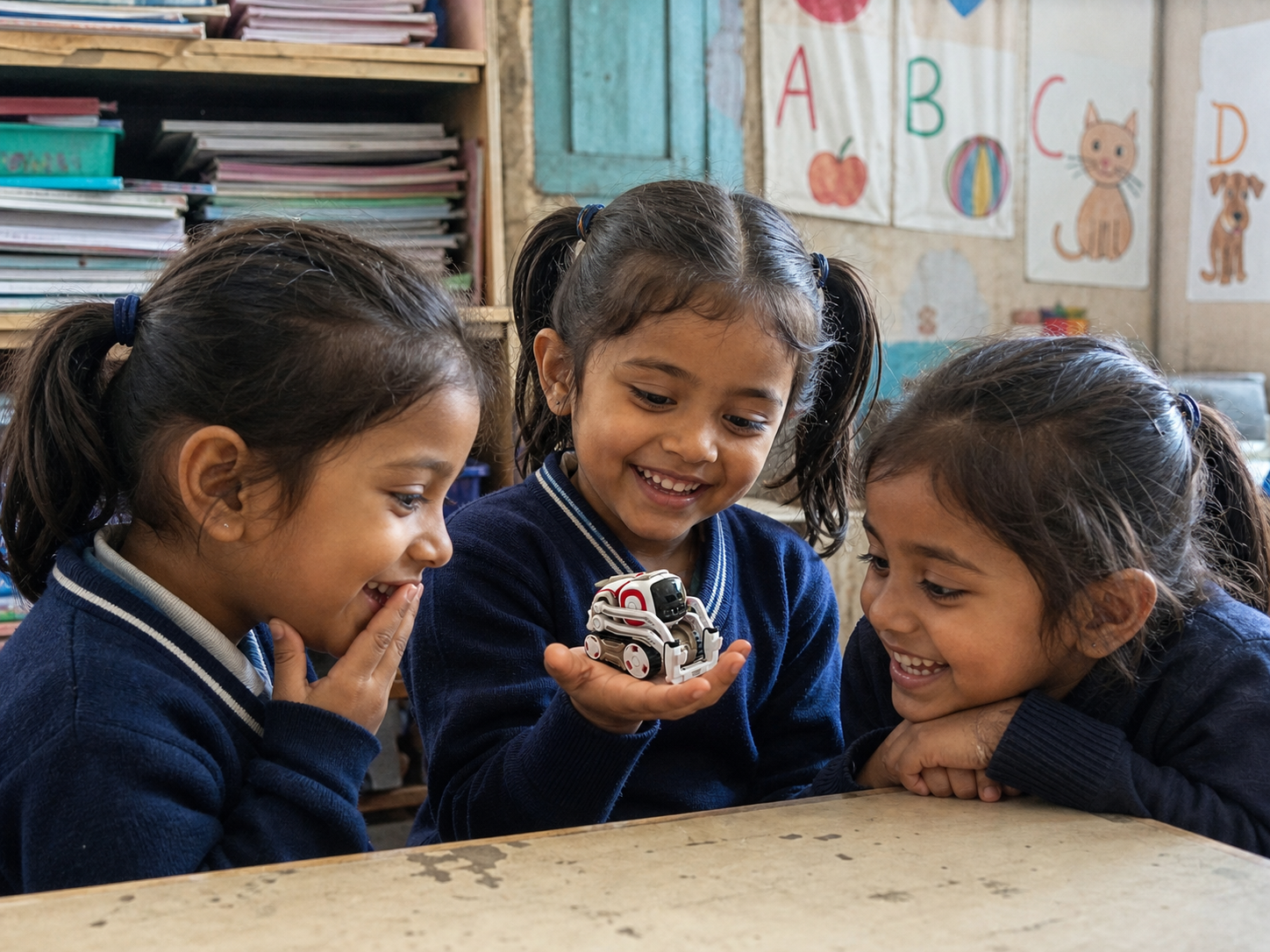
The researchers worked with 12 kindergarten children, average age about five, at an under-resourced community school in New Delhi. The robot was a small commercial model called Cozmo, which the children nicknamed “Raju.” Its job was to help the children learn the English alphabet, with English being a second language for them; their first language was Hindi.
The clever part was the teaching method. Rather than having the robot lecture the children, the researchers used a “learning by teaching” approach: the children took turns teaching the alphabet to Raju. Explaining something to someone else, even a robot, is one of the most effective ways to learn it yourself.
It is a thoughtful, well-designed study. But across five weeks, four problems surfaced, and each one carries a lesson for parents far beyond that one classroom.
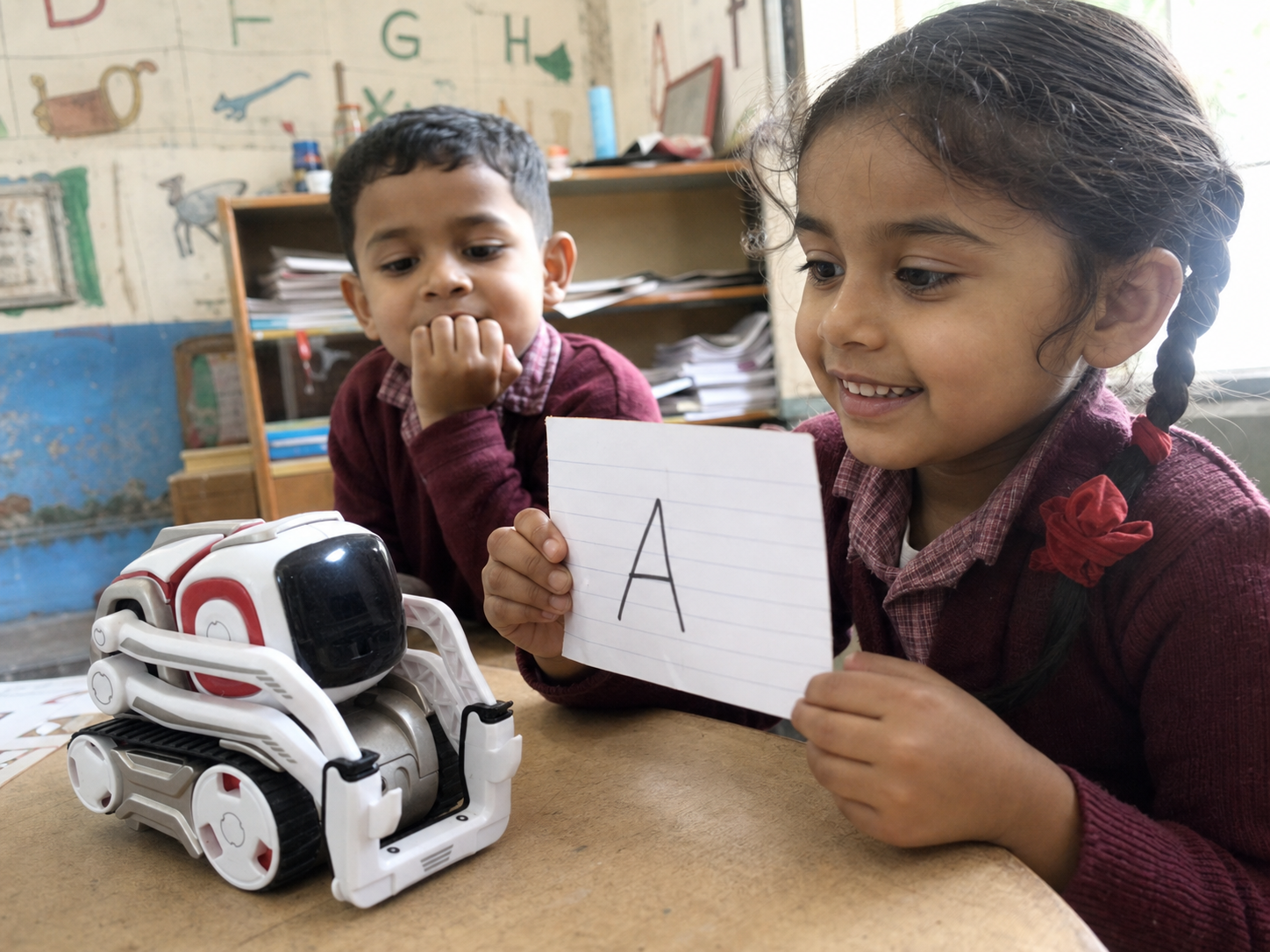
Lesson 1: A tutor’s voice has to fit your child
The first and most persistent problem was the robot’s accent. Cozmo was built in the United States and spoke with a “Westernized” English pronunciation. The children, who spoke Hindi at home, kept mishearing it.
When a child held up the letter “P,” the robot would say “P,” but to the children it sounded more like “T.” They would look to the adult in the room to check what the robot had actually said. The researchers watched children mix up P and B, S and H, M and N, over and over, not because the children were struggling with letters, but because the voice teaching them did not match the sounds they knew.
The researchers called this a “context gap,” and it matters more than it might sound. When a young child cannot connect the sound they hear to the sound they make, the seamless link between listening and speaking breaks. Worse, children tend to assume they are the ones getting it wrong. A mismatched accent does not just slow learning down; it can quietly chip away at a child’s confidence.
The takeaway for parents is simple: the voice doing the teaching needs to fit your child. An early reader, and especially a child learning English as an additional language, needs a tool that sounds familiar and, ideally, one that listens to how they speak and responds to it, rather than expecting the child to decode an unfamiliar accent first.
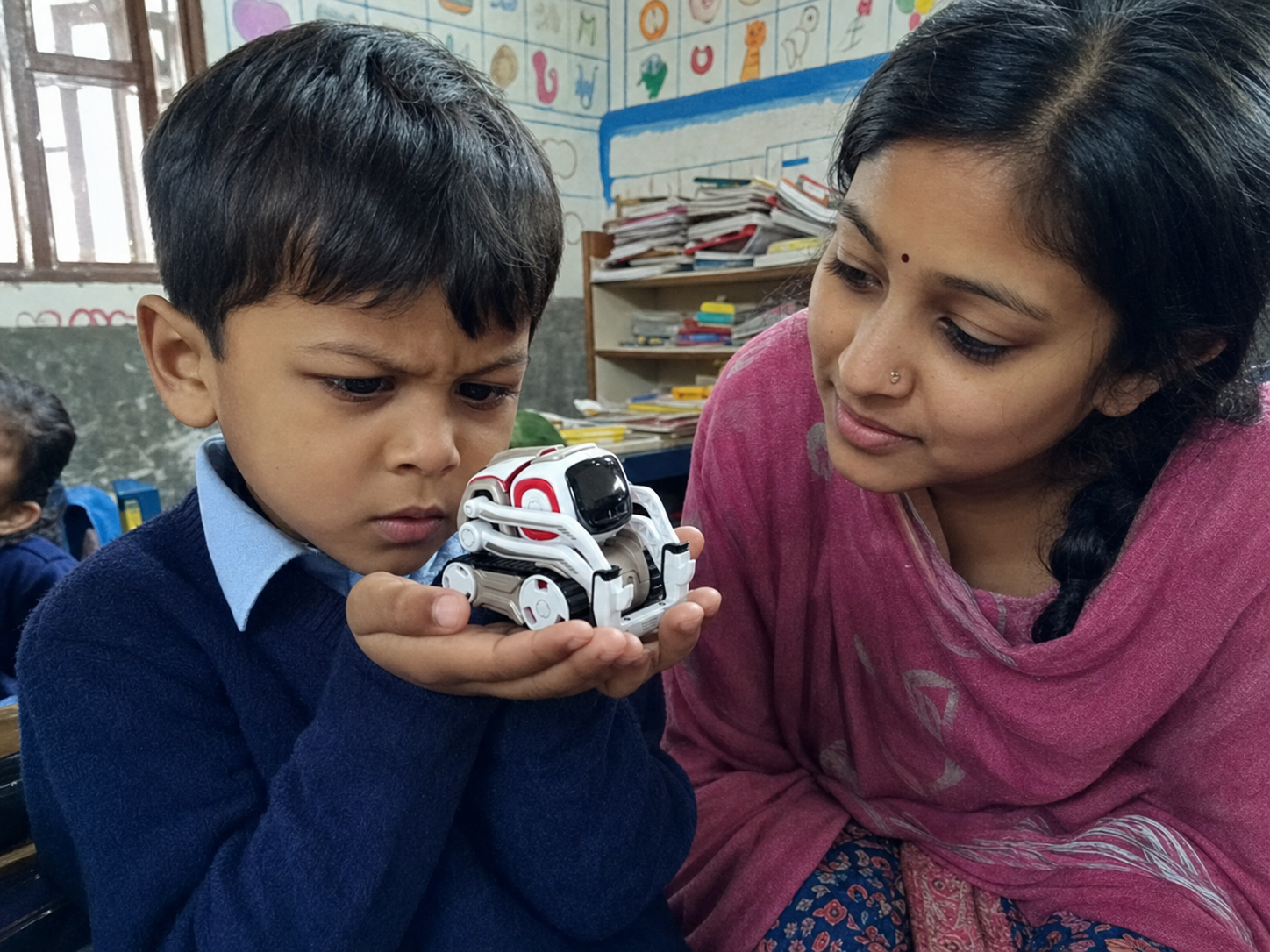
Lesson 2: Children believe what the tool tells them
Here is the finding that I think every parent should sit with. Because the school’s internet was too poor and the robot could not run on its own, a researcher quietly controlled Raju from the same room, a common research method called “Wizard of Oz.” For the first week, the children responded to Raju as if it were alive and thinking for itself.
By the second week, one boy worked it out. “You are controlling it!” he said. The researchers tried to reassure him, holding their hands up to show they were not touching anything, but he was not convinced, and two other children echoed his doubt. One of them briefly withdrew from the activity altogether. They felt, in a small way, deceived.
This taps into something researchers have documented repeatedly: young children extend a remarkable amount of trust to robots and AI. In one striking experiment, children aged seven to nine went along with a group of robots’ answers even when those answers were obviously wrong, agreeing with about three out of four incorrect responses (Vollmer et al., 2018). A meta-analysis of children’s trust in social robots found the same broad pattern: children readily treat these machines as credible social partners (Stower et al., 2021).
That trust is precisely why the design of these tools carries such responsibility. A child who believes their reading tool is a kind, all-knowing friend will absorb whatever it tells them, mistakes included. As a parent, the practical move is to stay involved: use these tools with your child, not instead of yourself, and keep checking that the feedback your child is receiving is actually correct.
Lesson 3: What happens when it breaks
Real technology fails, and young children notice. Throughout the study, Cozmo’s battery drained and its Bluetooth dropped out. When it did, the robot would yawn, make snoring sounds, and show sleepy eyes. The children decided that Raju had simply gotten tired: “Cozmo is tired, and he went to sleep,” one said. Sweet, but also a sign of how readily they filled in a human story for a machine.
On one occasion it was less sweet. The robot lost control and dashed across the table toward the children, and the adult had to lunge to catch it before it hit anyone. The children were briefly shocked, though they recovered quickly and went back to the activity.
No one was hurt, and that is not really the point. The point is that when we hand young children a piece of technology to learn from, we are responsible for what happens emotionally as well as physically when it glitches, freezes, or behaves unexpectedly. The younger the child, the more an adult needs to be close by, ready to steady things when the tool inevitably stumbles.
Lesson 4: The best tool is one your family can actually use
The final lesson is the quietest and, in some ways, the most important. The children adored Raju. One boy kept asking the researcher, “Brother, can you make a robot for me? How much does it cost?”
But this was a school where some families could barely afford the roughly two dollars a month in fees, and where children sometimes stayed home at the end of the month because that was when fees were due. A personal robot tutor was never going to be a realistic option. The researchers make a sobering point: technology that excites children but lies completely out of their reach can deepen the very inequalities it promises to solve.
For families, this reframes what “the best” reading tool even means. The most effective tool is not the most advanced or the most expensive. It is the one your child can actually use, consistently, in your real living room, on a device you already own.
So, can a robot teach your child to read?
It would be easy to read all this as “technology doesn’t work,” but that is the wrong conclusion, and the research does not support it. The same field has produced genuinely encouraging results. That major Science Robotics review found social robots can deliver learning gains approaching those of one-on-one human tutoring on focused tasks, largely because their physical presence engages children in a way a flat screen does not (Belpaeme et al., 2018). Even the children teaching Raju showed real curiosity and engagement once the activity got going.
The honest answer is this: a robot, or an app, can absolutely help your child learn to read, but it is not the technology that decides whether it works. It is the design. The tools that help are the ones built around how children actually learn: they speak in a voice the child understands, they give reliable feedback the moment it is needed, they are clear about what they are, and they fit naturally into a child’s day.
This is the philosophy we built Bookbot around. When I look at reading data from thousands of children using the app, the pattern is consistent: children who get to read aloud and receive immediate, private feedback, without the pressure of an audience, build confidence right alongside their skills. The app is not pretending to be a teacher. It is a practice tool that lets a child get the repetitions they need, the way a sports coach lets a young player take a hundred shots at goal.
The dream of a robot that teaches your child to read while you put your feet up is, for now, still a dream, and honestly, that is no bad thing. But a well-designed AI reading tool, used alongside you, can give your child something genuinely valuable: the chance to practice, to stumble privately, and to build the quiet confidence that turns a struggling reader into a willing one.
References