




A teenager’s school report is usually read as a verdict on the past year. A new study from Norway suggests it may also say something about the next twenty.
We have written before about how reading struggles affect a child’s mental health during the school years. This piece takes the long view. It follows almost every Norwegian teenager from their final grades at 16 to their family doctor’s records at up to age 39.
The finding that stayed with me is not that low grades carry risk. It is that a comfortable family background did not make that risk go away.
What the Norwegian data shows
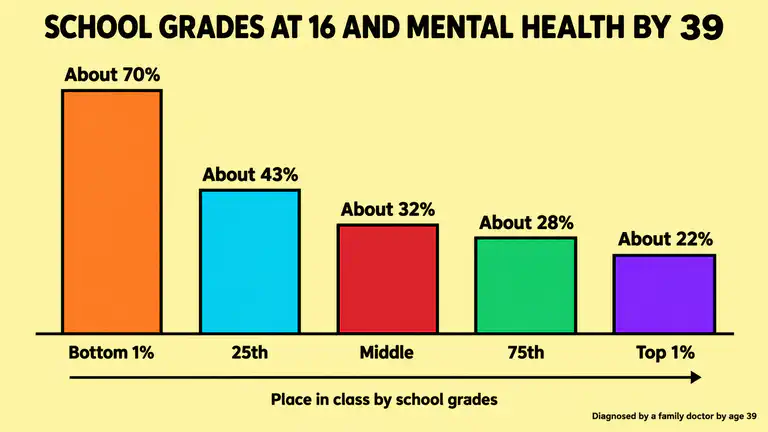
Magnus Nordmo, Monica Melby-Lervåg and Fartein Ask Torvik (2026) linked the grade point average of 921,761 Norwegians born between 1986 and 2000, taken at the end of compulsory school around age 16, to primary care records up to 2024. A diagnosis here means a family doctor recorded a mental health condition, most often anxiety or depression.
This is a preprint, which means it is not yet peer reviewed. I am using it because of its size and because it measures the whole population rather than a sample, but its numbers could still change.
The relationship between mental health and academic performance ran across the whole range of grades, not just at the bottom. Reading from the authors’ Figure 2, about 70% of teens in the lowest 1% of grades had a diagnosis by 39, compared with about 32% for the student in the exact middle and about 22% in the top 1%. In the authors’ own words, “more than half of the adolescents in the bottom percentiles eventually develop a mental disorder.”
Finland shows the same link between academic achievement and mental health. Weckström and colleagues (2023) followed 1,070,880 Finns and found that the lowest achievers, two standard deviations below average (roughly the bottom 2%), had about 2.45 times the risk of a later mental disorder diagnosis in specialist care. Adjusting for parental income, education and mental health changed that estimate only slightly.
Family background still matters, but it does not protect
Family background is not irrelevant to grades. Sandsør and colleagues (2023) found that even in egalitarian Norway, gaps in achievement by parental income and education are equivalent to about 2 to 2.5 years of schooling.
The Nordmo team then asked a sharper question. If you already know a teenager’s grades, does knowing their family background tell you anything more about their risk?
Mostly, no. Teens in the lowest quarter of grades were diagnosed at more than twice the rate of the top quarter, and that stayed true once the researchers took family income and parents’ education into account. Parents’ education stopped predicting anything at all once grades were known. Family income still mattered a little on its own.
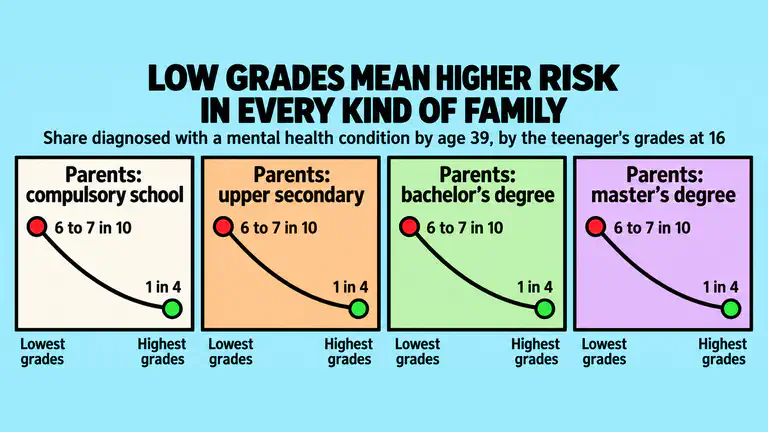
The chart I keep returning to is their Figure 3. Split the data by how far the parents went in education, and the pattern is the same in every group. Roughly six to seven in ten of the lowest achievers had a diagnosis by 39, and roughly one in four of the highest achievers, whether their parents left school at 16 or held a master’s degree.
What this means for your child
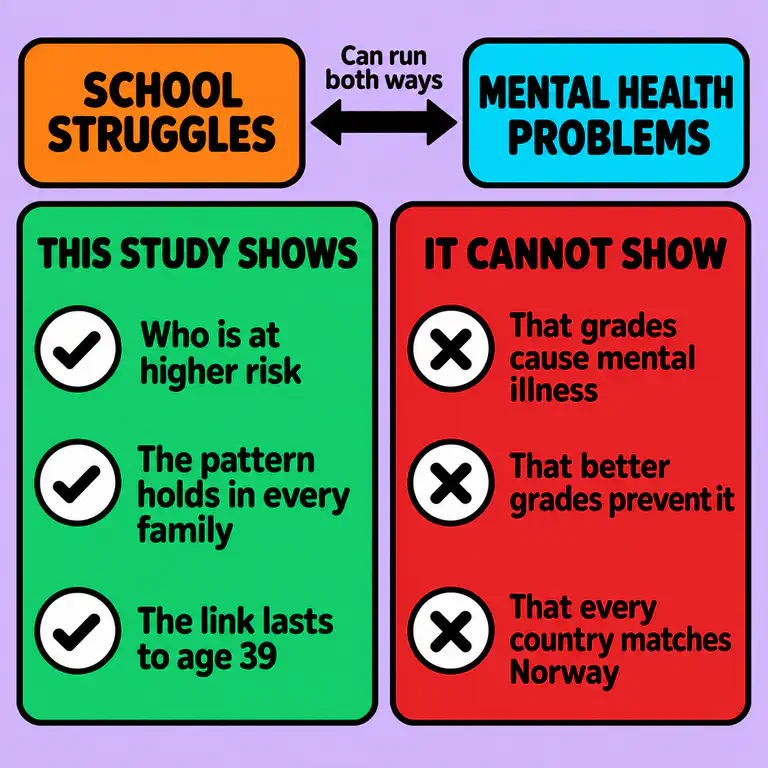
A grade point average at 16 is not reading at 6. This study says nothing directly about early reading, and nobody here tested whether reading support changes later mental health. What it does show is who is at higher risk.
There are three honest limits. The link is correlational, so it cannot show that low grades cause mental illness. The authors themselves flag reverse causation: early mental health problems can drag grades down. And Norway has little school streaming, rare private tutoring and universal welfare, so the pattern may differ elsewhere.
Earlier research points the same way. Donolato and colleagues (2022) pooled 50 studies of learning difficulties and mental health, covering 3,359 children with language or learning disorders, and found more internalising problems (worry, sadness, withdrawal) than in classmates, a gap of about a third of a standard deviation. A standard deviation measures how spread out scores are, so that is a modest but real difference.
Language is the foundation reading is built on, and it shows the same long shadow. Hagen and colleagues (2026) ran a Cochrane systematic review, meaning they gathered every eligible study on one question, of children identified with low language skills between ages four and eight. At age 12 or older, their psychological outcomes were about half a standard deviation poorer, rated moderate certainty.
What parents and teachers can take from this
- Treat low grades as a reason to ask, not a verdict. Most low achievement students in the Norwegian data had no diagnosis during the study. The grades flag higher risk across a group, not a fate.
- Do not assume advantage protects. Low grades carried the same extra risk in families where parents held degrees.
- When grades drop, ask about feelings too. Because the link between grades and mental health can run backwards, a slide in marks may be the first visible sign of anxiety or low mood.
- Keep academic help and emotional help as separate questions. Tutoring is not treatment. If you are worried about your child’s mood, talk to your family doctor or the school counsellor.
- Ask the school what happens at the bottom of the class. Nordmo and colleagues suggest schools already hold the data to spot students who may need extra support early.
- Remember that money still matters. The income link weakened but did not vanish, so free services are worth using if things are tight.
The long view
This study does not tell us how to prevent mental illness. It tells us where to look.
What I take from Norway is simpler. The teenager at the bottom of the class deserves attention whoever their parents are, and so do the children at the bottom of the reading group long before then.
References
Donolato, E., Cardillo, R., Mammarella, I. C., & Melby-Lervåg, M. (2022). Research review: Language and specific learning disorders in children and their co-occurrence with internalizing and externalizing problems: A systematic review and meta-analysis. Journal of Child Psychology and Psychiatry, 63(5), 507–518. https://doi.org/10.1111/jcpp.13536
Hagen, Å. M., Rogde, K., Lervåg, A., Melby-Lervåg, M., & Norbury, C. (2026). Long-term prognosis of low language proficiency in children. Cochrane Database of Systematic Reviews, 2026(6), CD015268. https://doi.org/10.1002/14651858.CD015268.pub2
Nordmo, M., Melby-Lervåg, M., & Torvik, F. A. (2026). School performance explains socioeconomic differences in mental health [Preprint, not peer reviewed]. Research Square. https://doi.org/10.21203/rs.3.rs-9550794/v1
Sandsør, A. M. J., Zachrisson, H. D., Karoly, L. A., & Dearing, E. (2023). The widening achievement gap between rich and poor in a Nordic country. Educational Researcher, 52(4), 195–205. https://doi.org/10.3102/0013189X221142596
Weckström, T., Elovainio, M., Pulkki-Råback, L., Suokas, K., Komulainen, K., Mullola, S., Böckerman, P., & Hakulinen, C. (2023). School achievement in adolescence and the risk of mental disorders in early adulthood: A Finnish nationwide register study. Molecular Psychiatry, 28(7), 3104–3110. https://doi.org/10.1038/s41380-023-02081-4