




In August last year, 11,350 Year 1 students in South Australia sat down with a teacher for a few minutes of early literacy assessment. The task looked simple: read 40 words aloud. Half were real. Half were invented, things like vurst and frip, included precisely because no child could have memorised them.
Sixty-six percent read 28 or more correctly, the score South Australia treats as on track (Department for Education, 2025).
About a third did not.
When I review that data, the number that stays with me is not the average. It is the gap sitting underneath it. In schools serving the most disadvantaged communities, 35% of students reached the benchmark. In the least disadvantaged, 79% did. Same check, same month, same state.
A screening check cannot close a gap like that. What it can do is make the gap visible in August of Year 1, rather than in Year 4, by which point a child has spent three years quietly concluding they are bad at reading.
What a Reading Screening Actually Measures
The best early predictors of reading are not about books at all. They are about sounds and letters.
January and Klingbeil (2020) pooled 48 studies covering 47,168 children in Kindergarten through Grade 2, testing how well short screening measures predicted later reading. The correlations ranged from .343 to .750. A correlation is a number between 0 and 1 describing how closely two things move together, so .750 means the screener and the later reading score line up fairly tightly, while .343 means the link is real but loose.
The strongest single predictor in that analysis was nonsense word reading, at .750.
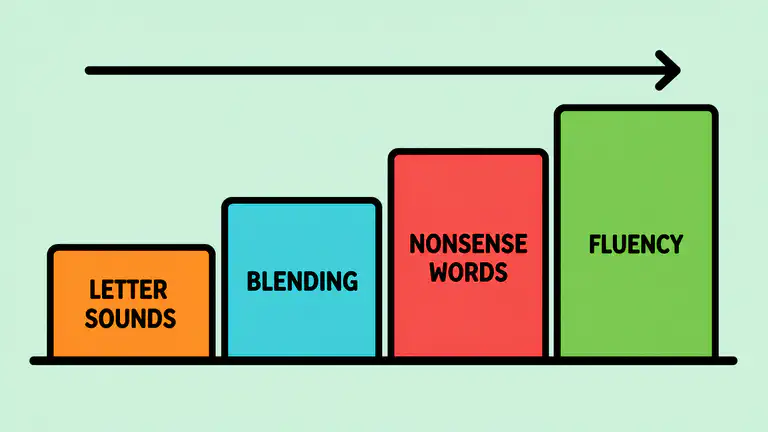
Asking a five-year-old to read frip tells you more about their reading future than asking them to read frog. A child can recognise frog from a picture book without decoding a single letter. Nobody has ever seen frip.
That is why almost every early reading assessment leans on invented words, and why letter sounds, blending, and word reading dominate the subtests, from the DIBELS reading assessment used across American schools to the kindergarten reading assessment batteries used in classrooms here.
Reading Assessment Tools Have Gotten Much Faster
For decades, a proper reading assessment meant a trained adult, one child, a quiet room, and half an hour. That cost is the reason so many children were never screened at all.
Two projects changed the arithmetic, from opposite directions.
ROAR, the Rapid Online Assessment of Reading, came out of Stanford’s Reading and Dyslexia Research Program. It runs in a web browser with no adult administering it. Yeatman et al. (2021) built a version around a simple word or nonword judgement and found it correlated at .91 with the Woodcock-Johnson Letter-Word Identification test, which needs a trained examiner. The short form ran in 2 to 3 minutes.
Ma et al. (2025) then made it adaptive, meaning the test adjusts difficulty as the child answers. Across 1,960 students, 75 adaptive items matched the precision of 125 fixed ones, cutting test length by 40%. In Grade 1 it correlated at .89 with FAST, a reading test widely used in American schools.
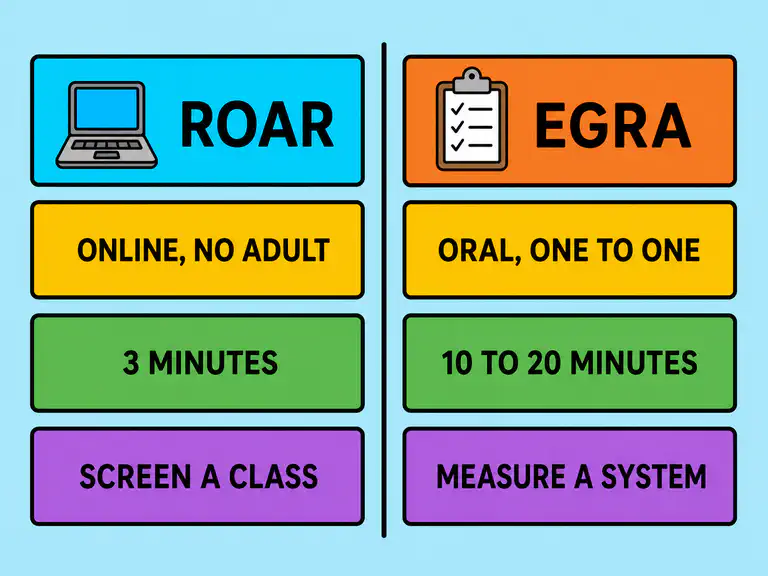
EGRA went the other way. The Early Grade Reading Assessment, built in 2006 by RTI International with USAID and World Bank funding, is deliberately low-tech: one assessor, one child, paper, a stopwatch. Dubeck and Gove (2015) report it has been adapted for more than 65 countries and over 100 languages, with the full battery running 10 to 20 minutes.
An EGRA assessment works where there is no electricity, no devices, and no shared written language between child and test designer. That is exactly what let it surface findings like this: in a sub-Saharan African sample, more than one in four Grade 2 students could not read a single word of a Grade 2 passage.
What This Means for Your Child
Dubeck and Gove (2015) are blunt about the limits of their own instrument: EGRA was never designed as a high-stakes accountability measure. The same holds for every screener I work with. A score is a snapshot of a few skills on one particular morning.
What a low score earns is a closer look, and soon.
Wanzek et al. (2018) pooled 25 studies of intensive early reading intervention across Kindergarten to Grade 3 and found an average effect size of 0.39, the standard way of expressing how much difference the extra help made. That drops to 0.28 once you correct for journals preferring to publish successes. In plain terms, children who got structured support moved clearly ahead of those who did not, by a margin wide enough to matter after a few months.
That effect shrinks the longer you wait. This is one of the things we work on at Bookbot and Flinders University: using speech recognition to listen while a child reads aloud, so the signals a teacher cannot catch across 25 children at once show up daily rather than annually.
What Actually Helps
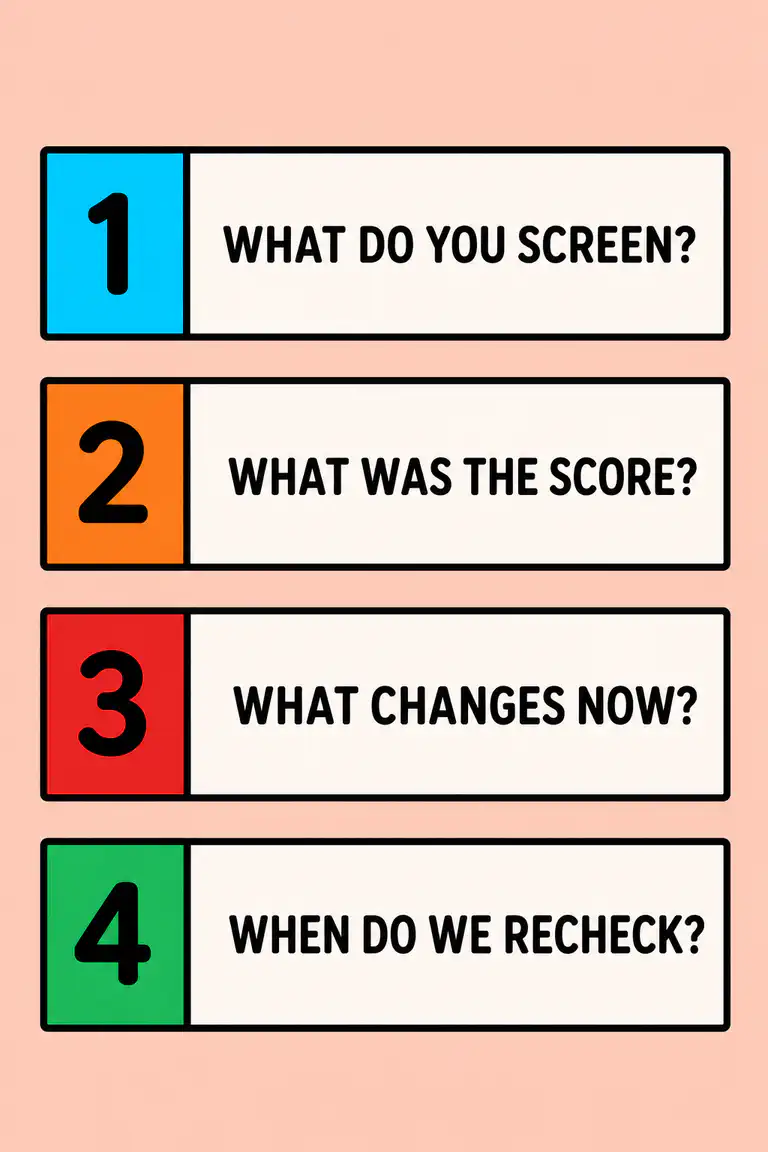
- Ask the school what they screen, and when. Most Australian states now run the Year 1 Phonics Screening Check. Ask for the actual number rather than a reassurance. A score of 27 and a score of 8 both sit below the benchmark and mean completely different things.
- Listen to your child read something unfamiliar. Favourite books are memorised, which is why screeners use invented words. Hand your child a page they have never seen and listen to what happens at the tricky words.
- Ask what changes on Monday. EGRA subtests were built to be instructionally transparent, so results point straight at what to teach next (Dubeck & Gove, 2015). A screening result that changes nothing about teaching wasted everyone’s morning.
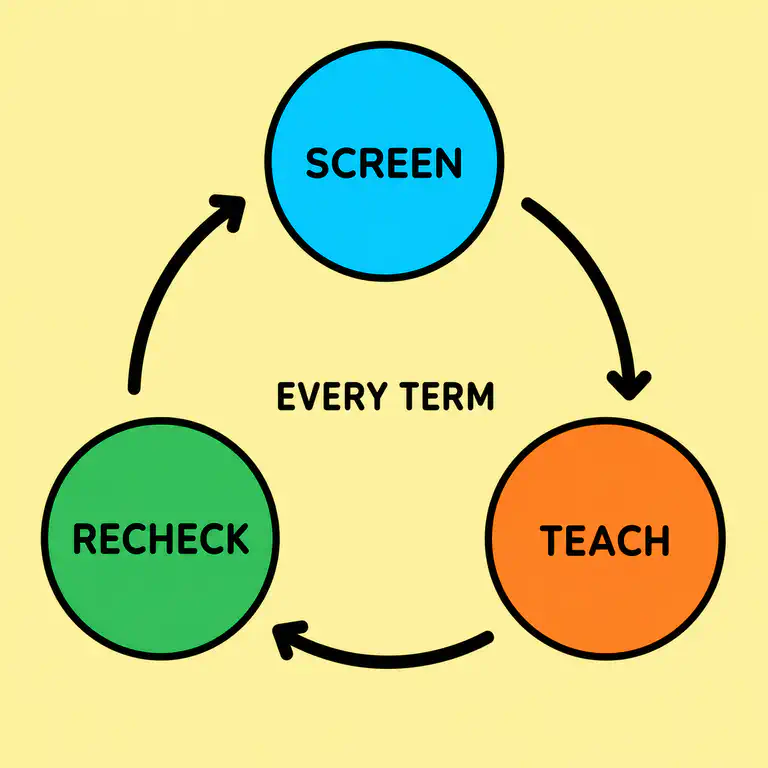
- Push for a recheck within the term. Growth over eight weeks tells you more than any single score. If nobody plans to measure again, the first measurement cannot do its job.
- Keep practice short, daily, and out loud. The effect sizes in Wanzek et al. (2018) came from consistent structured sessions, not marathon weekends. It is why Bookbot is built around a few focused minutes each day rather than one long session.
The Gap Closes When Somebody Looks
What I find most encouraging in the South Australian numbers is the trajectory. In 2018, 43% of Year 1 students hit the benchmark. By 2025 it was 66%, a rise of 23 percentage points (Department for Education, 2025). Nothing about those children changed. What changed was that somebody started checking early, and then taught differently in response.
That is the whole argument for early literacy assessment. Not the score, and not the ranking. Just the fact that a three-minute check in Year 1 can redirect the next six years of a child’s schooling. It is also why my research at Bookbot and Flinders keeps returning to one question: how early can we hear that a child is struggling, and how fast can we act.
If your child is in the first years of school and you have never seen a number from any reading screening, that is worth one email to their teacher this week. The tools exist now, they are fast, and increasingly they are free.
References
Department for Education, South Australia. (2025). 2025 phonics screening check summary. https://www.education.sa.gov.au/docs/curriculum/phonics/2025-phonics-screening-check-results-fact-sheet.pdf
Dubeck, M. M., & Gove, A. (2015). The early grade reading assessment (EGRA): Its theoretical foundation, purpose, and limitations. International Journal of Educational Development, 40, 315–322. https://doi.org/10.1016/j.ijedudev.2014.11.004
January, S. A., & Klingbeil, D. A. (2020). Universal screening in Grades K–2: A systematic review and meta-analysis of early reading curriculum-based measures. Journal of School Psychology, 82, 103–122. https://doi.org/10.1016/j.jsp.2020.08.007
Ma, W. A., Richie-Halford, A., Burkhardt, A. K., Kanopka, K., Chou, C., Domingue, B. W., & Yeatman, J. D. (2025). ROAR-CAT: Rapid Online Assessment of Reading ability with Computerized Adaptive Testing. Behavior Research Methods, 57(1). https://doi.org/10.3758/s13428-024-02578-y
Wanzek, J., Stevens, E. A., Williams, K. J., Scammacca, N., Vaughn, S., & Sargent, K. (2018). Current evidence on the effects of intensive early reading interventions. Journal of Learning Disabilities, 51(6), 612–624. https://doi.org/10.1177/0022219418775110
Yeatman, J. D., Tang, K. A., Donnelly, P. M., Yablonski, M., Ramamurthy, M., Karipidis, I. I., Caffarra, S., Takada, M. E., Kanopka, K., Ben-Shachar, M., & Domingue, B. W. (2021). Rapid online assessment of reading ability. Scientific Reports, 11, 6396. https://doi.org/10.1038/s41598-021-85907-x