



If you have ever felt a pang of guilt handing your child a tablet, you are not alone. Too much screen time is one of the most common worries parents raise, and the headlines make it worse: one day screens are ruining our children’s brains, the next day a reading app for kids claims to teach them to read in weeks. As a researcher who spends her days analysing reading data from thousands of children, I wanted to cut through the noise and look at what the science actually tells us about the effects of screen time on reading.
The short answer is that screen time is not one thing. The research increasingly shows that what children do on a screen matters far more than how many minutes they spend looking at one.
The Numbers Behind the Debate
A 2024 meta-analysis in JAMA Pediatrics, one of the largest to date, reviewed 100 studies covering 176,742 children (Mallawaarachchi et al., 2024). The findings paint a nuanced picture. General programme viewing, meaning passive watching of shows and videos, was negatively associated with cognitive outcomes including language skills, with a correlation of -0.16. That is a modest but consistent drag on development.
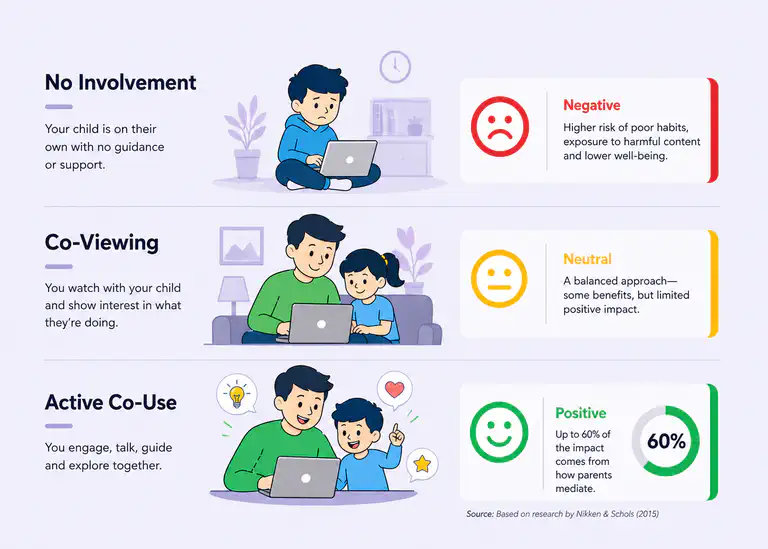
But here is where it gets interesting. When caregivers watched alongside children and talked about what they were seeing, the association flipped to positive (r = 0.14). And child-directed educational content on its own showed no significant negative effect at all.
A separate study from Frontiers in Psychology tracked 516 families with children aged 3 to 6 (Zu, Zhang & Wang, 2025). Entertainment screen time, things like YouTube videos and cartoons, negatively predicted early literacy skills. Educational screen time did not. What predicted literacy outcomes most strongly was not the screen itself but how parents mediated its use. Parental intervention strategies accounted for over 60% of the total effect on literacy.
The takeaway is clear: the screen is a tool, and like any tool, it depends on how you use it.
What Happens in the Brain
A 2025 study in Developmental Science used functional near-infrared spectroscopy, a brain imaging technique that measures blood flow, to watch what happens inside children’s heads during book reading versus screen time (Pecukonis et al., 2025). The researchers studied 28 preschoolers aged 3 to 6.
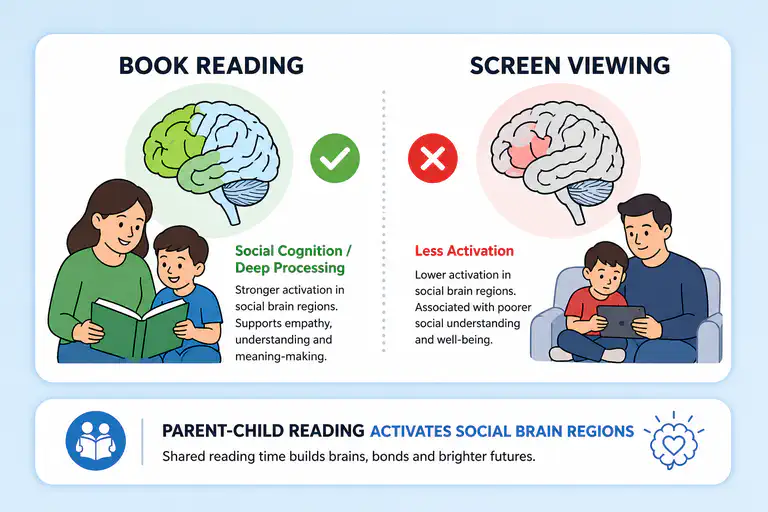
During live book reading with an adult, children showed significant activation in the right temporal parietal junction, a region involved in social cognition and understanding other people’s perspectives. During screen-based story viewing, that activation was absent. The brain was processing the same story content in fundamentally different ways depending on the medium.
This does not mean screens are inherently harmful. It means that reading a physical book with a parent engages social brain circuits that passive screen viewing does not. A longitudinal study of over 600 children found that while early screen time altered brain network development in ways linked to emotional difficulties, parent-child reading significantly buffered those negative effects of screen time (Huang et al., 2024). At high reading levels, the harmful brain associations disappeared entirely.
When I review research like this, what stands out is not that screens are bad but that shared reading is irreplaceable. This is one reason we built Bookbot to support, not replace, the experience of a child reading aloud, because the act of producing speech and hearing feedback engages those deeper cognitive pathways.
Not All Screen Time Is Equal
If passive screen time can slow reading development and shared book reading lights up social brain regions, where do educational apps fit?
A meta-analysis of 119 studies in the Review of Educational Research found that well-designed educational technology interventions produced meaningful gains across all literacy domains (Silverman et al., 2025). Effect sizes were 0.33 for decoding (the ability to sound out words), 0.30 for language comprehension, and 0.23 for reading comprehension. Those are not trivial numbers, roughly equivalent to several extra months of reading growth.
A 2025 randomised controlled trial published in Child Development tested this directly (Niklas et al., 2025). Five hundred children used a structured literacy app at home. The children who used the app showed significantly greater gains in letter knowledge and phonological awareness compared to control groups, even after controlling for family income, parental education, and the child’s own intelligence. The most striking finding was the dose: just 2.5 minutes of daily app use, around 430 minutes over the study period, was enough to produce a measurable 0.1 standard deviation improvement.
At Bookbot, I analyse real reading data from thousands of children, and what we see mirrors this research. Short, consistent, daily practice on a structured reading app compounds over time. The key is that the child is actively decoding and reading aloud, not passively watching animated characters.
Practical Strategies for Parents
-
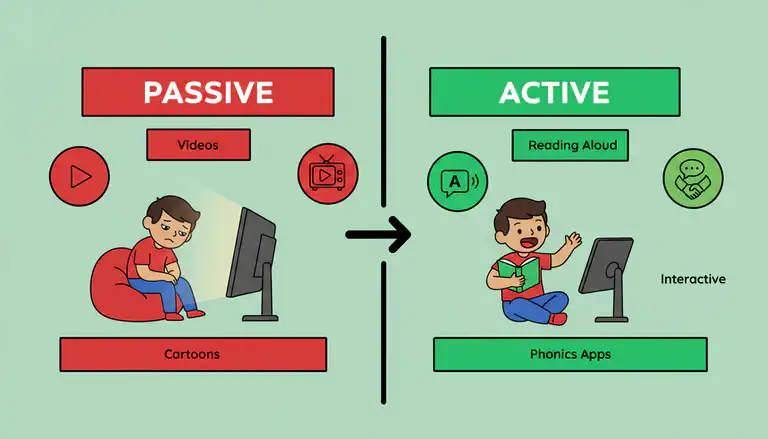
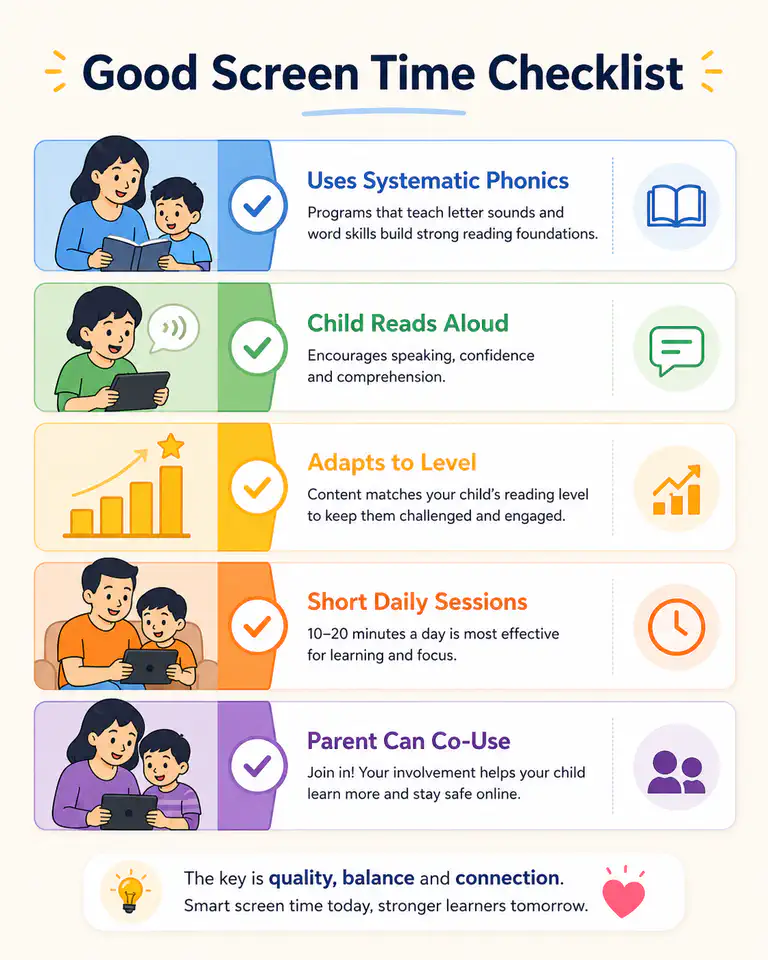
Distinguish between passive and active screen time. Watching videos is not the same as using a phonics-based reading app where your child sounds out words. When you are deciding how much screen time is too much, ask what your child is actually doing, not just how long they are doing it.
-
Read together every day, on paper. No app replicates the brain activation that comes from shared book reading with a caring adult. Even ten minutes of reading a physical book together provides cognitive benefits that screens cannot replicate (Pecukonis et al., 2025).
-
Co-view and co-use. When your child does use a screen, sit with them. Research shows that caregiver co-use flips the association from negative to positive (Mallawaarachchi et al., 2024). Ask questions, point things out, and talk about what you see.
-
Keep app sessions short and consistent. The Niklas et al. (2025) study found that even 2.5 minutes per day of a structured literacy app produced gains. You do not need marathon sessions. What matters is doing a little bit every day.
-
Protect sleep, outdoor play, and conversation. The biggest risk of screen time is not what it does but what it crowds out. If screens are replacing bedtime reading, outdoor play, or family conversation, that is where the real damage occurs.
-
Choose reading apps for kids built on reading science. Not all reading apps are equal. Look for apps that use systematic phonics, require your child to read aloud, and adapt to their level. This is the approach we take at Bookbot and Flinders University, building tools grounded in the same evidence base that this article draws from.
The Bottom Line
The research does not support a blanket “screens are bad” message, and it does not support handing a child a tablet and hoping for the best. What it supports is intentionality. Passive entertainment screen time is consistently linked to weaker literacy outcomes. Active, structured educational screen time can genuinely help. And shared reading with a real human remains the gold standard for building a reader’s brain.
That is what my research at Bookbot and Flinders University focuses on: finding the balance point where technology supports reading development without replacing the things that matter most.
References
Huang, H., Zhao, Y., Yang, Y., Li, Y., Yang, Y., & Chen, W. (2024). Screen time, brain network development and socio-emotional competence in childhood: Moderation of associations by parent–child reading. Psychological Medicine, 54(9), 2061–2071. https://doi.org/10.1017/S0033291724000114
Mallawaarachchi, T., Sharma, S., Goh, D., Hoskens, H., & Silk, T. J. (2024). Early childhood screen use contexts and cognitive and psychosocial outcomes: A systematic review and meta-analysis. JAMA Pediatrics, 178(11), 1121–1132. https://doi.org/10.1001/jamapediatrics.2024.3232
Niklas, F., Birtwistle, E., Mues, A., & Wirth, A. (2025). Learning apps at home prepare children for school: A randomised controlled trial. Child Development, 96(2), 456–469. https://doi.org/10.1111/cdev.14184
Pecukonis, M., Perdue, K. L., Wong, K., Tully, L., & Scott, L. S. (2025). Do children’s brains function differently during book reading and screen time? A fNIRS study. Developmental Science, 28(2), e13615. https://doi.org/10.1111/desc.13615
Silverman, R. D., Keane, K., Darling-Hammond, E., & Khanna, S. (2025). The effects of educational technology interventions on literacy in elementary school: A meta-analysis. Review of Educational Research, 95(1), 5–45. https://doi.org/10.3102/00346543241261073
Zu, J., Zhang, Y., & Wang, R. (2025). The impact of screen exposure on early literacy skills of preschool children: The mediation of parental media intervention. Frontiers in Psychology, 16, 1745413. https://doi.org/10.3389/fpsyg.2025.1745413