



Your child has dyslexia, and your phone is full of ads for dyslexia apps. Many now promise AI for dyslexia: a tutor that adapts to exactly how your child learns. So you go looking for proof, and you find it: a 2025 review in which every single study came back positive.
That sounds like the answer you wanted. When I review research, it is the result that makes me slow down.
A perfect record is rare in any field. In a young one full of small studies and hopeful companies, it usually says more about which studies got published than about the tools.
What the review of AI for dyslexia found
Paglialunga and Melogno (2025) searched six research databases for experiments on AI for learning disabilities published between 2022 and 2025. They found 11 studies with 3,033 participants, and six of them focused on dyslexia. The most common were adaptive learning systems (software that picks the next task based on the last answer) and learning games. A few tested text-to-speech tools and ChatGPT.
All 11 reported positive results. Then the authors rated each study’s risk of bias, meaning how likely it is that the way the study was run, rather than the tool, produced the result. None got the best rating, low. Seven were moderate, three were high and one was serious.
The authors themselves call the all-positive record “statistically improbable” and point to publication bias, which means studies with disappointing results tend never to be published.
Several studies had no comparison group at all. One measured how accurately an AI sorted data from 20 students, not whether anyone read better. Four of the 11 studied secondary school or university students, not young children.
Why the big numbers need a second look
The headline result came from Gharaibeh and Basulayyim (2025). They gave 60 Arabic-speaking children with dyslexia, aged 8 to 11, reading lessons built around ChatGPT. The review reports an effect size of 1.66 on reading comprehension.
An effect size is a standard way to measure how much a programme helped: the bigger the number, the bigger the improvement. It’s counted in standard deviations, a yardstick for how spread out children’s scores are.
For context, Hall and colleagues (2023) ran a meta-analysis, a study that combines the results of many studies, of 53 reading intervention studies with 6,053 children from kindergarten to Grade 5 with or at risk for dyslexia. The average effect was 0.33, and for reading comprehension it was 0.26. Our guide to dyslexia interventions covers it.
A single study reporting six times the 40-year average for comprehension needs a second look, not a headline.
Cheung and Slavin (2016) examined 645 education studies. Small studies, and those using tests the researchers designed themselves, reported effects roughly twice as large as big studies using independent tests. Studies that didn’t randomly assign children to groups reported bigger effects too. The ChatGPT study was small and not randomised.
The biggest study of young children in the review is quieter. Samuelsson (2023) studied 1,006 eight-year-olds in Sweden practising number facts. Among children with maths difficulties, those who simply practised memorising gained more on a fluency test (7.1 points) than those practising with AI (4.2 points).
Both groups improved. The AI just didn’t beat ordinary practice for the children who needed help most.
Does the gain survive when the AI is switched off?
The review flags a second gap: none of the 11 studies tracked children over the long term. That matters because of cognitive offloading, which means letting the AI do the thinking instead of building the skill yourself.
Bastani and colleagues (2025) tested exactly this with nearly 1,000 high school maths students in Turkey. It isn’t a dyslexia study, but the lesson carries over. Students with an unrestricted GPT-4 tutor did 48% better on practice problems, then 17% worse than the comparison group on an exam taken without AI. A version built to give teacher-designed hints instead of answers largely removed that harm.
For a child with dyslexia, the skill that needs building is decoding, which means working out a word from its letters and sounds. A tool that does the decoding for them can make tonight’s homework easier and leave that skill exactly where it was.
Text to speech for dyslexia: a support, not a teacher
This doesn’t make every tool that reads aloud a problem. Wood and colleagues (2018) combined 22 studies of 2,942 students from Grade 3 to university and found text-to-speech improved reading comprehension, with an effect of 0.35. For a child who can’t yet decode their science book, that is real access to the content.
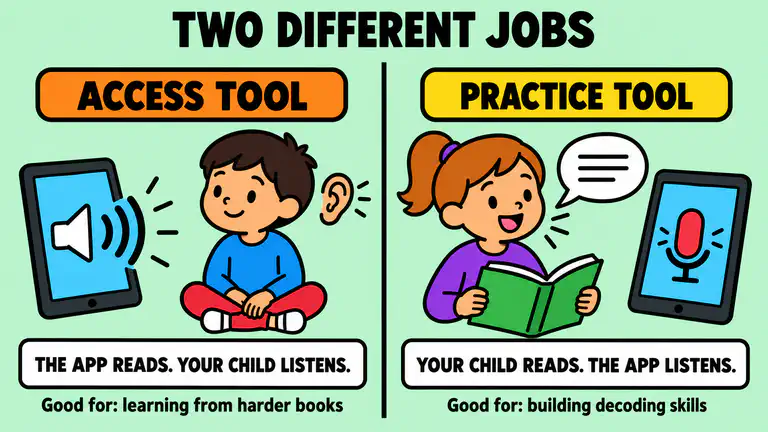
But it is assistive technology for dyslexia, not a reading lesson. The strongest setup uses both: text-to-speech so your child can learn from books above their decoding level, and structured practice where your child does the reading.
Bookbot does both jobs. It reads books aloud, so your child can listen to harder books than they can read yet. And in its reading practice, your child reads aloud while speech recognition listens and catches words that go wrong. The child does the decoding, and the app tracks which sound-spelling patterns they’ve mastered.
How to judge AI tools for dyslexia
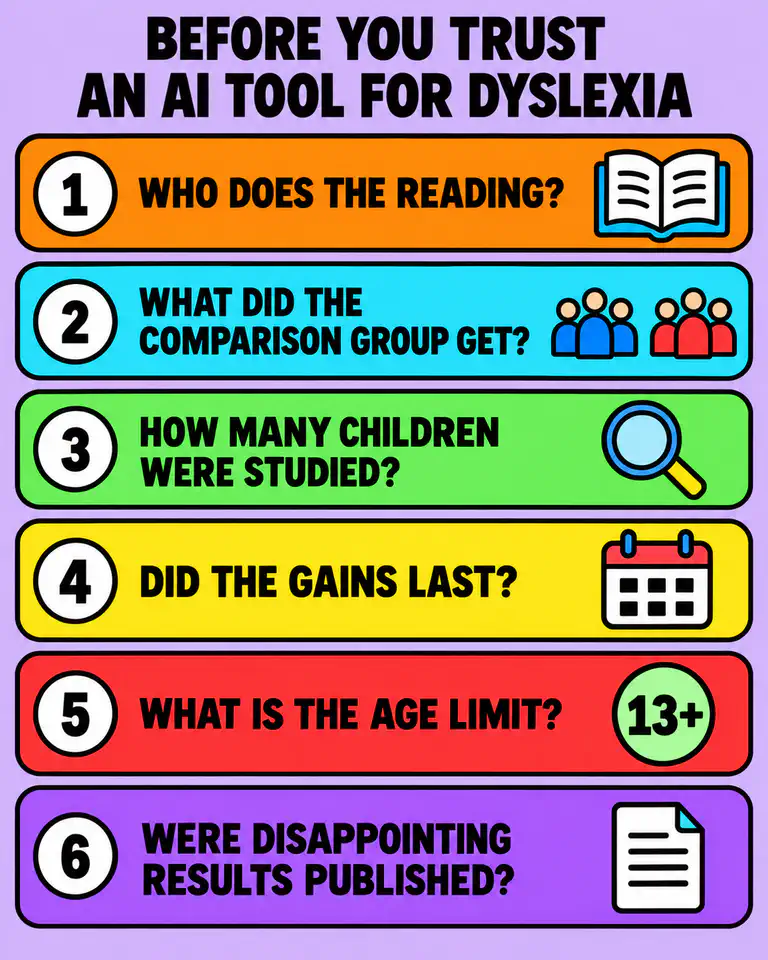
- Ask who does the reading. If the AI reads, summarises or answers for your child, it is an access tool. That’s useful, but it isn’t teaching decoding, and unassisted skills can slip (Bastani et al., 2025).
- Ask what the comparison group got. “Children improved” means little on its own, because children grow and learn other things during a study too. Most of the 11 studies didn’t randomly assign children to groups (Paglialunga & Melogno, 2025).
- Shrink big numbers from small studies. Well-tested dyslexia interventions average about 0.33 (Hall et al., 2023). A small study claiming far more is likely to shrink when repeated at scale (Cheung & Slavin, 2016).
- Ask whether the gains lasted. None of the 11 studies tracked children over the long term (Paglialunga & Melogno, 2025).
- Check the age limit. ChatGPT’s own terms require users to be at least 13, with a parent’s permission under 18 (OpenAI, 2026).
- Keep AI alongside structured teaching, not instead of it. The review’s authors call AI a supplement to good instruction, not a replacement. Hall et al. (2023) also found more hours of intervention brought bigger effects.
- Ask the company for its disappointing results. A company that has only ever published good news is showing you its best studies, not all of them.
What I take from this
None of this means AI can’t help children with dyslexia. The review’s authors think it can, and so do I. But right now, the evidence is a promise, not proof.
So the next time an app tells you its AI is proven to help children with dyslexia, ask it the questions I ask of every study. Who did the reading? Compared with whom? And where were those children once the tool was switched off?
References
Bastani, H., Bastani, O., Sungu, A., Ge, H., Kabakcı, Ö., & Mariman, R. (2025). Generative AI without guardrails can harm learning: Evidence from high school mathematics. Proceedings of the National Academy of Sciences, 122(26), e2422633122. https://doi.org/10.1073/pnas.2422633122
Cheung, A. C. K., & Slavin, R. E. (2016). How methodological features affect effect sizes in education. Educational Researcher, 45(5), 283–292. https://doi.org/10.3102/0013189X16656615
Gharaibeh, M., & Basulayyim, A. (2025). ChatGPT enhances reading comprehension for children with dyslexia in Arabic language. Disability and Rehabilitation: Assistive Technology, 20(8), 2858–2871. https://doi.org/10.1080/17483107.2025.2508389
Hall, C., Dahl-Leonard, K., Cho, E., Solari, E. J., Capin, P., Conner, C. L., Henry, A. R., Cook, L., Hayes, L., Vargas, I., Richmond, C. L., & Kehoe, K. F. (2023). Forty years of reading intervention research for elementary students with or at risk for dyslexia: A systematic review and meta-analysis. Reading Research Quarterly, 58(2), 285–312. https://doi.org/10.1002/rrq.477
OpenAI. (2026). Terms of use (effective January 1, 2026). https://openai.com/policies/terms-of-use/
Paglialunga, A., & Melogno, S. (2025). The effectiveness of artificial intelligence-based interventions for students with learning disabilities: A systematic review. Brain Sciences, 15(8), 806. https://doi.org/10.3390/brainsci15080806
Samuelsson, J. (2023). Arithmetic fact fluency supported by artificial intelligence. Frontiers in Education Technology, 6(1), 13–25. https://doi.org/10.22158/fet.v6n1p13
Wood, S. G., Moxley, J. H., Tighe, E. L., & Wagner, R. K. (2018). Does use of text-to-speech and related read-aloud tools improve reading comprehension for students with reading disabilities? A meta-analysis. Journal of Learning Disabilities, 51(1), 73–84. https://doi.org/10.1177/0022219416688170