




Your child can explain how volcanoes work, in detail, unprompted. Ten minutes with a reading book turns into wriggling, pencil sharpening, and an urgent need for water.
If there is an ADHD diagnosis in your family, you have probably been told the same thing: sort out the attention first, and the reading will follow. I analyse reading data from thousands of children, and that is the assumption I would most like to see retired.
The largest review says close to the opposite. Chan and colleagues (2023), writing in the Journal of Attention Disorders, pooled 18 studies of reading intervention for children with ADHD and concluded that reading instruction should be the first-line treatment for their reading difficulties, not the thing you get to afterwards.
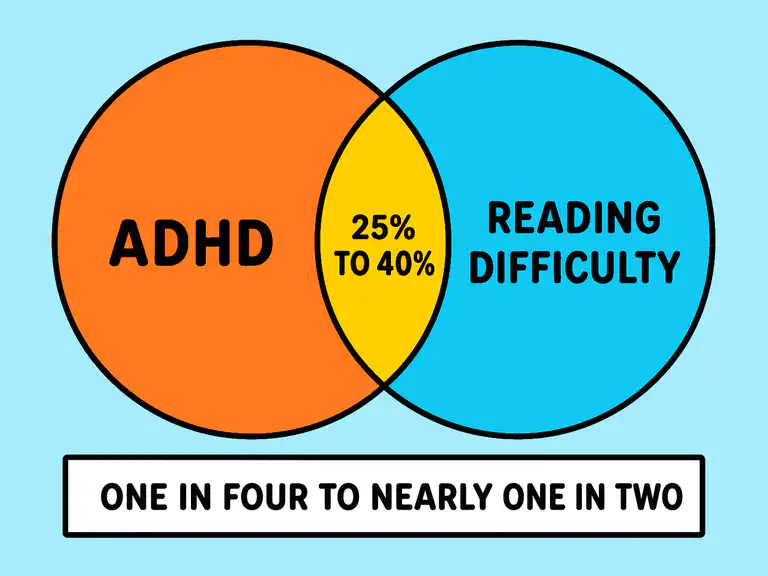
How Often ADHD and Reading Difficulties Overlap
Chan and colleagues (2023) put the overlap at 25% to 40%, meaning a quarter to nearly half of children with ADHD also carry a diagnosed reading disability. DuPaul, Gormley and Laracy (2013) reviewed 17 studies from 2001 to 2011 and found a mean co-occurrence rate of 45.1% once writing difficulties were counted alongside reading and maths. Reading difficulties and ADHD are not a rare pairing. They are close to standard.
The Chan meta-analysis (a study that pools many earlier studies into one estimate) covered 18 studies published between 1986 and 2020, with 564 children aged 6 to 18. Averaged across every measure, the effect size (a number describing how large a change was) came out at 0.96. Anything above 0.8 counts as large.
Two bigger numbers get quoted from Chan and colleagues (2023), and both need context. On study-built tests of the exact skills just taught, the effect was 1.91. On standardised reading tests the plain average was 0.66, and the widely quoted 1.11 is a best-case estimate: what the model predicts for carefully diagnosed children in mainstream classrooms who get at least 30 hours aimed at decoding (sounding words out from their letters) and phonemic awareness (hearing and moving the individual sounds inside spoken words). Only 4 of the 18 studies had a comparison group and only 3 were randomised trials, so most of these figures describe change from before to after, not a taught group against an untaught one. The gains are real and large. They are not miracle sized.
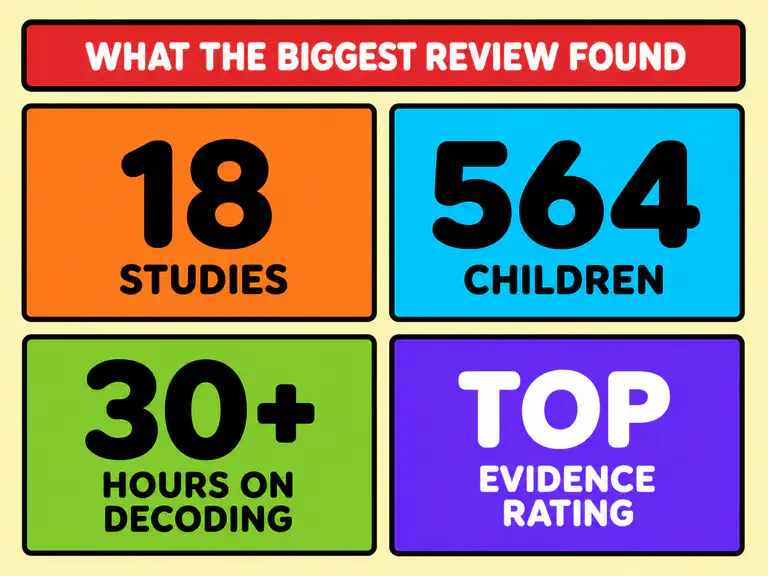
What earned the top rating matters more than the headline number. Interventions running at least 30 hours on decoding and phonemic awareness met every benchmark for Level 1 (Well-Established) evidence. Comprehension-focused interventions produced significantly smaller gains, and adding behavioural treatment on top produced no extra reading benefit. What moved reading was reading instruction, in enough quantity, aimed at the right skill.
What This Means for Your Child
Tamm and colleagues (2017) ran the cleanest test of the ordering question. They randomised 216 children in Grades 2 to 5 who had both ADHD and word reading difficulties to ADHD-focused treatment, intensive reading instruction, or both. Attention ratings improved most where attention was treated. Word reading and decoding improved most where reading was taught. Neither stood in for the other. How ADHD itself is treated is a conversation for your child’s doctor.
Then there is the confound worth explaining. A child who cannot decode will look inattentive during reading, ADHD or not. Sounding out every word is exhausting, so they drift, guess, skip lines, and slide sideways off the chair. That behaviour is a sensible response to a task that is too hard, and it fades once the task stops being too hard.
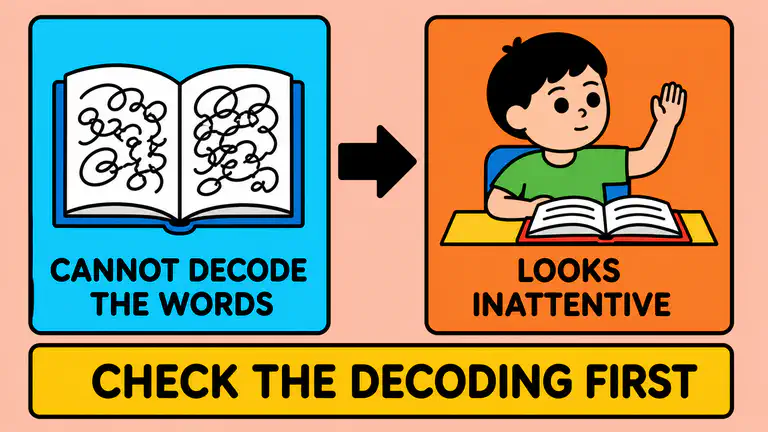
Roberts and colleagues (2015) watched this run in the other direction. Across a three-year randomised study of struggling middle school readers, intensive reading intervention improved reading, and those reading gains in turn improved teacher ratings of attention. Reading came first. Attention followed.
ADHD and reading comprehension is where the overlap gets tangled. Friedman and colleagues (2017) compared 31 boys with ADHD to 30 typically developing boys aged 8 to 12. Working memory (the mental workspace that holds information while you use it) and the speed of converting letters into sounds together fully explained the comprehension difference. Small study, boys only, so I hold it loosely. But it points somewhere useful: comprehension suffers partly because decoding eats the workspace that meaning-making needs. It is also why ADHD reading problems get misread as pure attention problems.
Practical Strategies
The ADHD reading strategies below share one logic: lower the load, and spend the minutes where the evidence says they pay.
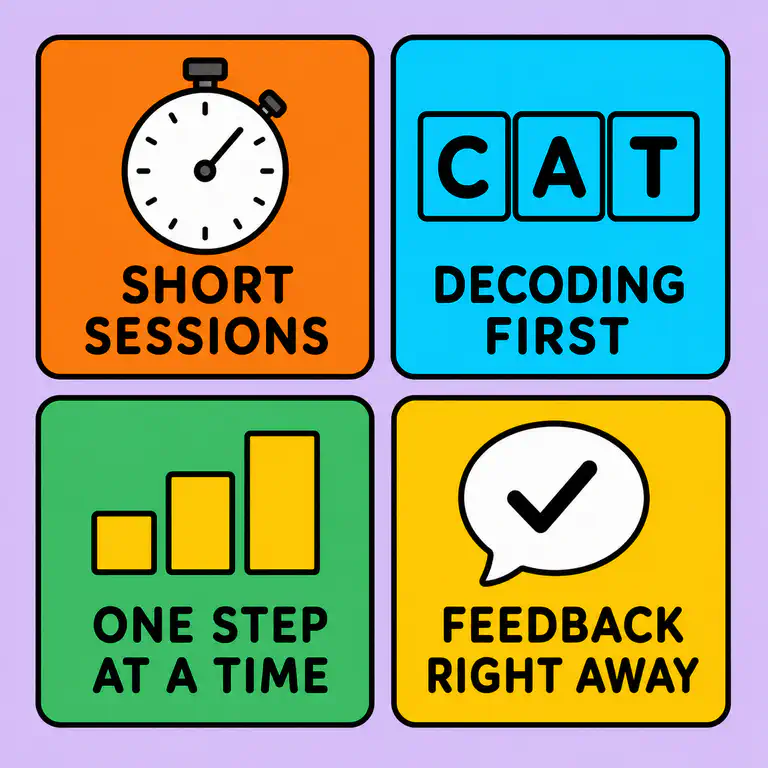
- Run short sessions, more often. The programmes in Chan and colleagues (2023) averaged about 30 hours across 10 to 11 weeks, roughly 25 minutes a day in a school term. No study here tested session length directly, but for a child who tires fast, I would rather see two eight-minute goes than one gruelling twenty-minute one.
- Spend the minutes on decoding. Decoding and phonemic awareness instruction outperformed comprehension-focused instruction in Chan and colleagues (2023). Comprehension work has its place, but not while a child is still sounding words out.
- Lower the working-memory load. Following Friedman and colleagues (2017), give one instruction at a time, use decodable books matched to what your child has been taught, and resist adding new sight words mid-lesson.
- Correct on the spot. Luman, Oosterlaan and Sergeant (2005) reviewed 22 studies covering 1,181 children: reinforcement lifted task performance for children with and without ADHD, somewhat more so in ADHD, and children with ADHD preferred immediate reward over delayed. That review was about rewards, not corrections, but I apply the same logic to both: help that arrives three pages later is easy to miss.
- Have your child read aloud. Reading aloud makes an error visible the moment it happens. Bookbot listens as a child reads and responds to the word as it is spoken, which is how we build that immediate feedback into daily practice.
- Plan in terms, not weeks. Thirty hours is the number that earned Level 1 evidence in Chan and colleagues (2023). Three weeks of enthusiasm will not get there, and knowing that early stops you concluding too soon that it is not working.
- Do not wait for attention to be sorted first. On the evidence from Tamm and colleagues (2017), the reading half of the problem waits for reading instruction.
Where This Leaves You
None of this makes reading instruction a treatment for ADHD, and I want to be careful about that. It is not. What the evidence supports is narrower and more useful: ADHD and learning to read are not sequential problems, and the reading side can be worked on now, with the same structured decoding instruction that helps every other struggling reader.
When I review the research here, what encourages me most is how ordinary the answer turns out to be. No specialised ADHD reading method. No waiting list. Explicit decoding practice, enough of it, in small pieces, with feedback that arrives while the word is still in the air. The hard part was never the method. It is finding 25 minutes a day a child will tolerate.
Start with ten. Ten honest minutes of decoding beats forty minutes of a child looking at a page and thinking about volcanoes.
References
Chan, E. S. M., Shero, J. A., Hand, E. D., Cole, A. M., Gaye, F., Spiegel, J. A., & Kofler, M. J. (2023). Are reading interventions effective for at-risk readers with ADHD? A meta-analysis. Journal of Attention Disorders, 27(2), 182-200. https://doi.org/10.1177/10870547221130111
DuPaul, G. J., Gormley, M. J., & Laracy, S. D. (2013). Comorbidity of LD and ADHD: Implications of DSM-5 for assessment and treatment. Journal of Learning Disabilities, 46(1), 43-51. https://doi.org/10.1177/0022219412464351
Friedman, L. M., Rapport, M. D., Raiker, J. S., Orban, S. A., & Eckrich, S. J. (2017). Reading comprehension in boys with ADHD: The mediating roles of working memory and orthographic conversion. Journal of Abnormal Child Psychology, 45(2), 273-287. https://doi.org/10.1007/s10802-016-0171-7
Luman, M., Oosterlaan, J., & Sergeant, J. A. (2005). The impact of reinforcement contingencies on AD/HD: A review and theoretical appraisal. Clinical Psychology Review, 25(2), 183-213. https://doi.org/10.1016/j.cpr.2004.11.001
Roberts, G., Rane, S., Fall, A.-M., Denton, C. A., Fletcher, J. M., & Vaughn, S. (2015). The impact of intensive reading intervention on level of attention in middle school students. Journal of Clinical Child & Adolescent Psychology, 44(6), 942-953. https://doi.org/10.1080/15374416.2014.913251
Tamm, L., Denton, C. A., Epstein, J. N., Schatschneider, C., Taylor, H., Arnold, L. E., Bukstein, O., Anixt, J., Koshy, A., Newman, N. C., Maltinsky, J., Brinson, P., Loren, R. E. A., Prasad, M. R., Ewing-Cobbs, L., & Vaughn, A. (2017). Comparing treatments for children with ADHD and word reading difficulties: A randomized clinical trial. Journal of Consulting and Clinical Psychology, 85(5), 434-446. https://doi.org/10.1037/ccp0000170