


Ada's Empty Water Jug (3+ syllables)
![Create a single full-page children's book illustration. Use the attached character reference images and match each named character exactly — same shapes, colours and contemporary clothing; do not redesign them. SCENE: Dhegdheer (match attached reference) stands on a hilltop, with her ear spread wide. The place is a red desert plain with sand dunes. COMPOSITION: Compose ONE full-bleed scene with a single continuous background that fills the whole image, characters at natural size placed toward the RIGHT. Keep the LEFT 50% text area genuinely open inside a smooth, low-detail gradient blur covering the LEFT 60% of the image. Use only a plain, continuous continuation of the scene background there, with NO characters, objects, props, hanging items, plants, patterns or decorations. Keep all important characters and detailed scene content in the RIGHT 40%, with only a soft natural fade into the blurred left text area. That LEFT 50% text area must be the SAME continuous background colour as the scene (not a flat panel, not a different shade, no dividing line). Do NOT shrink or squash the characters. Book text will be overlaid in the LEFT 50% text area. Do not include any written text, letters, numbers, captions, speech bubbles, signs, labels, logos, or watermarks anywhere; the image must be purely illustrative.
[EDITOR_REGEN_REQUIREMENTS]
These editor requirements are mandatory and override any conflicting earlier wording:
- Change the name Asad in all versions to a girl's name that fit in the phonics lesson.](/cdn-cgi/image/fit=scale-down,format=auto,metadata=none,quality=75,width=800/https://books.bookbotkids.com/images/books/dhegdheer/page_01_crop.webp)
On the red-sand plains, the thorn trees grow low and twisted. Here lives an ogress named Dhegdheer. That name means Long-Ear. She has one enormous ear, flat as a sail and stiff as dried hide, and it turns toward any sound for miles. Every family knows her name, and they whisper it with dread.
![Create a single full-page children's book illustration. Use the attached character reference images and match each named character exactly — same shapes, colours and contemporary clothing; do not redesign them. SCENE: Ada (match attached reference) crouches in the sand beside a small contemporary rural homestead with a canvas shade, a simple modern house wall, and practical water containers nearby, holding a plastic water jerrycan. She looks at a huge strange footprint with a frightened but determined expression. COMPOSITION: Compose ONE full-bleed scene with a single continuous background that fills the whole image, characters at natural size placed toward the LEFT. Keep the RIGHT 50% text area genuinely open — plain, continuous background with NO characters, objects, props, hanging items, plants, patterns or decorations in it — while the rest of the scene fills the frame naturally. That RIGHT 50% text area must be the SAME continuous background colour as the scene (not a flat panel, not a different shade, no dividing line). Do NOT shrink or squash the characters. Book text will be overlaid in the RIGHT 50% text area. Do not include any written text, letters, numbers, captions, speech bubbles, signs, labels, logos, or watermarks anywhere; the image must be purely illustrative.
[EDITOR_REGEN_REQUIREMENTS]
These editor requirements are mandatory and override any conflicting earlier wording:
- Change the name Asad in all versions to a girl's name that fit in the phonics lesson.](/cdn-cgi/image/fit=scale-down,format=auto,metadata=none,quality=75,width=800/https://books.bookbotkids.com/images/books/dhegdheer/page_02_crop.webp)
A girl named Ada lives with her mother and their three camels on the edge of the plains. Ada is ten, quick-eyed and quick to think. One afternoon, her mother does not come back from the well. Ada finds only the empty water jug lying in the sand. Beside it sits one enormous footprint.
![Create a single full-page children's book illustration. Use the attached character reference images and match each named character exactly — same shapes, colours and contemporary clothing; do not redesign them. SCENE: Old Nuur (match attached reference) sits on a low folding stool under an acacia tree, holding out a seed pod (match attached reference; held loose in Old Nuur's hand) to Ada (match attached reference). Ada stands in front of him with one hand open, listening, while a small coil of braided cord and a modern notebook rest beside him. COMPOSITION: Compose ONE full-bleed scene with a single continuous background that fills the whole image, characters at natural size placed in the lower part of the frame. Keep the TOP 50% text area genuinely open inside a smooth, low-detail gradient blur covering the TOP 60% of the image. Use only a plain, continuous continuation of the scene background there, with NO characters, objects, props, hanging items, plants, patterns or decorations. Keep all important characters and detailed scene content in the LOWER 40%, with only a soft natural fade into the blurred top text area. That TOP 50% text area must be the SAME continuous background colour as the scene (not a flat panel, not a different shade, no dividing line). Do NOT shrink or squash the characters. Book text will be overlaid in the TOP 50% text area. Do not include any written text, letters, numbers, captions, speech bubbles, signs, labels, logos, or watermarks anywhere; the image must be purely illustrative.
[EDITOR_REGEN_REQUIREMENTS]
These editor requirements are mandatory and override any conflicting earlier wording:
- Change the name Asad in all versions to a girl's name that fit in the phonics lesson.](/cdn-cgi/image/fit=scale-down,format=auto,metadata=none,quality=75,width=800/https://books.bookbotkids.com/images/books/dhegdheer/page_03_crop.webp)
Ada runs to the elder, old Nuur, who sits weaving rope in the shade of a thorn tree. 'Dhegdheer has taken her,' Nuur says softly. 'That one ear hears everything.' He presses a small gift into Ada's hand. It is a dry seed pod that shakes like a camel's ankle bells. 'Keep this,' he says. 'Sound can be a door, or a wall.'
![Create a single full-page children's book illustration. Use the attached character reference images and match each named character exactly — same shapes, colours and contemporary clothing; do not redesign them. SCENE: Ada (match attached reference) walks alone across a cracked white salt pan. A seed pod (match attached reference; tied to Ada's wrist) is tied to her wrist as she squints and thinks. COMPOSITION: Compose ONE full-bleed scene with a single continuous background that fills the whole image, characters at natural size placed toward the RIGHT. Keep the LEFT 50% text area genuinely open — plain, continuous background with NO characters, objects, props, hanging items, plants, patterns or decorations in it — while the rest of the scene fills the frame naturally. That LEFT 50% text area must be the SAME continuous background colour as the scene (not a flat panel, not a different shade, no dividing line). Do NOT shrink or squash the characters. Book text will be overlaid in the LEFT 50% text area. Do not include any written text, letters, numbers, captions, speech bubbles, signs, labels, logos, or watermarks anywhere; the image must be purely illustrative.
[EDITOR_REGEN_REQUIREMENTS]
These editor requirements are mandatory and override any conflicting earlier wording:
- Change the name Asad in all versions to a girl's name that fit in the phonics lesson.](/cdn-cgi/image/fit=scale-down,format=auto,metadata=none,quality=75,width=800/https://books.bookbotkids.com/images/books/dhegdheer/page_04_crop.webp)
Ada ties the seed pod to her wrist and follows the great footprints north. The trail leads to a salt pan, a white, blinding flat, dangerous to cross. The ground cracks like broken pots under her feet. Each step rings out sharp and clear, for sound carries across a salt pan like a shout across still water. Ada keeps that fact in mind and walks on.
![Create a single full-page children's book illustration. Use the attached character reference images and match each named character exactly — same shapes, colours and contemporary clothing; do not redesign them. SCENE: Ada (match attached reference) peers down into a dry ravine with a cave and a thorn pen (match attached reference; closed and intact) below. Dhegdheer (match attached reference) sleeps and blocks the cave entrance, and Ada's Mother (match attached reference) is among the prisoners. COMPOSITION: Compose ONE full-bleed scene with a single continuous background that fills the whole image, characters at natural size placed toward the LEFT. Keep the RIGHT 50% text area genuinely open — plain, continuous background with NO characters, objects, props, hanging items, plants, patterns or decorations in it — while the rest of the scene fills the frame naturally. That RIGHT 50% text area must be the SAME continuous background colour as the scene (not a flat panel, not a different shade, no dividing line). Do NOT shrink or squash the characters. Book text will be overlaid in the RIGHT 50% text area. Do not include any written text, letters, numbers, captions, speech bubbles, signs, labels, logos, or watermarks anywhere; the image must be purely illustrative.
[EDITOR_REGEN_REQUIREMENTS]
Dhegdheer must match the current canonical character image exactly: olive-green skin, rounded face and pig-like nose, small white tusk, black hair bun, magenta-orange headband, one enormous orange/turquoise/magenta patterned ear and gold disc earring, orange-yellow sunburst top, purple patterned waist sash, blue/teal/orange geometric skirt, beads and bangles, bare green feet. No charcoal-grey skin, bald head or ragged brown coat. Preserve the scene action, expression, other characters and composition.](/cdn-cgi/image/fit=scale-down,format=auto,metadata=none,quality=75,width=800/https://books.bookbotkids.com/images/books/dhegdheer/page_05_crop.webp)
At the edge of a dry ravine, Ada finds Dhegdheer's cave. The ogress has built a pen from thorn branches. Inside sit many prisoners, men, women, and children, all too terrified to call out. Ada spots her own mother crouched at the back. The ogress sleeps, her great ear folded over her face like a blanket. One sound, and that ear will snap open.
![Create a single full-page children's book illustration. Use the attached character reference images and match each named character exactly — same shapes, colours and contemporary clothing; do not redesign them. SCENE: Ada (match attached reference) loosens a branch from the thorn pen (match attached reference; partly loosened with one branch cracking) while Ada's Mother (match attached reference) and the other prisoners in contemporary everyday clothing hide behind her. Dhegdheer (match attached reference) watches from the cave, her ear raised and one eye glaring. COMPOSITION: Compose ONE full-bleed scene with a single continuous background that fills the whole image, characters at natural size placed in the lower part of the frame. Keep the TOP 50% text area genuinely open — plain, continuous background with NO characters, objects, props, hanging items, plants, patterns or decorations in it — while the rest of the scene fills the frame naturally. That TOP 50% text area must be the SAME continuous background colour as the scene (not a flat panel, not a different shade, no dividing line). Do NOT shrink or squash the characters. Book text will be overlaid in the TOP 50% text area. Do not include any written text, letters, numbers, captions, speech bubbles, signs, labels, logos, or watermarks anywhere; the image must be purely illustrative.
[EDITOR_REGEN_REQUIREMENTS]
Dhegdheer must match the current canonical character image exactly: olive-green skin, rounded face and pig-like nose, small white tusk, black hair bun, magenta-orange headband, one enormous orange/turquoise/magenta patterned ear and gold disc earring, orange-yellow sunburst top, purple patterned waist sash, blue/teal/orange geometric skirt, beads and bangles, bare green feet. No charcoal-grey skin, bald head or ragged brown coat. Preserve the scene action, expression, other characters and composition.](/cdn-cgi/image/fit=scale-down,format=auto,metadata=none,quality=75,width=800/https://books.bookbotkids.com/images/books/dhegdheer/page_06_crop.webp)
Ada creeps down to the thorn pen. She signs to the prisoners: wait. One by one she pulls the thorn branches free, but the dry wood cracks. The great ear jumps and immediately turns toward the sound. Dhegdheer's eye opens, yellow as a sand lizard. 'Who is there?' she roars, and the ravine walls shake.
![Create a single full-page children's book illustration. Use the attached character reference images and match each named character exactly — same shapes, colours and contemporary clothing; do not redesign them. SCENE: Ada (match attached reference) sprints across red sand while Dhegdheer (match attached reference) chases close behind. Dhegdheer's ear points toward Ada. COMPOSITION: Compose ONE full-bleed scene with a single continuous background that fills the whole image, characters at natural size placed toward the RIGHT. Keep the LEFT 50% text area genuinely open — plain, continuous background with NO characters, objects, props, hanging items, plants, patterns or decorations in it — while the rest of the scene fills the frame naturally. That LEFT 50% text area must be the SAME continuous background colour as the scene (not a flat panel, not a different shade, no dividing line). Do NOT shrink or squash the characters. Book text will be overlaid in the LEFT 50% text area. Do not include any written text, letters, numbers, captions, speech bubbles, signs, labels, logos, or watermarks anywhere; the image must be purely illustrative.
[EDITOR_REGEN_REQUIREMENTS]
These editor requirements are mandatory and override any conflicting earlier wording:
- Change the name Asad in all versions to a girl's name that fit in the phonics lesson.
- missing arm](/cdn-cgi/image/fit=scale-down,format=auto,metadata=none,quality=75,width=800/https://books.bookbotkids.com/images/books/dhegdheer/page_07_crop.webp)
Ada runs. Dhegdheer comes fast after her, that great ear turning, set on every step. The ogress can follow sound the way a hawk follows shadow. No matter which way Ada twists and dodges, the ear finds her. Her heart pounds furiously. She cannot outrun Dhegdheer, not on soft sand, not through thorn, not on the open plain.
![Create a single full-page children's book illustration. Use the attached character reference images and match each named character exactly — same shapes, colours and contemporary clothing; do not redesign them. SCENE: Ada (match attached reference) stands at the edge of a salt pan with one arm out after throwing a seed pod (match attached reference; untied and skittering across the salt crust). Dhegdheer (match attached reference) lunges the wrong way while her ear swings left. COMPOSITION: Compose ONE full-bleed scene with a single continuous background that fills the whole image, characters at natural size placed toward the LEFT. Keep the RIGHT 50% text area genuinely open — plain, continuous background with NO characters, objects, props, hanging items, plants, patterns or decorations in it — while the rest of the scene fills the frame naturally. That RIGHT 50% text area must be the SAME continuous background colour as the scene (not a flat panel, not a different shade, no dividing line). Do NOT shrink or squash the characters. Book text will be overlaid in the RIGHT 50% text area. Do not include any written text, letters, numbers, captions, speech bubbles, signs, labels, logos, or watermarks anywhere; the image must be purely illustrative.
[EDITOR_REGEN_REQUIREMENTS]
Dhegdheer must match the current canonical character image exactly: olive-green skin, rounded face and pig-like nose, small white tusk, black hair bun, magenta-orange headband, one enormous orange/turquoise/magenta patterned ear and gold disc earring, orange-yellow sunburst top, purple patterned waist sash, blue/teal/orange geometric skirt, beads and bangles, bare green feet. No charcoal-grey skin, bald head or ragged brown coat. Preserve the scene action, expression, other characters and composition.](/cdn-cgi/image/fit=scale-down,format=auto,metadata=none,quality=75,width=800/https://books.bookbotkids.com/images/books/dhegdheer/page_08_crop.webp)
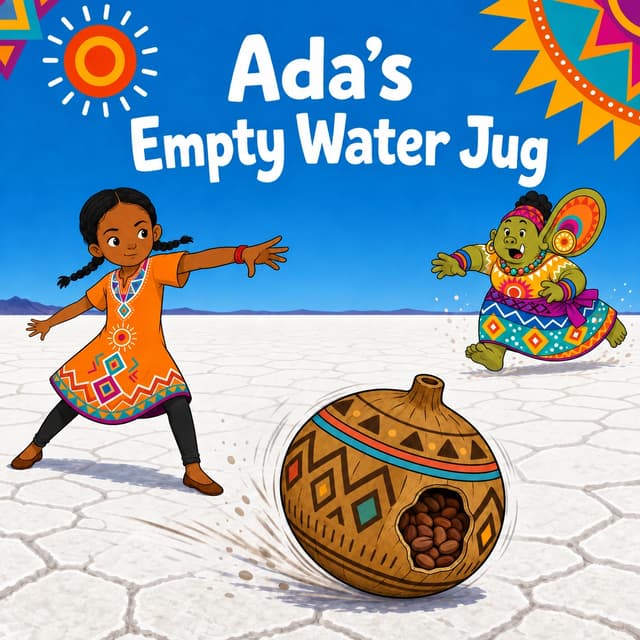
Then Ada's feet hit the salt pan. Crack, crack, crack. Suddenly a plan lights up in her mind. She stops, unties the seed pod, and throws it hard across the white crust. It slides and shakes, just like a girl running in ankle bells. The sound races across the salt pan, far to the left. Dhegdheer's ear swings hard, and the ogress leaps after it, away from Ada, away from the cave.
![Create a single full-page children's book illustration. Use the attached character reference images and match each named character exactly — same shapes, colours and contemporary clothing; do not redesign them. SCENE: Ada (match attached reference) holds the hand of Ada's Mother (match attached reference) and points south as mothers, children, and herdsmen in contemporary practical clothing leave the thorn pen (match attached reference; torn open). The scene is outside an empty cave at night, with a few small flashlights kept low and dim. COMPOSITION: Compose ONE full-bleed scene with a single continuous background that fills the whole image, characters at natural size placed in the lower part of the frame. Keep the TOP 50% text area genuinely open — plain, continuous background with NO characters, objects, props, hanging items, plants, patterns or decorations in it — while the rest of the scene fills the frame naturally. That TOP 50% text area must be the SAME continuous background colour as the scene (not a flat panel, not a different shade, no dividing line). Do NOT shrink or squash the characters. Book text will be overlaid in the TOP 50% text area. Do not include any written text, letters, numbers, captions, speech bubbles, signs, labels, logos, or watermarks anywhere; the image must be purely illustrative.
[EDITOR_REGEN_REQUIREMENTS]
These editor requirements are mandatory and override any conflicting earlier wording:
- Change the name Asad in all versions to a girl's name that fit in the phonics lesson.](/cdn-cgi/image/fit=scale-down,format=auto,metadata=none,quality=75,width=800/https://books.bookbotkids.com/images/books/dhegdheer/page_09_crop.webp)
Ada sprints back to the ravine. She tears open the thorn pen, takes her mother's hand, and calls out. 'Everyone, move! Stay quiet and move!' The prisoners stream out, one by one, into the dark. Ada leads them south, toward the far edge of the salt pan. There the ground is soft, and their feet will make no sound.
![Create a single full-page children's book illustration. Use the attached character reference images and match each named character exactly — same shapes, colours and contemporary clothing; do not redesign them. SCENE: Ada (match attached reference), Ada's Mother (match attached reference), and the fleeing group run across the sand and look back at Dhegdheer (match attached reference) in the distance. An elderly man in modern simple clothing and worn shoes has fallen ahead of them, and Ada turns back to help him. COMPOSITION: Compose ONE full-bleed scene with a single continuous background that fills the whole image, characters at natural size placed toward the RIGHT. Keep the LEFT 50% text area genuinely open — plain, continuous background with NO characters, objects, props, hanging items, plants, patterns or decorations in it — while the rest of the scene fills the frame naturally. That LEFT 50% text area must be the SAME continuous background colour as the scene (not a flat panel, not a different shade, no dividing line). Do NOT shrink or squash the characters. Book text will be overlaid in the LEFT 50% text area. Do not include any written text, letters, numbers, captions, speech bubbles, signs, labels, logos, or watermarks anywhere; the image must be purely illustrative.
[EDITOR_REGEN_REQUIREMENTS]
These editor requirements are mandatory and override any conflicting earlier wording:
- Change the name Asad in all versions to a girl's name that fit in the phonics lesson.](/cdn-cgi/image/fit=scale-down,format=auto,metadata=none,quality=75,width=800/https://books.bookbotkids.com/images/books/dhegdheer/page_10_crop.webp)
A great howl splits the night. Dhegdheer has found the seed pod: silent, still, a trick. That one ear hears everything. Now it hears feet shuffle on soft sand. She turns and comes thundering back. The last of the freed prisoners, an old man with a twisted ankle, stumbles and falls. Dhegdheer is close, too close.
![Create a single full-page children's book illustration. Use the attached character reference images and match each named character exactly — same shapes, colours and contemporary clothing; do not redesign them. SCENE: Ada (match attached reference) stands in a white salt pan, stamping and shuffling with arms spread as noise ripples outward. Dhegdheer (match attached reference) crouches at the edge covering her ear, while the freed prisoners, including Ada's Mother (match attached reference), and the old man watch from far away. COMPOSITION: Compose ONE full-bleed scene with a single continuous background that fills the whole image, characters at natural size placed toward the LEFT. Keep the RIGHT 50% text area genuinely open — plain, continuous background with NO characters, objects, props, hanging items, plants, patterns or decorations in it — while the rest of the scene fills the frame naturally. That RIGHT 50% text area must be the SAME continuous background colour as the scene (not a flat panel, not a different shade, no dividing line). Do NOT shrink or squash the characters. Book text will be overlaid in the RIGHT 50% text area. Do not include any written text, letters, numbers, captions, speech bubbles, signs, labels, logos, or watermarks anywhere; the image must be purely illustrative.
[EDITOR_REGEN_REQUIREMENTS]
Dhegdheer must match the current canonical character image exactly: olive-green skin, rounded face and pig-like nose, small white tusk, black hair bun, magenta-orange headband, one enormous orange/turquoise/magenta patterned ear and gold disc earring, orange-yellow sunburst top, purple patterned waist sash, blue/teal/orange geometric skirt, beads and bangles, bare green feet. No charcoal-grey skin, bald head or ragged brown coat. Preserve the scene action, expression, other characters and composition.](/cdn-cgi/image/fit=scale-down,format=auto,metadata=none,quality=75,width=800/https://books.bookbotkids.com/images/books/dhegdheer/page_11_crop.webp)
Ada runs back to the old man, pulls him to his feet, and drags him onto the salt pan, the one place where every sound rings out in every direction at once. She stamps and scrapes and drags her feet, filling the whole flat with a storm of noise. Dhegdheer's ear spins left, right, left again. Too many sounds, from too many ways, all at the same moment. The ogress claps her own enormous ear against her head and shrieks in pain. A flood of sound is the one thing that ear cannot bear. She stumbles, and finally flees north into the dark hills, and is never seen on those plains again.
![Create a single full-page children's book illustration. Use the attached character reference images and match each named character exactly — same shapes, colours and contemporary clothing; do not redesign them. SCENE: Ada (match attached reference) and Ada's Mother (match attached reference) sit outside their simple contemporary rural home, sharing tea from a metal kettle and modern cups with Old Nuur (match attached reference) and freed villagers. Three camels graze nearby, with a white salt pan in the distance. COMPOSITION: Compose ONE full-bleed scene with a single continuous background that fills the whole image, characters at natural size placed in the lower part of the frame. Keep the TOP 50% text area genuinely open — plain, continuous background with NO characters, objects, props, hanging items, plants, patterns or decorations in it — while the rest of the scene fills the frame naturally. That TOP 50% text area must be the SAME continuous background colour as the scene (not a flat panel, not a different shade, no dividing line). Do NOT shrink or squash the characters. Book text will be overlaid in the TOP 50% text area. Do not include any written text, letters, numbers, captions, speech bubbles, signs, labels, logos, or watermarks anywhere; the image must be purely illustrative.
[EDITOR_REGEN_REQUIREMENTS]
These editor requirements are mandatory and override any conflicting earlier wording:
- Change the name Asad in all versions to a girl's name that fit in the phonics lesson.](/cdn-cgi/image/fit=scale-down,format=auto,metadata=none,quality=75,width=800/https://books.bookbotkids.com/images/books/dhegdheer/page_12_crop.webp)
By morning, all the prisoners are home. Ada's mother fixes their little home and makes tea strong enough to taste three houses away. Old Nuur comes to sit with them, and he smiles when he sees Ada's empty wrist. 'Ada used the door,' he says. 'And then Ada used the wall.' Ada laughs and hands him his cup. From that day on, the people tell her story the way they tell their best tales, out loud, so everyone can hear. Her one ear hears everything. But in the end, so does the whole world.