


Anansi and the Juicy Feast <ui>


Long, long ago, before the world had all its tales, Anansi the spider had a fine round belly. It was fat and smooth, like a ripe fruit the color of river clay. Anansi was so proud of that belly. He fed it well, and he meant to keep it round forever. Then the big Harvest Feast was called, and all his trouble began.

The big Harvest Feast came just once every seven years. Every village in the forest held its feast on a different day. The hill village ate on Monday, the river village on Tuesday, the valley village on Wednesday, all week long. There would be yam stew and nut soup and fried fruit and sweet corn. So much food that the juicy smell blew on the wind for five days.
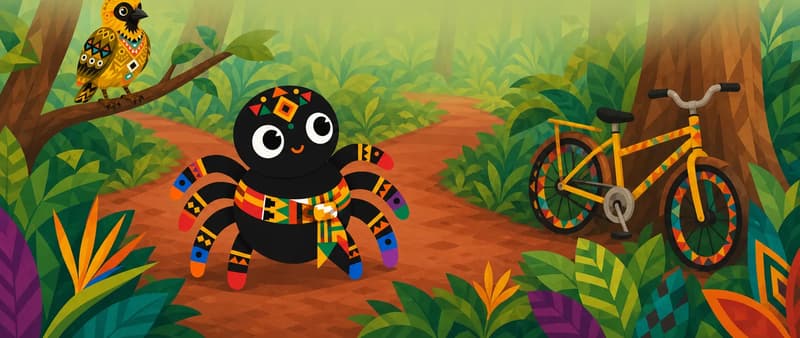
Anansi wanted to eat at every feast. That was the trouble. The villages were spread far across the forest, and each feast began at the very same hour. No one could get from one to the next in time. Every other animal just picked one village, ate, and was happy. But Anansi could not pick. Eating at all seven feasts became his one pursuit. 'Eyes bigger than your belly,' said Weaver Bird next door. Anansi waved her away. He was already thinking.

By morning, Anansi had his plan, and it suited him well. He would get the longest rope in the forest and cut it into seven equal bits. He would carry one bit to each village and hand one end to the village head. 'When the feast is ready, give this rope one hard tug, and I will come at once,' he would say. Then he would stand in the middle of the forest, holding all seven ropes, and wait.

Anansi carried the ropes from village to village, charming each head with his best smile. 'What a special guest,' each head said, glad to take the rope. It felt fine to have such a well-liked friend. Anansi had recruited all seven villages. By the time he trotted back to his spot in the middle of the forest, he was tired. But the thought of seven big meals kept his legs going. He tied all seven rope-ends around his waist to keep his hands free, and he sat down to wait.

Anansi waited through the early morning. He waited through the middle of the morning. He went over the order he would run: hill village first, then river, then valley. 'I will eat just a little at each one,' he told himself, 'just enough to taste every dish.' Then he stopped. 'No. I will eat the full feast at each one.' He laughed to himself, thinking of their faces when they saw how much one spider could eat. It would be the most fruitful day of his life. He did not know how close to the edge he sat.
![Create a single full-page children's book illustration. Use the attached character reference images and match each named character exactly — same shapes, colors and clothing; do not redesign them. SCENE: Seven Ashanti village chiefs in festival kente smile at steaming harvest feasts and reach at the same moment for Seven Festival Ropes (match attached reference; one rope end held by each of the seven chiefs). Enamel bowls and polished metal pots sit beside the food. COMPOSITION: Compose ONE full-bleed scene with a single continuous background that fills the whole image, characters at natural size placed toward the RIGHT. Keep the LEFT 50% text area genuinely open inside a smooth, low-detail gradient blur covering the LEFT 60% of the image. Use only a plain, continuous continuation of the scene background there, with NO characters, objects, props, hanging items, plants, patterns or decorations. Keep all important characters and detailed scene content in the RIGHT 40%, with only a soft natural fade into the blurred left text area. That LEFT 50% text area must be the SAME continuous background color as the scene (not a flat panel, not a different shade, no dividing line). Do NOT shrink or squash the characters. Book text will be overlaid in the LEFT 50% text area. Do not include any written text, letters, numbers, captions, speech bubbles, signs, labels, logos, or watermarks anywhere; the image must be purely illustrative.
[EDITOR_REGEN_REQUIREMENTS]
These editor requirements are mandatory and override any conflicting earlier wording:
- This is not described correctly. they would be in different villages](/cdn-cgi/image/fit=scale-down,format=auto,metadata=none,quality=75,width=800/https://books.bookbotkids.com/images/books/why-spider-has-a-tiny-waist/page_07_crop.webp)
Here is what Anansi did not know. This year the harvest was the best in forty years, the juiciest crop anyone could recall. Every village had finished cooking early. Each head looked at the hot, steaming feast and thought, the sooner we tug, the sooner our special guest comes. All seven heads looked at their feast. All seven heads smiled. All seven heads reached for their rope at the very same moment.

Yank. Yank. Yank. Yank. Yank. Yank. Yank. Seven ropes went tight at once. The pull of seven villages, all going different ways, hit Anansi's round middle with a big bang. He flew off the ground. He spun like a top. He made a sound no spider had ever made before. It would leave a bruise for a week. The ropes did not break. The knots held tight, because Anansi had tied them himself, and his knots were always good. That, it turned out, was the trouble.

Anansi was pulled east and west and north and south, up two hills and toward the river, all at the same moment. Every rope was taut. Every head tugged, wondering why their special guest was so slow. Anansi tried to shout for help. His voice came out as a tiny squeak, because there was not much room for air in his bruised middle now. The ropes squeezed tighter. And tighter. And tighter still.

At last the ropes went slack, because all seven heads, baffled by the pull, had let go at the same moment. Anansi dropped to the ground like a stone. He lay there a long, long time, looking up at the sky. His belly, once so round and fine, was now squeezed in the very middle. It looked like two round bits joined by a thin thread, no longer plump as a fruit. He sat up slow. He looked down at himself. He sighed.

By the time Anansi reached the hill village, they had eaten. By the time he reached the river village, they had packed up the pots. At the valley village, the children were already asleep. He went from village to village and found empty tables and full, happy animals patting their round bellies. The juicy big meals were all over. At the last village, Weaver Bird spotted him coming late, and she said it again, the thing she had said at the start. 'Eyes bigger than your belly.' She meant his waist. Everyone could see his waist now.

Anansi went home hungry. His fine round belly was gone forever, pinched into the thin spider-waist that all spiders carry to this day. It is what came of his greedy pursuit. You cannot be in seven places at once. Wanting it all often means getting nothing, and Weaver Bird is nearly always right. When a child at the feast piles their bowl too high, their grandmother sets it down gently and says what grandmothers in the Ashanti forest have said ever since. 'Eyes bigger than your belly.' And now you know just where that saying came from.