


Anansi and All Wisdom <augh>

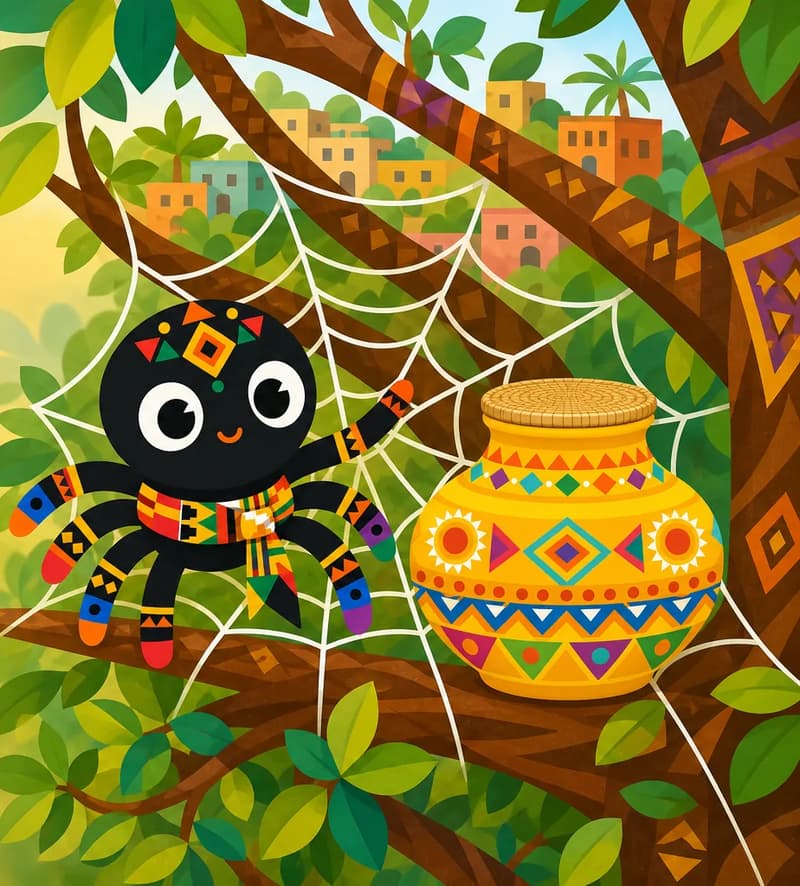
Anansi has a plan so big it makes his eight eyes shine. He will travel every road, visit every village, and collect all the wisdom in the world. Every clever idea, every sharp thought, every trick, he will put into one big pot. Then Anansi alone will be the most wise creature alive, and all must come to him for answers. He smiles a haughty smile at the pot, the way a cat smiles at a covered dish.

Anansi sets off through the forest. At every road fork he stops the animals and asks their best thoughts. The gray hornbill gives him the wisdom of patience. The river-crab gives the wisdom of moving sideways to get ahead. Even old Tortoise, who rarely speaks, mutters that a wise one carries what matters on his own back. Anansi tips each idea into the pot and taps the lid on tight. He laughs to himself, sure that no one else can hold so much. By the time he reaches the tall tree, the pot feels very heavy and very full.
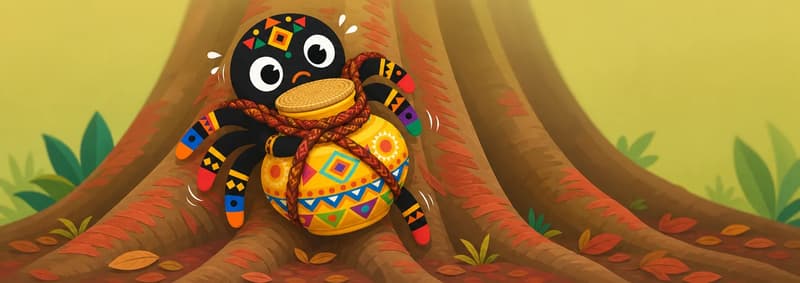
'I will hide the pot at the very top of this tree,' Anansi says, 'where no one can reach it.' He ties the pot's neck with a long, strong rope and loops the rope over his front four legs. He holds the pot close to his belly and starts to climb. But the pot swings and hits the bark and sends him sliding back down to the roots. He tries again. Slide. Again. Slide. The whole thing is starting to look laughable, and the smooth trunk is no help at all.
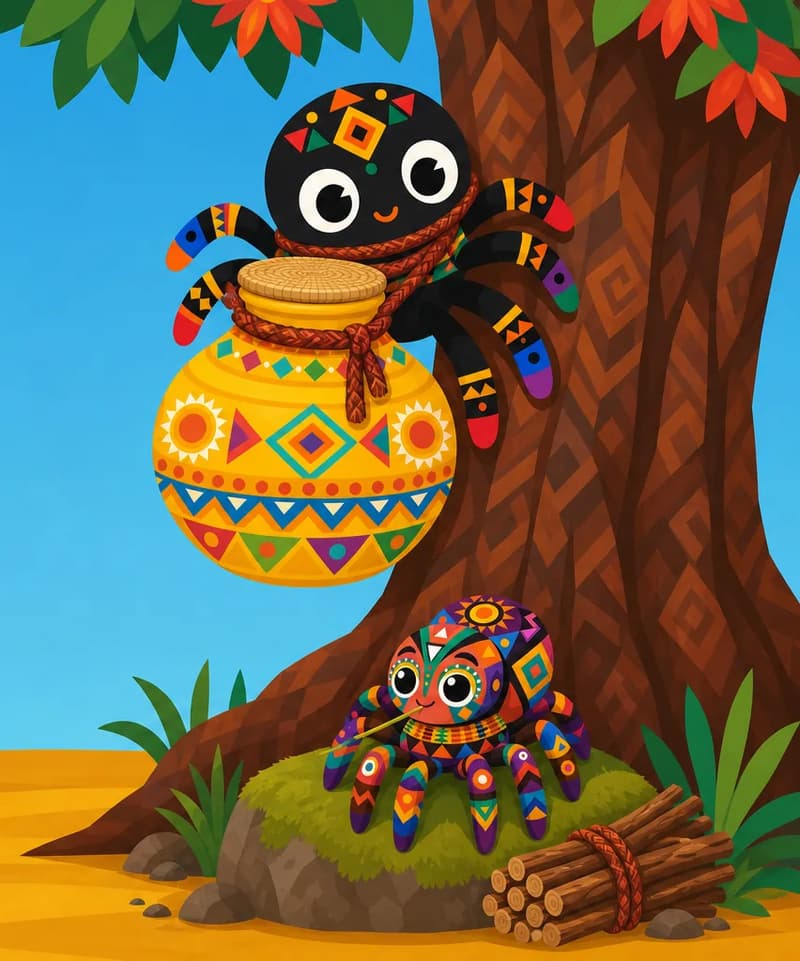
Sitting nearby on a low rock, watching quietly, is Anansi's small son, Ntikuma. The boy came to gather firewood when the sliding-spider scene began. Ntikuma bites a stem of grass and thinks for a moment. 'Father,' he calls up, 'why not tie the pot to your back instead of holding it in front? Then all your legs are free to climb.' It is such a simple, clear thought that Anansi nearly laughs, then freezes on the bark instead.
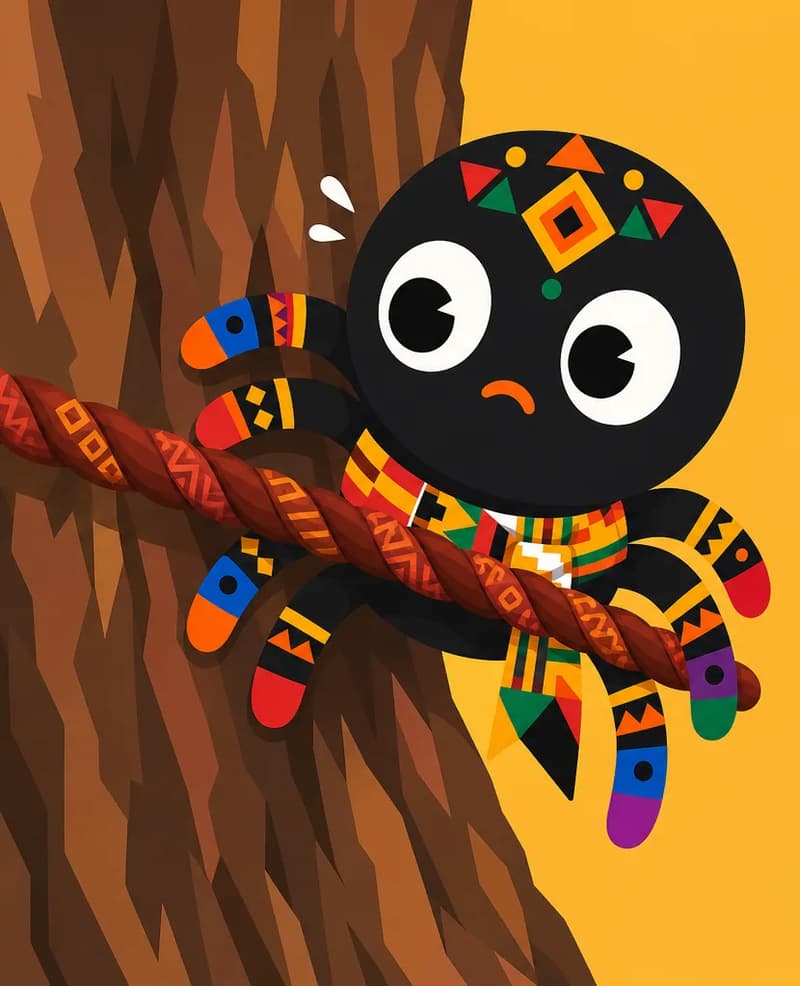
A hot rush of shame runs through Anansi, from his first leg to his eighth. He spent all morning gathering every scrap of wisdom in the world. And here is his own small son, giving him, for free, the most useful idea yet. The pot is supposed to hold everything. But this idea came from outside the pot. That means the pot is already incomplete, and Ntikuma was not even collecting. Anansi is distraught.

'If a child who stayed home has wisdom I do not have,' Anansi mutters, 'then there must be wisdom with the fisherman on the lake. And the drummer in the next village. And the old women who read the clouds.' He looks at the container. He looks at the tree. The container feels less like treasure now and more like naught but a heavy argument he is losing. Still, he cannot quite give up the plan. He climbs again, this time with the container tied to his back. His legs grip perfectly. Up and up he goes.
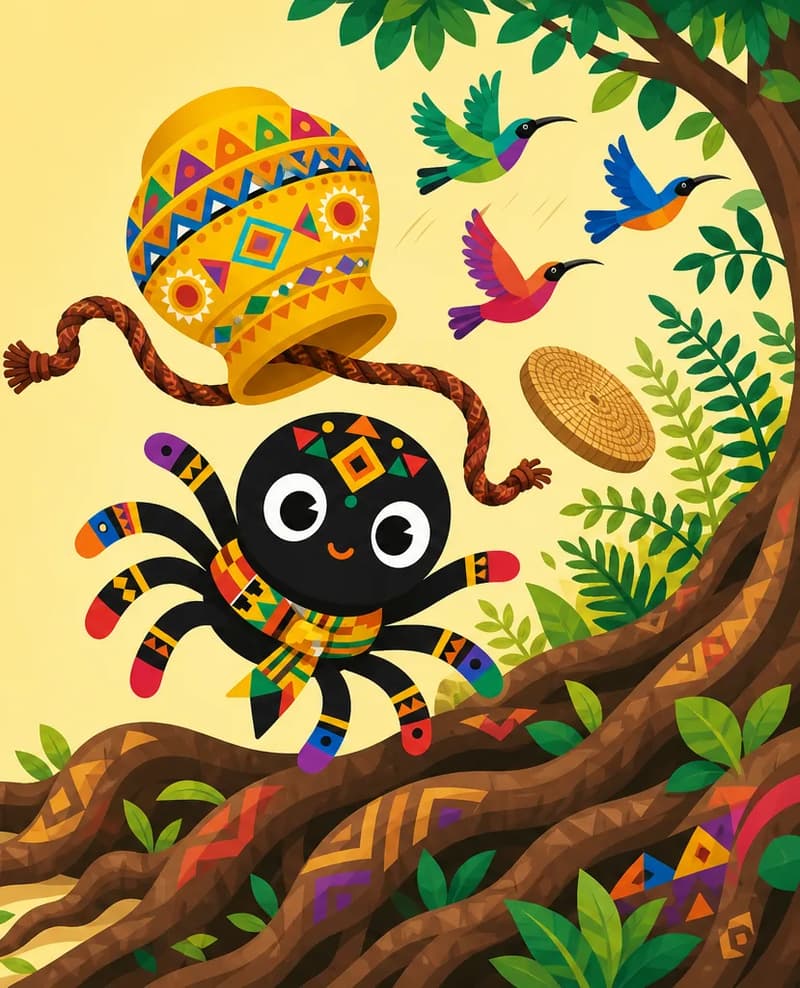
He is almost at the first high branch when the rope slips. The container tilts. Anansi grabs for it with two spare legs, lets go of the trunk with the others, and for one long, fraught, weightless moment he feels himself falling. The container falls faster. It hits a root with a crack that startles the birds from their nests. The lid spins off and rolls into the ferns below.
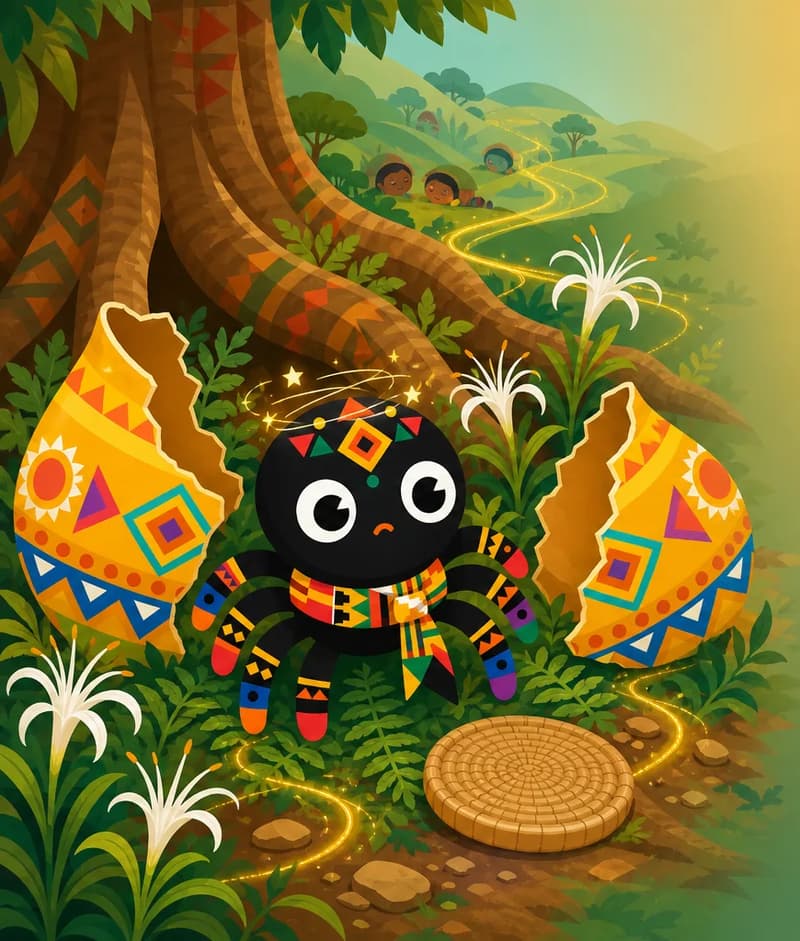
The wisdom bursts out of the container in every direction at once, shining, spinning, scattering on the morning wind. Some settles in the flowers by the stream. Some drifts into the ears of sleeping children. The wind's onslaught blows some all the way to the next kingdom, and the one beyond that. Anansi lands in the ferns with a soft thud, safe but surrounded by the ruins of his beautiful plan. The container sits in two pieces, and the wisdom is completely, perfectly gone.

Anansi sits in the ferns for a long time. Ntikuma sits beside him and does not say anything, because sometimes that is the most wise thing to do. The forest is very quiet, except for the river and the birds. Then a weaver-bird lands on the broken pot, tips its head, and sings three bright notes, as if it agrees with something. Anansi looks at his hands, all eight legs, all empty, and for the first time that day he feels strangely light, almost ready to laugh.
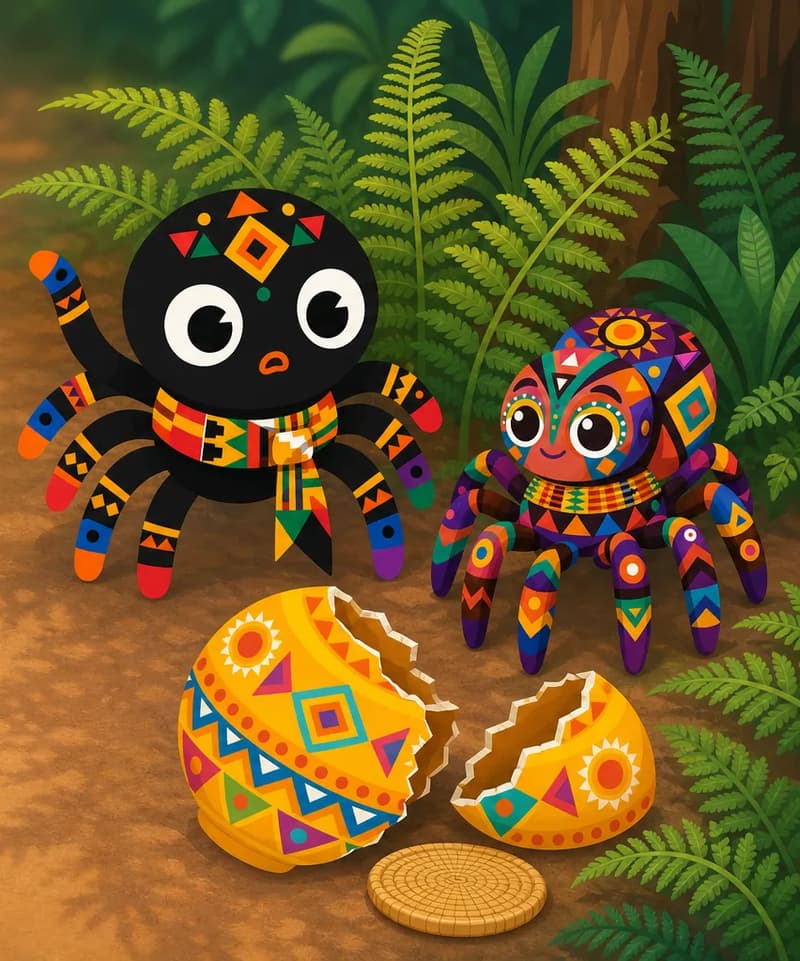
'I got the hornbill's patience,' Anansi says slowly, 'but I did not use it. I got the crab's wisdom of moving sideways, but I climbed straight up. Tortoise taught me to carry what matters on my own back, and then I ignored it.' He counts on four legs and runs out of legs before he runs out of ignored wisdom. 'The wisdom was never really in the pot,' Ntikuma says gently. 'It was in the using of it.' Anansi opens his mouth to argue, then shuts it again.
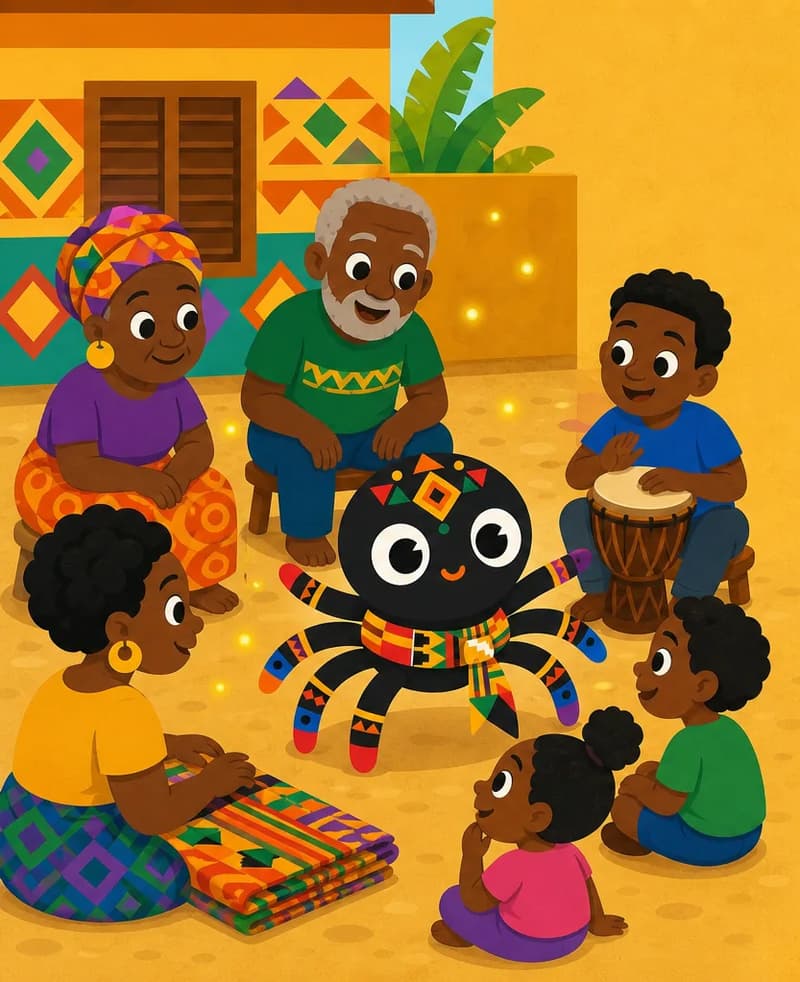
From that day on, wisdom lives in the wind, in the water, in the old songs and the new questions, in grandmothers and in small boys who watch quietly from rocks. Whenever anyone grows too sure they hold all the answers, a naughty little breeze scatters their papers, and someone smiles. Anansi tells the story on himself, because a spider who can laugh at his own plans is much harder to beat than one who cannot.

Nyame looks down from the sky and is pleased. Not because Anansi failed, the Sky-God is too kind for that, but because the wisdom has spread to every corner of the forest, instead of sitting sealed in one pot under one tall tree. And sometimes, late in the evening, when a child solves a problem that stumped every adult in the room, you can hear Ntikuma's voice in the answer, and Anansi's soft laughter. No one holds all the wisdom, not even Anansi. And that, it turns out, is a very wise thing indeed.