




Think about the last book that made you feel something. Maybe you were gripped by suspense or surprised by a twist you didn’t see coming. Now think about whether you remember specific words from that book. Chances are, you do.
When I review the research on how children pick up new words, one finding keeps coming through: emotions aren’t just passengers along for the reading ride. They’re active drivers of vocabulary development.

The Science Behind Emotional Reading and Vocabulary
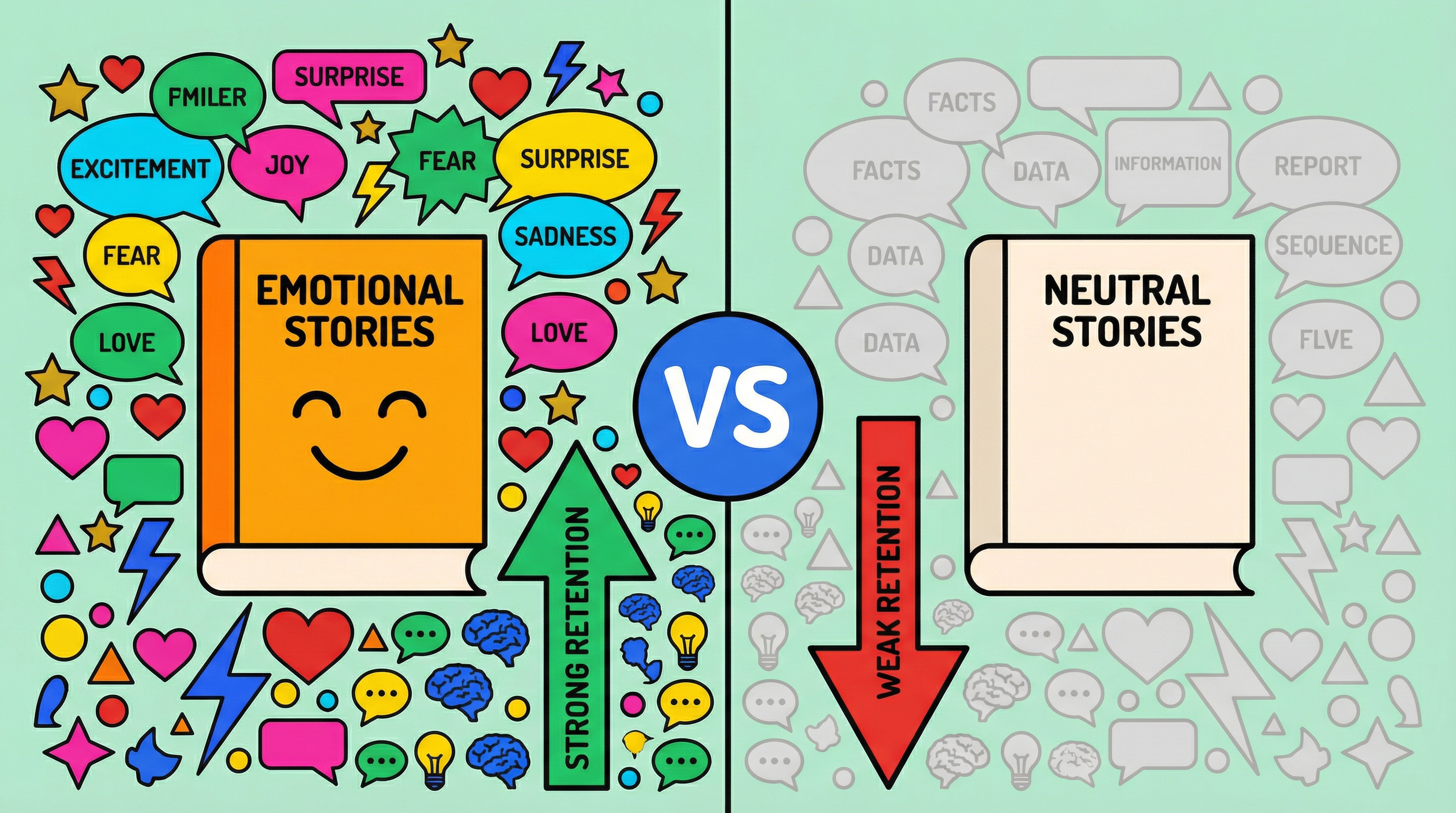
A 2025 study from the University of Oxford put this to the test. Dong and colleagues asked 76 adults to read 30 made-up words embedded in short stories. Some stories were happy, some were scary or sad, and some were deliberately neutral. The researchers then tested how well participants recognized and understood these new words, both immediately and 24 hours later.
The results were striking. Words encountered in emotional stories, whether positive or negative, were recognized more accurately than words from neutral stories right away. But here’s what I find most encouraging: when the researchers tested participants a full day later, words from the negative emotional stories (the scary or sad ones) were still remembered better than words from neutral contexts (Dong et al., 2025, Quarterly Journal of Experimental Psychology).
Something about emotional context makes new words stick.
Why Feelings Help Words Stick
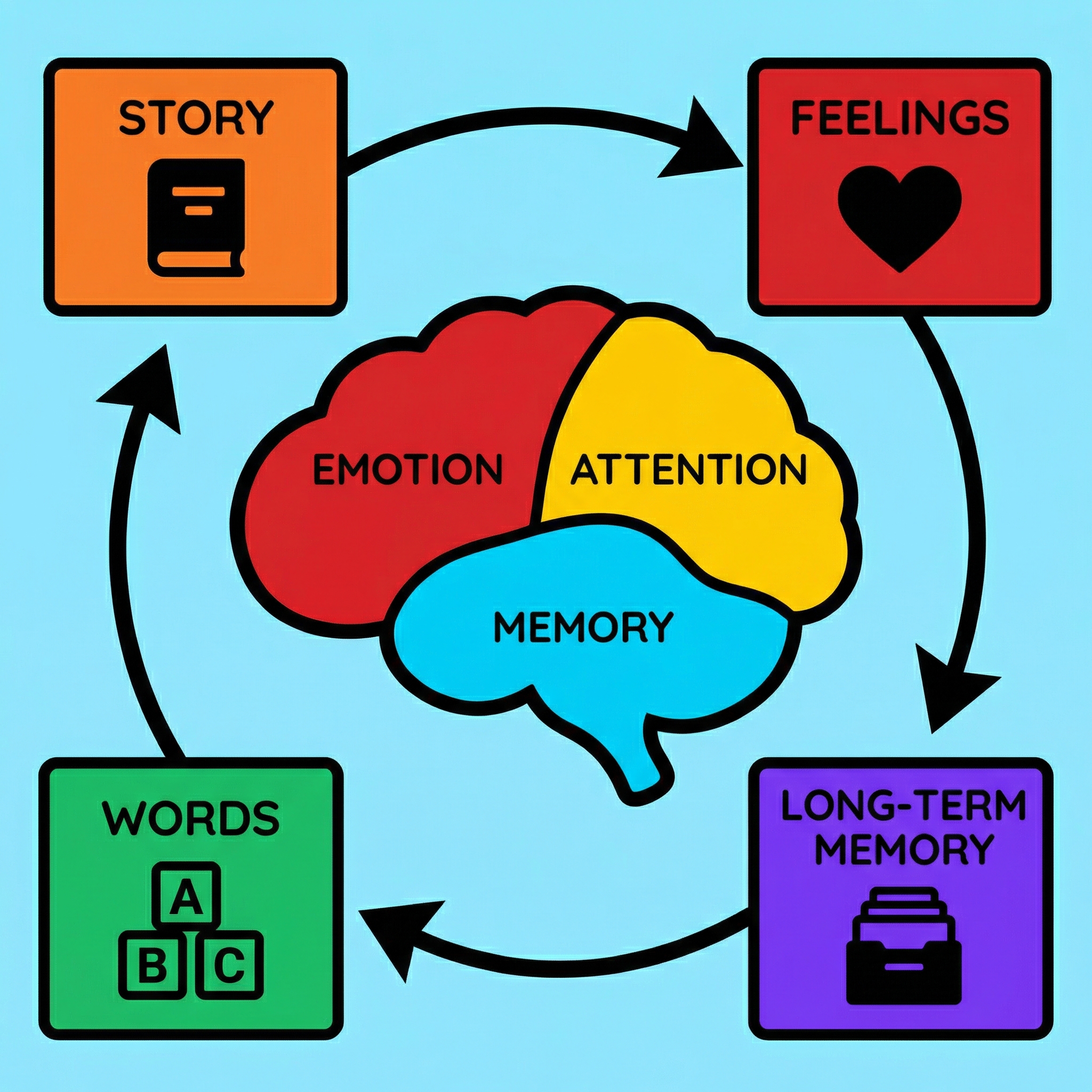
This isn’t just one study telling us something surprising. It fits within a broader body of neuroscience research. Mary Helen Immordino-Yang, a neuroscientist at USC, has spent years studying how emotions shape learning. Her core finding is that meaningful learning is inherently emotional, because our brains think deeply about things we care about (Immordino-Yang, 2015). When a child reads a story that makes them feel worried for a character or excited by an adventure, their brain isn’t just processing the plot. It’s consolidating the language that carries those feelings.
A 2025 systematic review (a study that pulls together findings from many papers) in Frontiers in Psychology reinforces this. Li, Zhang, and Wang analyzed 31 studies and found that social-emotional learning (the skills involved in recognizing and managing feelings) is associated with improvements in reading comprehension and vocabulary acquisition. Emotional involvement enhances memory consolidation and attention focus during reading tasks (Li et al., 2025).
When a story makes your child feel something, their brain pays closer attention to the words being used to create that feeling.
What This Means for Your Child’s Reading
The broader research on reading and vocabulary reinforces how important book time is. Mol and Bus (2011) conducted a meta-analysis (a large-scale review combining data from many studies) of 99 studies with 7,669 participants and found that print exposure, meaning the amount a person reads for pleasure, explained 12% of oral language skills in preschool-age children. That figure climbed to 34% in university students (Psychological Bulletin).
Reading develops vocabulary in ways that direct instruction alone cannot replicate. Children encounter words in rich, meaningful contexts that help them understand not just what a word means, but how it feels and when it’s used. This is incidental word learning (picking up new words naturally through context rather than direct instruction), and it’s one of the primary mechanisms behind developing vocabulary for reading.
This is something I see in my work with Bookbot and Flinders University, where I analyze reading data from thousands of children. The children who engage most with their stories tend to show the strongest vocabulary gains.
But there are other benefits to reading with emotional engagement.
A meta-analysis by Swanson and colleagues found that read-aloud interventions for at-risk children ages 3 to 8 produced a grand mean effect size of d = 1.02 for vocabulary outcomes, which means these interventions had a large, measurable impact on how many words children learned (Swanson et al., 2011, Journal of Learning Disabilities). Interactive approaches where children participated actively in the story, rather than passively listening, showed particularly strong results.
Practical Strategies for Parents
-
Choose books that make your child feel something. Stories with suspense, humor, or empathy aren’t just entertaining. They create the emotional context that helps new vocabulary stick. A story about a nervous first day of school teaches words like “anxious” and “brave” in a way a vocabulary list never could.
-
Talk about the emotions in the story. After reading, ask your child how a character felt and why. “What do you think scared the rabbit?” or “Why was she so excited?” These conversations reinforce both emotional understanding and the vocabulary that goes with it.
-
Don’t shy away from stories with difficult emotions. The Oxford study found that negative emotional contexts (fear, sadness, tension) produced the strongest long-term vocabulary retention. Books where characters face challenges and work through them are powerful vocabulary builders.
-
Re-read favorites. Children who ask for the same book again aren’t being difficult. Repetition in a familiar emotional context solidifies new words and deepens comprehension.
-
Read aloud interactively. Reading increases vocabulary most when children participate. Pause to ask questions, let them predict what happens next, and encourage them to use new words in their own sentences.
-
Make reading a daily habit. Mol and Bus’s (2011) research shows the relationship between reading and vocabulary strengthens over time. Even 15 minutes of daily reading to improve vocabulary adds up, exposing children to thousands of new words in context each year.

Every Story Is a Vocabulary Lesson
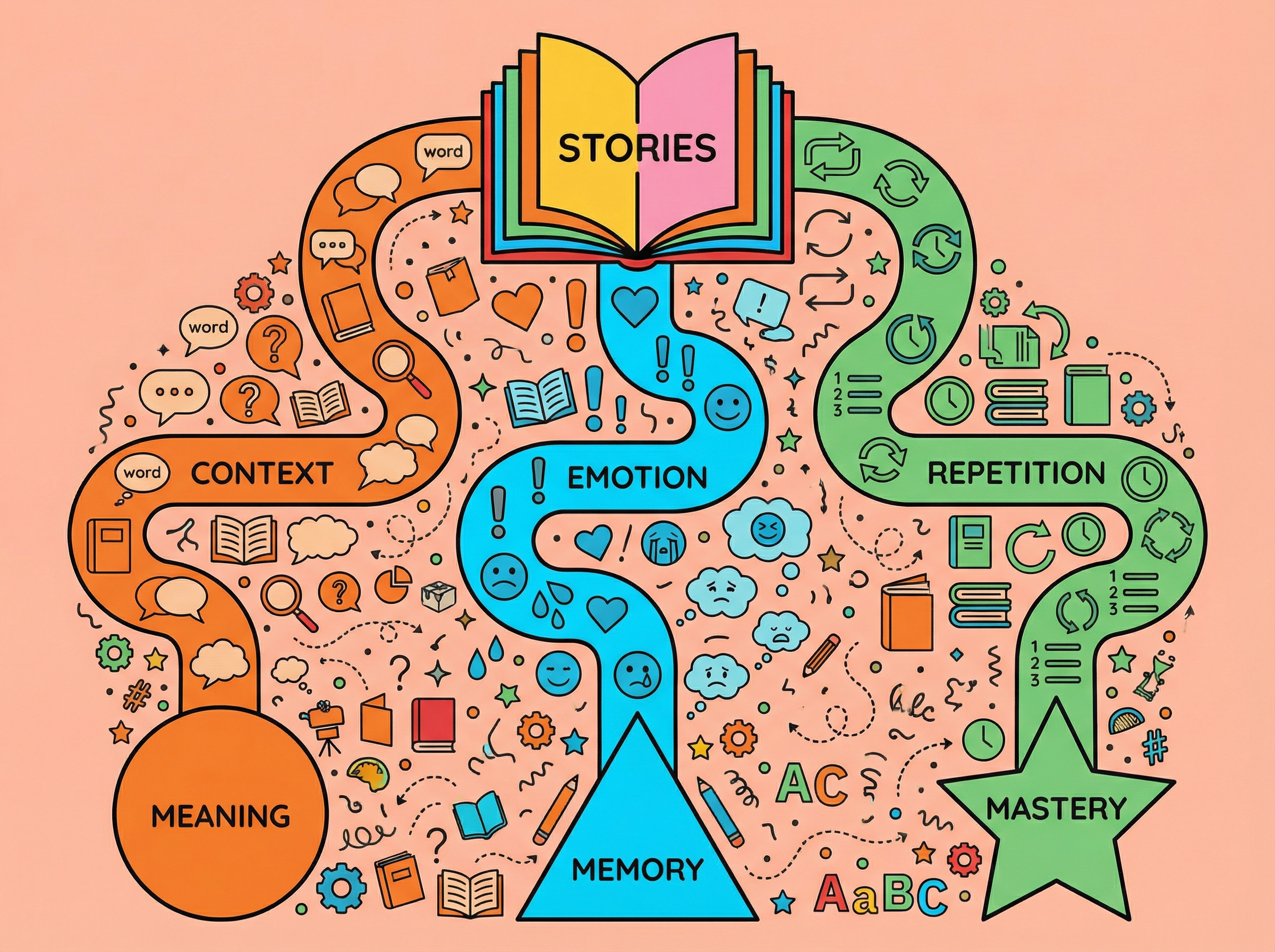
What I find most hopeful about this research is how natural the process is. You don’t need flashcards or word lists. You need stories that make your child laugh, worry, wonder, and care. The emotional connection they form with characters and plots is doing the heavy cognitive lifting, turning unfamiliar words into lasting knowledge.
This is one of the reasons we built Bookbot the way we did. The app pairs children with engaging, levelled stories and uses speech recognition to listen as they read aloud, giving immediate feedback. When children practise reading stories that hold their attention, they’re building vocabulary through exactly the kind of emotionally rich, contextual reading the research supports.
So tonight, pick a story that makes your child feel something. It’s one of the best things you can do for their reading and vocabulary.
References
Dong, Y., Mak, M. H. C., Hepach, R., & Nation, K. (2025). Learning new words via reading: The influence of emotional narrative context on learning novel adjectives. Quarterly Journal of Experimental Psychology, 78(10), 2167-2180. https://doi.org/10.1177/17470218241308221
Immordino-Yang, M. H. (2015). Emotions, Learning, and the Brain: Exploring the Educational Implications of Affective Neuroscience. W. W. Norton & Company.
Li, H., Zhang, Z., & Wang, H. (2025). How social-emotional learning promotes reading achievement? A systematic review of mechanisms and instructional design. Frontiers in Psychology, 16. https://doi.org/10.3389/fpsyg.2025.1631429
Mol, S. E., & Bus, A. G. (2011). To read or not to read: A meta-analysis of print exposure from infancy to early adulthood. Psychological Bulletin, 137(2), 267-296. https://doi.org/10.1037/a0021890
Swanson, E., Vaughn, S., Wanzek, J., Petscher, Y., Heckert, J., Cavanaugh, C., Kraft, G., & Tackett, K. (2011). A synthesis of read-aloud interventions on early reading outcomes among preschool through third graders at risk for reading difficulties. Journal of Learning Disabilities, 44(3), 258-275. https://doi.org/10.1177/0022219410378444