



We have always been big fans of Arm technology. Every phone and tablet running Bookbot, whether it is an iPhone, an iPad, or an Android device, is powered by an Arm chip. Their architecture is the reason we can run speech recognition and text-to-speech directly on a child’s device, even when there is no internet connection. For families in remote communities, that is the difference between a child getting reading support and not.
So when UNICEF brought us together with Arm’s engineering team for a workshop at their Austin, Texas campus on March 11, we jumped at the opportunity.
What We Worked On
The workshop focused on a question that matters deeply to us: how can we make Bookbot’s AI run even better on the hardware children already have in their hands?
We explored three main areas. First, optimizing our automatic speech recognition (the technology that listens to a child read aloud) and text-to-speech (the voice that reads back to them) to run more efficiently on Arm processors. Second, building voice activity detection for classrooms, so Bookbot can tell when a child is actually speaking versus when the room is just noisy. Third, removing classroom background noise from the audio before it reaches the speech recogniser, so children in busy classrooms get the same quality feedback as a child reading quietly at home.
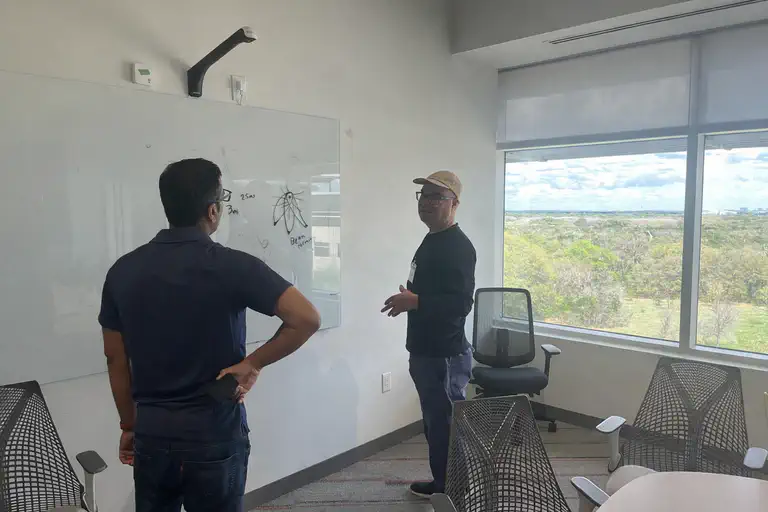
I want to especially thank Vikash Kumar from Arm for his incredible contribution. Before the workshop even began, Vikash had written an in-depth research paper on Bookbot, digging into how our technology works and where it could improve. He came to the table with detailed, impressive ideas on optimising our models for Arm silicon. That kind of preparation and genuine interest made the whole day far more productive than we could have hoped.
Why This Matters
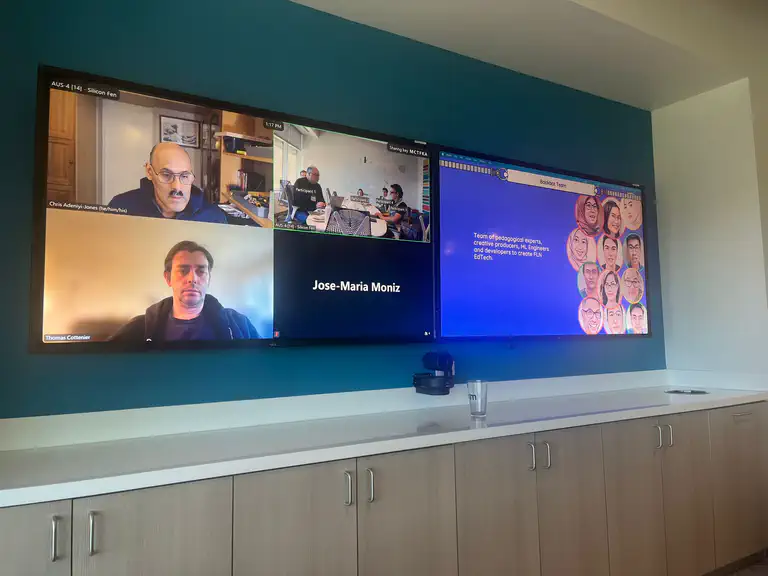
The workshop was a hybrid session, with Arm engineers joining both in person and remotely. Chris Adeniyi-Jones, Thomas Cottenier, and Jose-Maria Moniz joined via video alongside the Austin team, and we walked them through the Bookbot platform, our team, and the technical challenges we face in the field.
Bookbot already works offline, which is essential for the communities we serve. But this collaboration with Arm takes things to another level. If we can squeeze more performance out of the processors already sitting in every child’s pocket, we can deliver faster, more accurate reading feedback on even more devices, including older and lower-cost hardware. That means reaching more children in more places.
Looking Ahead
This is the beginning of a partnership we are really excited about. The ideas that came out of the workshop, from noise cancellation to more efficient on-device inference (running AI directly on the phone instead of relying on a server), have the potential to make Bookbot meaningfully better for every child who uses it.
A huge thank you to UNICEF for facilitating this connection, to Arm for hosting us in Austin, and to Vikash and the entire Arm team for their enthusiasm and expertise. We cannot wait to start building on what we planned together.