



Some children seemed to move through the pandemic years relatively intact. Others struggled long after schools reopened, still anxious, more withdrawn, harder to reach. As a parent or teacher, watching that play out raised a question that was hard to answer with any confidence: was resilience just something children either had or didn’t? Or was it something we could actually build?
A study published in March 2026 in Developmental Science gives us the clearest answer yet. Not just that resilience helps, but that it is a genuine cause of better outcomes in children facing adversity. This distinction matters more than it might sound.
The Study That Changes the Conversation
Hongcui Du and colleagues at Florida State University and the University of Waterloo studied 1,166 twin children across the United States (Du, Little & Hart, 2026). The children were tracked during the 2021-2022 school year, about eighteen months after the initial pandemic disruption, with an average age of just under thirteen.
What made this study different was its methodology. The team used a twin-based Direction of Causation (DOC) modeling approach, which leverages the natural genetic experiment of twins. Because identical twins share 100% of their genetics and fraternal twins share roughly 50%, comparing outcomes across twin pairs lets researchers separate cause from mere correlation. Most studies linking resilience to better outcomes cannot tell us which came first. This one could.
The answer was unambiguous. Resilience resources explained 32% of the variance in overall COVID-19 impacts across all children in the study. The path coefficient (a measure of causal strength, where 0 means no relationship and 1 means perfect prediction) from resilience to overall COVID impacts was -0.67, a large effect by any standard in developmental research. Children with more resilience resources experienced meaningfully less disruption to their social connections, lower general stress, and fewer pandemic-related anxiety symptoms.
The effect held across three specific COVID-19 impact domains: social connections, general stress, and COVID-related anxiety. For economic hardship, the picture was more nuanced. The relationship ran both ways: stronger resilience buffered economic impacts, but financial stress in the family also eroded children’s resilience resources over time.
When I look at children’s development data at Bookbot, this bidirectional pressure is visible. Children navigating instability at home don’t just struggle in the short term. The stress accumulates and shapes how they approach every challenge, including learning to read. The resilience question and the learning question are not as separate as they might seem.
What the Resilience Measure Actually Captured
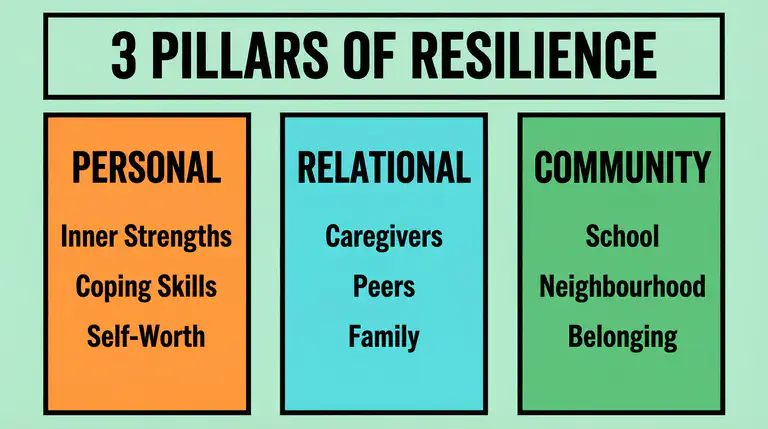
The researchers used the Child and Youth Resilience Measure (CYRM), assessing three areas: personal resources (a child’s sense of their own strengths and coping abilities), relational resources (connections with caregivers and peers), and community resources (feeling that school and neighbourhood are places they belong and matter).
None of these are fixed traits. They are built through experience, which is precisely why the causal finding matters. The study is not saying that naturally resilient children happen to cope better. It is saying that building resilience resources across these three domains produces a measurable reduction in how severely a crisis lands.
A 2025 systematic review in Frontiers in Psychiatry, covering 68 randomised controlled trials and over 16,600 participants, confirmed this: resilience-based, mindfulness-based, and sport-based school programs all produced meaningful improvements in children’s stress coping abilities. Resilience is teachable.
What This Means at Home and in the Classroom
Children with strong personal, relational, and community resources going into the pandemic experienced about a third less of its negative impact. That is a substantial buffer to build toward.
Economic stress deserves particular attention. The bidirectional finding is a signal to parents who have been through financial hardship: your child’s resilience may need intentional support, not just passive reassurance. Research by Olsavsky and colleagues (2024), following 231 caregiver-child pairs, confirmed that when caregivers experienced higher COVID-19 impact, children’s resilience declined over time, which in turn reduced their quality of life. The parent-child relationship transmits both stress and protection.
At Bookbot, we design for this. A child who practises reading consistently in a low-pressure environment builds not just phonics skills but a quiet accumulation of evidence that they can do hard things. That is exactly the kind of personal resilience resource the research is measuring.
Practical Strategies for Building Resilience in Children
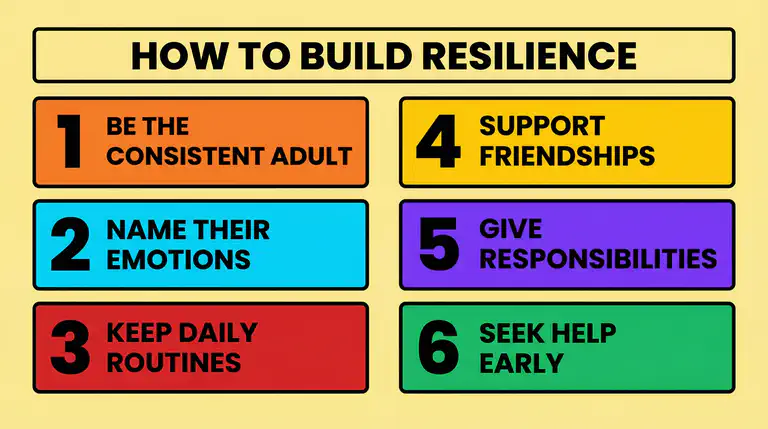
The research across all three domains points toward specific, actionable steps:
-
Be the consistent adult. The most powerful resilience factor in the literature is at least one stable, caring relationship. This means showing up reliably, listening without rushing to fix, and being genuinely interested in the child as a person.
-
Teach children to name their emotions. Children who can label what they are feeling develop better self-regulation than those who cannot. When a child is upset, try: “That sounds really frustrating. What do you think is making you feel that way?” Labelling is a personal resilience skill.
-
Protect routines, especially during disruption. COVID research consistently found that predictable daily routines buffered children’s mental health even when daily life changed dramatically. Bedtimes, mealtimes, and reading routines provide a sense of control when circumstances feel unpredictable.
-
Actively support friendships. Relational resources were among the strongest buffers in the Du et al. study. For children who became more withdrawn during the pandemic years, peer connection needs to be a deliberate priority, not something left to happen naturally.
-
Give children real responsibilities. Contributing to a family, classroom, or community builds the sense of mattering that underpins community resilience. Even small responsibilities (caring for a pet, helping a sibling, a classroom role) build this over time.
-
Seek support early if you see warning signs. Persistent sleep difficulties, withdrawal from previously enjoyed activities, and disproportionate irritability are all worth taking seriously. Resilience can be built at any age, but earlier support produces better outcomes.
The Evidence Is Encouraging
The pandemic is not fully behind us in its effects on children. A 2025 overview in Child and Adolescent Psychiatry and Mental Health found that mental health consequences continue to emerge years later, particularly among children from low-income families (Singh et al., 2025).
But the Du et al. study gives us something to hold onto. Resilience resources are genuinely protective. They do not just correlate with better outcomes. They cause them. The children who fared best were not those who faced less difficulty. They were those who had something to draw on when it arrived.
That is what building resilience in children actually means. Not toughening them up, but filling the well so there is something there when they need it. My work at Bookbot and Flinders keeps returning to the same finding: what protects children is not the absence of difficulty, but the presence of support.
References