



Your child reads the word night in a book on Tuesday. On Friday, spelling test day, it comes back as nite. That is not a memory problem. It is the gap between recognising a word and knowing it.
Most families file spelling under homework admin. Learn the list, survive the test, forget the list.
It deserves better. When I review the research on early literacy, spelling keeps turning up in the reading results. Teaching children to write words sound by sound helps them read, not just spell. That changes how to teach spelling at home.
The clearest number comes from a meta-analysis (a study pooling many earlier studies) led by Emma Shanahan in Reading and Writing (2025). Across 19 studies and 72 results, writing instruction improved reading for struggling children from pre-kindergarten to fifth grade at an effect size of 0.27 (a measure of how big the difference was; 0.27 is small but real). The gains showed up in word-level skills such as decoding and word reading, and most clearly from pre-K to Grade 2.
On spelling and reading comprehension, the picture is mixed. Some studies saw comprehension gains (Weiser and Mathes, 2011, among them), but in Shanahan’s pooling they were small and could not be told apart from chance.
The useful detail is in the moderator analysis, which asks what worked best. Transcription instruction, the mechanics of getting words onto the page through handwriting and spelling, beat broader lessons on composing whole texts.
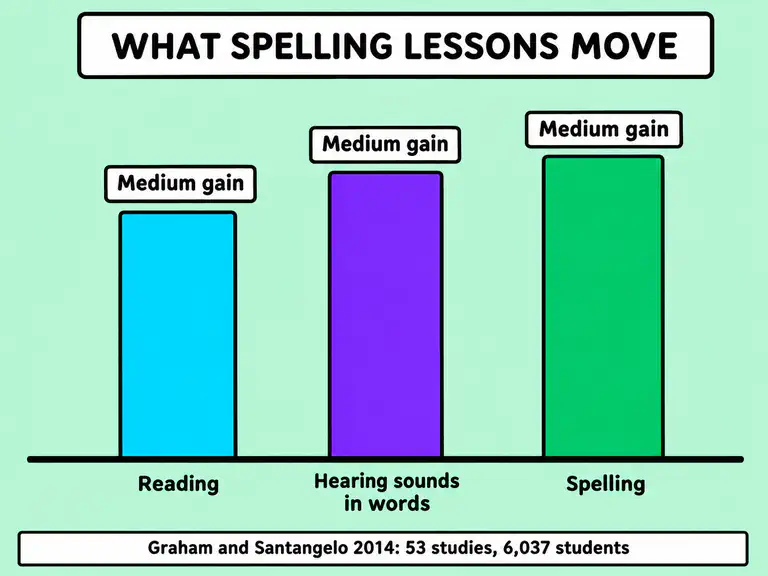
Older evidence, from all students rather than only struggling ones, agrees. Steve Graham and Tanya Santangelo (2014) pooled 53 studies and 6,037 students, kindergarten to Grade 12. Formal spelling instruction beat none at an effect size of 0.54 for spelling, and lifted phonological awareness (hearing the sounds inside spoken words) by 0.51 and reading skills by 0.44. All three are medium-sized gains.
Learning to spell did not stay in its lane.
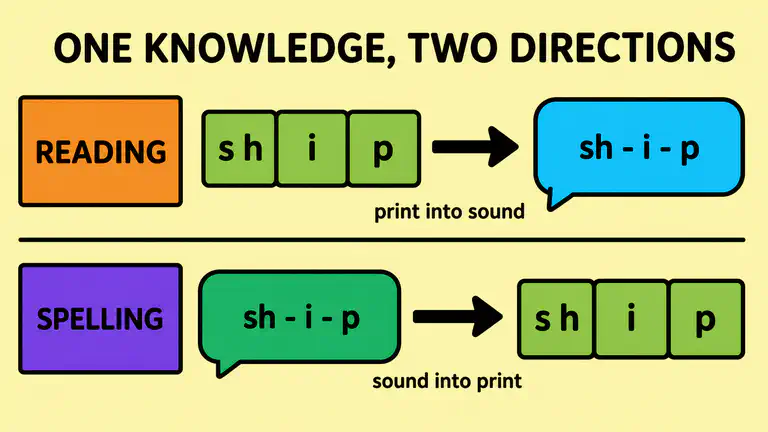
Bookbot works on the first of those two directions: it listens while a child reads aloud, print turning into sound. The second direction, sound turning into print, is where a pencil comes in.
Why Spelling and Reading Pull From the Same Knowledge
Reading a word and spelling it draw on the same knowledge but make very different demands. Decoding, turning letters into sounds, tolerates approximation: a child can half-recognise night from its shape, its first letter, and the picture on the page. Encoding, turning sounds into letters, lets nobody off. Every sound must be accounted for, in order.
Spelling exposes the gaps reading hides. That makes it a good check on what a child really knows about a word.
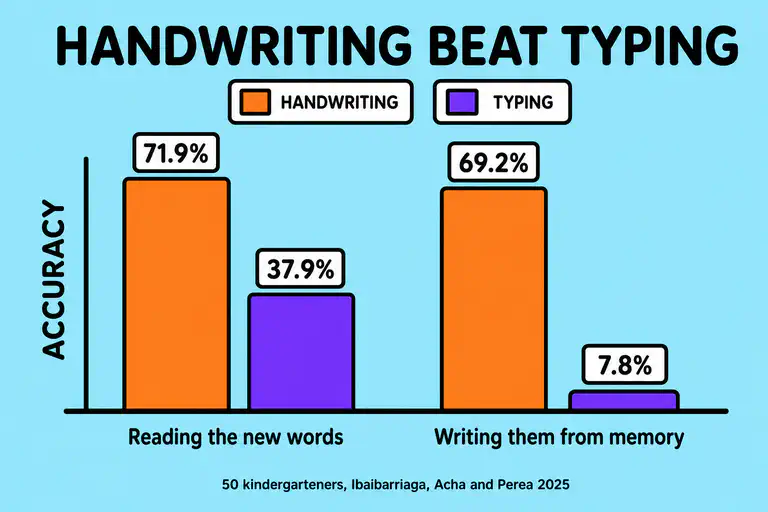
It also explains why the hand matters. Gorka Ibaibarriaga, Joana Acha and Manuel Perea (2025) had 50 kindergarteners learn nine unfamiliar letters from the Armenian and Georgian alphabets, plus 16 made-up words. Two groups used pencil and paper, two a keyboard. The handwriting groups later sounded those words out correctly 71.9% of the time against 37.9%, and wrote them from memory 69.2% against 7.8%.
The groups were small, 12 or 13 children each, and the letters were not English. Picking a learned letter out of a line-up showed no difference; the advantage appeared only on harder tasks.
Writing is no substitute for reading instruction, though. Young-Suk Grace Kim and colleagues (2025) ran a randomised controlled trial (teachers assigned to conditions by chance, the strongest design in education research) with 248 first and second graders in Scientific Studies of Reading. Spelling, vocabulary, sentence skills and writing quality improved, by small to large amounts. Word reading did not move.
How to Teach Spelling at Home in Ten Minutes a Day
One honest note first. The studies above tested programmes run by teachers and tutors. The ten-minute kitchen-table version below is my adaptation of what they did, not something they tested at home. These spelling activities aim to improve spelling and reading at once, and none takes more than ten minutes.
-
Dictate one decodable sentence, then have your child read it back. Use only letter-sound patterns they already know. This borrows from the encoding programmes Beverly Weiser and Patricia Mathes (2011) reviewed: 11 controlled studies where children wrote words from their sounds, with gains in phonemic awareness (hearing separate sounds in a word), decoding, fluency, spelling and comprehension.
-
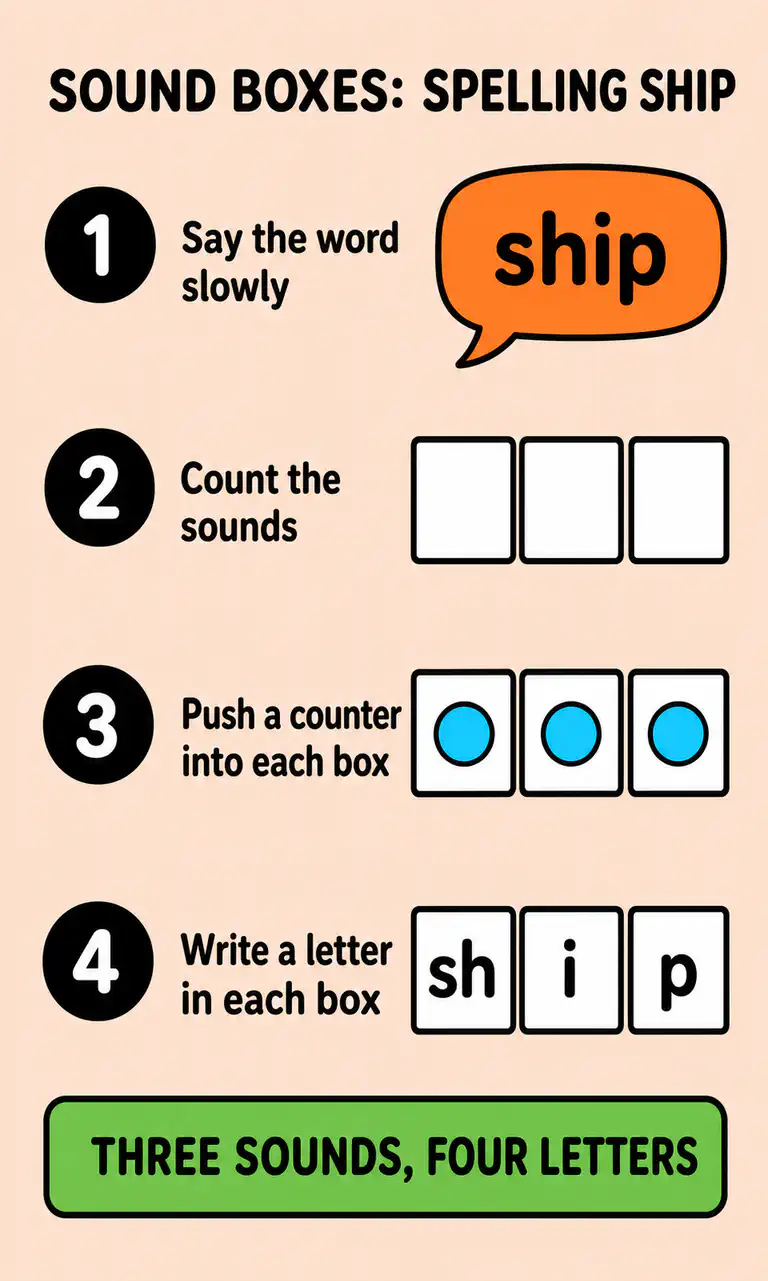
Use sound boxes before the pencil comes out. Draw one box per sound, say the word slowly, and have your child push a counter into each box, then write a letter in it. These are Elkonin boxes. They follow the same order as the programmes in Weiser and Mathes (2011): sounds first, letters second.
-
Have your child say each sound aloud while writing its letter. Saying and writing together is transcription work, the kind of instruction linked to larger reading gains in Shanahan et al. (2025).
-
Write the word straight after reading it. Pick three words from the book your child just finished and ask them to spell those from memory. Reading a word shows recognition; writing it shows the word is mapped.
-
Give spelling real time, not leftovers. Graham and Santangelo (2014) found that more formal spelling instruction helped more. My suggestion: of ten minutes, five can be a pencil.
-
Keep early practice on paper. On Ibaibarriaga et al.’s (2025) evidence, the keyboard is the weaker tool at this age. And since Kim et al. (2025) lifted spelling without moving word reading, daily reading aloud still has to happen.
Where to Start
A shaky speller is not a separate problem sitting beside reading. It is the same problem from the other side. If your child needs help with spelling, start below the level that is failing: a child who cannot spell ship is not rescued by a longer list.
What I find most encouraging is how small the change is. The programmes in these studies had children write words by hand while paying attention to the sounds inside them. A pencil and ten minutes is the home version of that.
Pick one sentence tonight. Say it, let them write it, then let them read it back.
References
Graham, S., & Santangelo, T. (2014). Does spelling instruction make students better spellers, readers, and writers? A meta-analytic review. Reading and Writing, 27(9), 1703-1743. https://doi.org/10.1007/s11145-014-9517-0
Ibaibarriaga, G., Acha, J., & Perea, M. (2025). The impact of handwriting and typing practice in children’s letter and word learning: Implications for literacy development. Journal of Experimental Child Psychology, 253, 106195. https://doi.org/10.1016/j.jecp.2025.106195
Kim, Y.-S. G., Harris, K. R., Goldstone, R., Camping, A., & Graham, S. (2025). The science of teaching reading is incomplete without the science of writing: A randomized control trial of integrated teaching of reading and writing. Scientific Studies of Reading, 29(1), 32-54. https://doi.org/10.1080/10888438.2024.2380272
Shanahan, E., Reno, E., Chandler, B. W., Novelli, C., An, J., Choi, S., & McMaster, K. L. (2025). Effects of writing instruction on the reading outcomes of students with literacy difficulties in pre-kindergarten to fifth grade: A meta-analysis. Reading and Writing, 38(3), 627-650. https://doi.org/10.1007/s11145-024-10527-6
Weiser, B., & Mathes, P. (2011). Using encoding instruction to improve the reading and spelling performances of elementary students at risk for literacy difficulties: A best-evidence synthesis. Review of Educational Research, 81(2), 170-200. https://doi.org/10.3102/0034654310396719