



The robot teacher story that travelled around the world last week began with a purchase order. A school district in upstate New York approved $57,590 for a humanoid robot with silicone skin and long dark hair, nicknamed her Sally, and planned to put her in front of high school robotics students.
Within days the plan was on hold. The state teachers’ union president said a robot built by a company with corporate ties to a sex doll manufacturer had no business in a classroom. Parents wanted to know where their children’s data would go.
I understand that reaction. I had it myself, for about four seconds.
Then I went back to the research, and it says something less satisfying than “robots don’t belong in schools.” Robots in the classroom can work rather well, in one specific configuration, and Sally was arguably specced into it. What failed at Salamanca was not the idea of an ai robot teacher. It was everything arranged around it.
The evidence here is unusually specific
Most education research hands you a murky answer. This one does not.
de Winter and colleagues (2026) ran a meta-analysis, which pools results from many separate studies into one estimate, across 146 studies of social robots in education. Seventy-eight had control groups, meaning a comparison class that carried on without the robot.
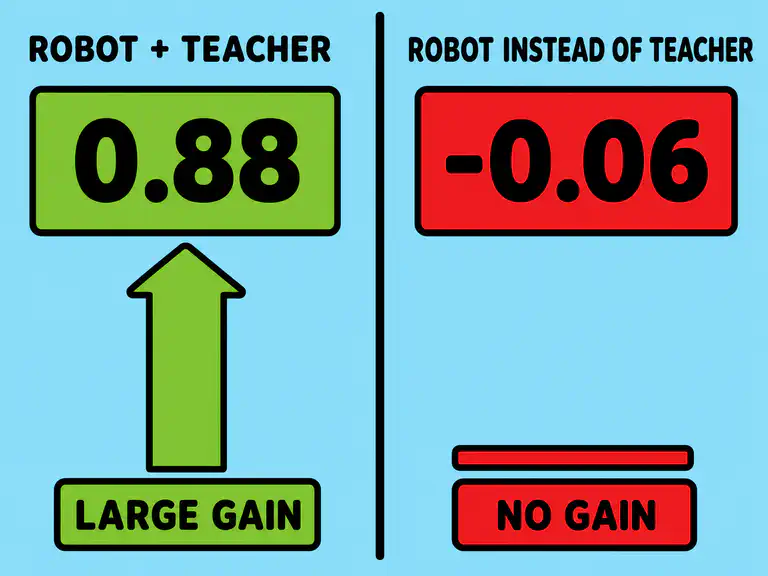
When the robot worked alongside a teacher, the effect size was 0.88. Effect size is a way of measuring how much difference something made, and 0.88 is large. Most classroom interventions land between 0.2 and 0.4.
When the robot replaced the teacher, it was -0.06. That is nothing at all, fractionally worse than nothing.
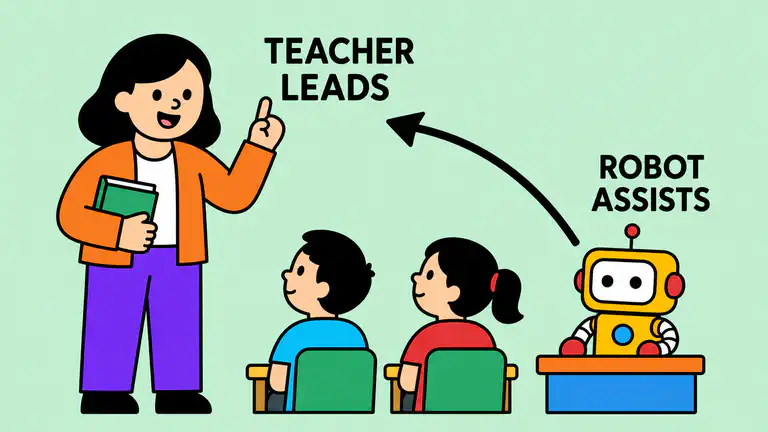
Read those two numbers beside each other. The same technology, in comparable classrooms, teaching comparable content, either produces one of the strongest effects in the literature or none at all. The variable is whether a human teacher is still in the room.
Belpaeme and colleagues (2018) help explain why. Reviewing 309 study results going back to 1992, they found social robots can approach one-on-one human tutoring on narrow, well-defined tasks, largely because a physical body engages children more than a face on a screen. The gains shrink as the task grows broader and more open-ended, which is exactly where real teaching lives.
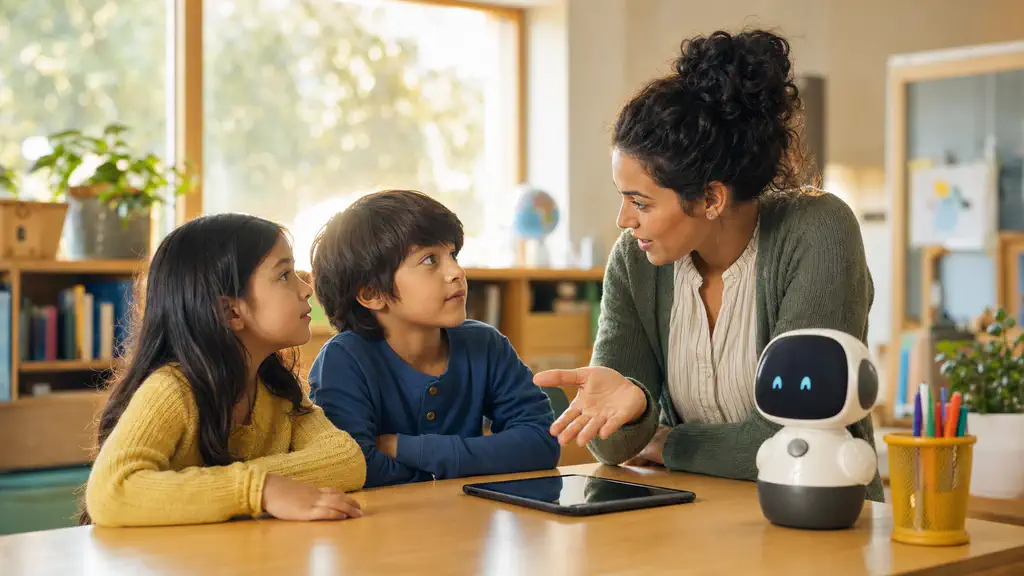
That gap is what I am working on at Bookbot with Dr. Nathan Caruana’s HAVIC Lab at Flinders University, where we have put Bookbot onto a small social robot called Maki. We are not building a teacher. We want to know whether a patient robot listening to a child read aloud helps her keep going.
What actually went wrong at Salamanca
Sally was never going to run a class. She was a stationary unit, bought to help high school robotics students understand how a machine like her works and how to troubleshoot her. On the de Winter evidence, that sits close to the configuration that produces 0.88.
The failures were procedural, and avoidable.
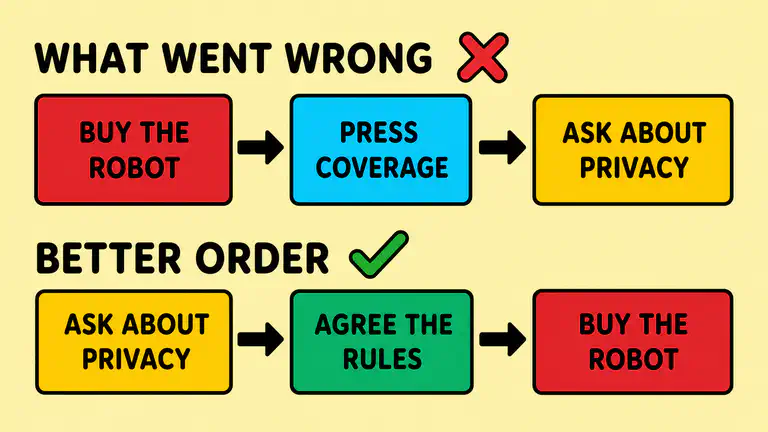
The purchase was approved before the privacy agreements existed, and the district is negotiating those now, after the board vote and after parents began asking. The vendor’s corporate ties surfaced in the news rather than in due diligence. The consultation is damage control instead of design input.
There is also the design itself. Sally was built to look like a person, and that realism buys nothing pedagogically. It does cost something.
Why this matters more for younger children
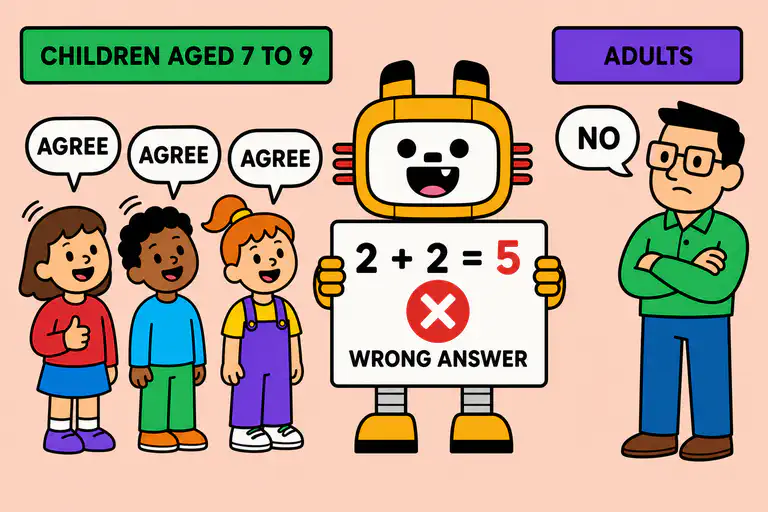
Vollmer and colleagues (2018) ran a classic conformity experiment, the kind where a group gives an obviously wrong answer to see whether you go along with it. Adults resisted a group of robots. Children aged seven to nine conformed to them.
Sit with that. Children agreed with robots that were plainly wrong. Adults did not.
That is why I am uneasy about lifelike design, and it has nothing to do with squeamishness. The more human a machine looks, the more social credibility it borrows, and children hand that over freely. Singh and colleagues (2023) found the same readiness to trust in twelve kindergarteners in New Delhi, even when the robot’s accent led them to the wrong sound.
So the risk with robot tutors is not that they are cold and mechanical. It is the reverse: children treat them as more trustworthy than they have earned, and a lifelike face amplifies that.
This is why our Safe AI for Children policy contains a line we will not cross: we do not build features designed to create emotional attachment to the app or to a synthetic character. Bookbot’s face is friendly and unmistakably a robot. That is deliberate.
What to ask before a robot arrives
If your child’s school raises the idea of robots teaching in schools, these are the questions worth asking. Salamanca is answering them in the wrong order.
- Is a teacher still in the room? de Winter’s 0.88 against -0.06 turns entirely on this. A robot assisting a teacher has research behind it. A robot instead of one does not.
- What happens to the audio and video? Ask whether anything is recorded by default, whether it leaves the device, and how long it is kept. At Bookbot, speech recognition, the technology that listens as a child reads aloud, runs on the device and the audio is discarded by default, so there is no recording to protect.
- Who is accountable when it fails? Teachers are registered and can be held to account. No equivalent register exists for an ai robot teacher. Ask for a named person, not a committee.
- Does it look like a person, and if so, why? If nobody can explain what the realism achieves for learning, it is a marketing decision paid for with children’s trust.
- What does it do when it is unsure? A system that guesses will eventually tell a child she is wrong when she was right. Ours stays quiet when it is not confident, because a missed error costs one word and a false accusation costs confidence.
The backlash could cost us something
What I want to avoid here is an overcorrection.
It would be easy, after Sally, to treat AI in the classroom as a settled argument where the answer is simply no. That would be a shame. The evidence on robots replacing teachers and the evidence on robots assisting them point in opposite directions, and a blanket no discards both. Assistive robotics holds real promise for the children hardest to reach, which is why we are studying whether a reading robot can support Indigenous children, who have rarely seen themselves reflected in the technology handed to them.
Salamanca did not fail because it wanted a robot. It failed because it bought one first and asked the questions afterwards. Those questions are not difficult. We wrote ours down and published them so people can check whether we keep to them.
When I look at reading data from thousands of children, what predicts progress is never how clever the technology is. It is whether a child feels safe enough to try the next word after getting one wrong. Any machine we put in front of a child has to be judged on that.
References