




Imagine your child sitting with a book, sounding out the same word for the third time, her face tightening with frustration. She is smart, curious, and can tell you everything about dinosaurs from a documentary she watched once. But when she looks at a printed page, something stalls.
If this sounds familiar, you are not alone. Dyslexia affects roughly 10 to 20 per cent of children worldwide, according to the International Dyslexia Association. And for most of these kids, the struggle has nothing to do with effort or intelligence. It has everything to do with how their brain is wired for reading.
I study this wiring. As a cognitive neuroscientist working with Bookbot and Flinders University, I analyse real reading data from thousands of children, and the neuroscience behind dyslexia is one of the areas I find most fascinating, because it tells us not just what is going wrong but exactly where to intervene.

The Reading Circuit: Three Regions That Work Together
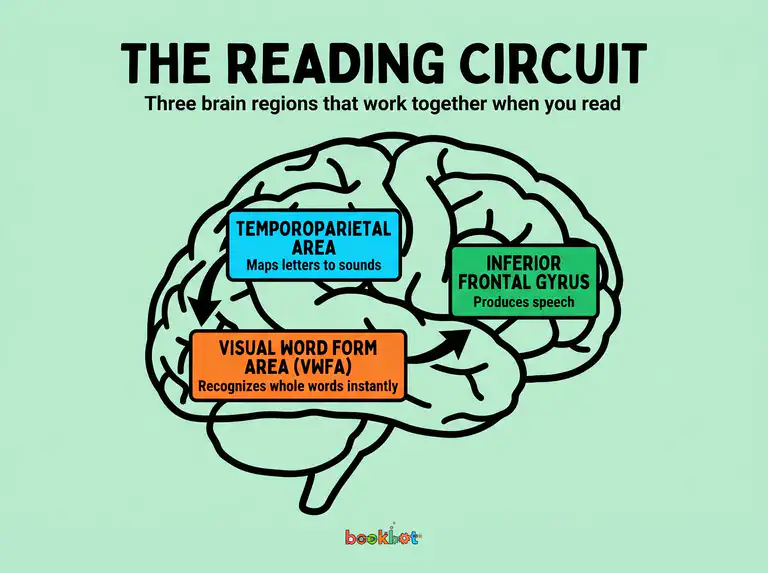
When a skilled reader sees a word on a page, three brain regions fire in rapid sequence. The left temporoparietal area maps the letters to their sounds. The visual word form area (VWFA), a small region on the left side of the brain roughly the size of a ten-pence coin, recognises the word as a whole unit. And the inferior frontal gyrus handles the production side, turning that recognition into speech.
In a typical reader, this circuit becomes fast and automatic. A child sees “dog” and her brain retrieves the word almost instantly, without needing to sound it out letter by letter.
In a child with dyslexia, this circuit works differently.
What Brain Scans Actually Show
A landmark study by Shaywitz and colleagues at Yale used functional MRI to scan the brains of 144 children, 70 with dyslexia and 74 typical readers, as they read real words and pseudowords, which are made-up words that follow normal spelling patterns (Shaywitz et al., 2002). The results were striking. Children with dyslexia showed significantly less activation in both posterior brain regions, the temporoparietal area and the occipitotemporal area where the VWFA lives. Instead, they showed increased activation in the frontal regions, as if the brain were compensating for a broken motorway by rerouting through slower side streets.
This pattern has been confirmed by dozens of studies since. When I review this research on how does dyslexia affect reading at the neural level, what stands out is how consistent the findings are. The same disruption appears across labs worldwide: reduced activity in the back of the brain, where fast, automatic word recognition should happen.
Then in 2026, a Stanford-led team published a study in Nature Communications that took this even further. Mitchell, Yeatman, and colleagues scanned 87 children over six years and found something remarkable: in nearly all typical readers, the visual word form area was clearly detectable on brain scans, but in children with dyslexia, the VWFA was smaller or entirely absent in more than a third of them (Mitchell et al., 2025).
The brain region responsible for instant word recognition may literally not be there yet in a child with dyslexia.
What This Means for Your Child
If your child is struggling to read, this is not a character flaw. It is a neurobiological difference, one that exists before a child ever picks up a book. Research on infants with a family history of dyslexia shows that the arcuate fasciculus, a bundle of nerve fibers connecting the brain’s language regions, already develops differently in these children before they start school (Vandermosten et al., 2015).
But here is the part that I find most encouraging when I analyse the data.
The dyslexic brain is not fixed.
That same Stanford study showed that after eight weeks of intensive, structured reading intervention, the visual word form area actually grew in children with dyslexia. Their reading scores improved by about one grade level over those eight weeks. Children who did not receive the intervention showed no comparable brain changes (Mitchell et al., 2025).
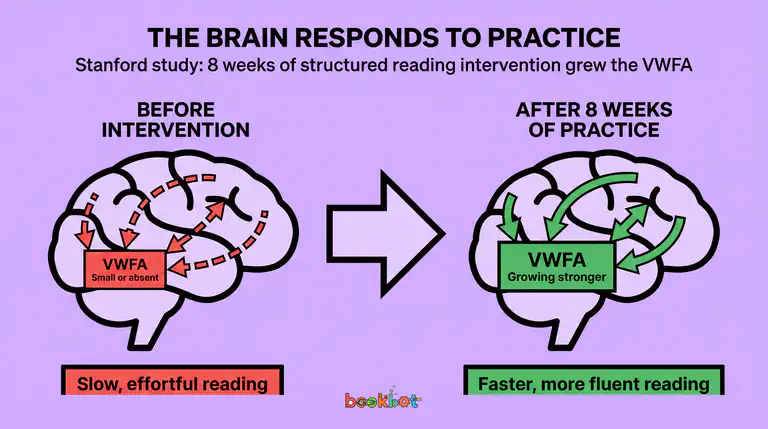
A broader review of 39 neuroimaging studies confirmed this pattern across multiple research groups. Perdue and colleagues found that reading intervention produces measurable changes throughout the brain’s reading network, including increased activation in the left hemisphere regions that are typically underactive in dyslexia (Perdue et al., 2022).
The brain responds to the right kind of practise. That is the central finding.
Practical Strategies for Parents
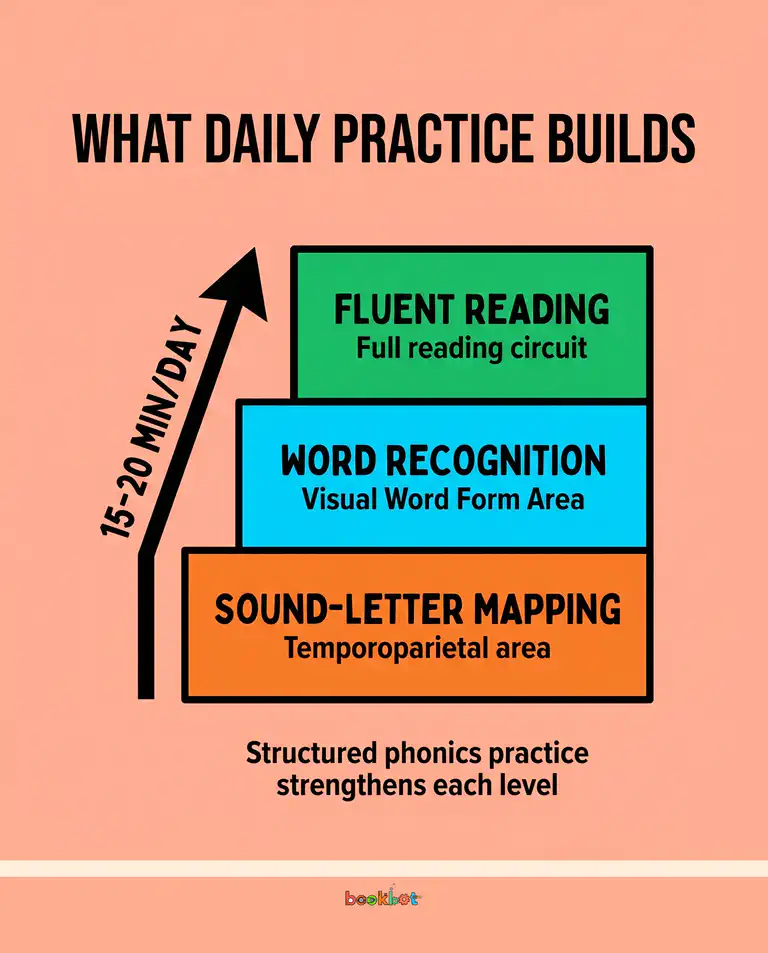
Start with structured, systematic phonics. The evidence is clear: explicit instruction that connects sounds to letters is the most effective approach for dyslexia in children. A meta-analysis, a study that combines the results of many individual studies, covering 53 research trials found that systematic phonics intervention significantly improves reading outcomes, with younger children benefiting the most (Hall et al., 2023). This is exactly what we build at Bookbot: structured, phonics-based reading practise that meets children where they are.
Practise daily, even if briefly. The Stanford study used eight weeks of intensive practise. You do not need a clinical setting. What matters is consistency: 15 to 20 minutes of focused reading practise every day builds the neural pathways that the dyslexic brain needs.
Focus on decoding, not memorisation. When a child with dyslexia guesses at words based on pictures or context, the reading circuit does not get the workout it needs. Sounding out words, even when it is slow and frustrating, is what trains the temporoparietal and occipitotemporal regions to fire correctly. At Bookbot, our speech recognition listens as children read aloud and guides them through decoding in real time, so this critical practise happens with every session.
Read aloud together. Your child’s listening comprehension is likely far ahead of her reading ability. Reading to her keeps vocabulary and knowledge growing while she builds decoding skills. That gap between what she understands by ear and what she can read on the page is one of the clearest signs of dyslexia, and closing it is the goal.
Do not wait for a formal diagnosis. The research on neuroplasticity, the brain’s ability to reorganise itself through new connections, shows that the brain is most responsive to intervention when children are young. If your child is struggling with letter sounds, rhyming, or sounding out simple words in Reception or Year 1, structured practise can begin immediately.
Celebrate the effort, not just the outcome. When your child pushes through a difficult word, her brain is literally building new connections. Acknowledging that effort matters.
The Brain Can Change
Dyslexia is real, it is neurobiological, and it is not the child’s fault. But the same neuroscience that identifies the problem also points to the solution. With structured, phonics-based practise, the regions that process written language can grow and strengthen, even in children where those regions started out smaller or less active.
That is what my research at Bookbot and Flinders University focuses on: giving every child’s brain the best chance to build a strong reading circuit. The data keeps showing us that with the right support, these children can become confident readers.
References
Hall, C., Steinle, P. K., & Vaughn, S. (2023). Forty years of reading intervention research for elementary students with or at risk for dyslexia: A systematic review and meta-analysis. Reading Research Quarterly, 58(2). https://doi.org/10.1002/rrq.477
Mitchell, J., Yeatman, J. D., et al. (2025). The balance between stability and plasticity of the visual word form area in dyslexia. Nature Communications. https://doi.org/10.1038/s41467-025-67054-3
Perdue, M. V., Mahaffy, K., Vlahcevic, K., Wolfman, E., Erbeli, F., Richlan, F., & Landi, N. (2022). Reading intervention and neuroplasticity: A systematic review and meta-analysis of brain changes associated with reading intervention. Neuroscience & Biobehavioral Reviews, 132, 465-494. https://doi.org/10.1016/j.neubiorev.2021.11.011
Shaywitz, B. A., Shaywitz, S. E., Pugh, K. R., Mencl, W. E., Fulbright, R. K., Skudlarski, P., Constable, R. T., Marchione, K. E., Fletcher, J. M., Lyon, G. R., & Gore, J. C. (2002). Disruption of posterior brain systems for reading in children with developmental dyslexia. Biological Psychiatry, 52(2), 101-110. https://doi.org/10.1016/S0006-3223(02)01365-3
Vandermosten, M., Hoeft, F., & Ghesquiere, P. (2015). A three-time point longitudinal investigation of the arcuate fasciculus throughout reading acquisition in children developing dyslexia. NeuroImage, 116, 101-112. https://doi.org/10.1016/j.neuroimage.2015.05.049