Drop Them Both! UFLI Foundations Lesson 79
3.8 Books are rated by kids in the Bookbot app
Drop Them Both!

Practice Words

more hard before dark large arm chart arms far for form forty harsh marks or sharp start are hardly
Page 1
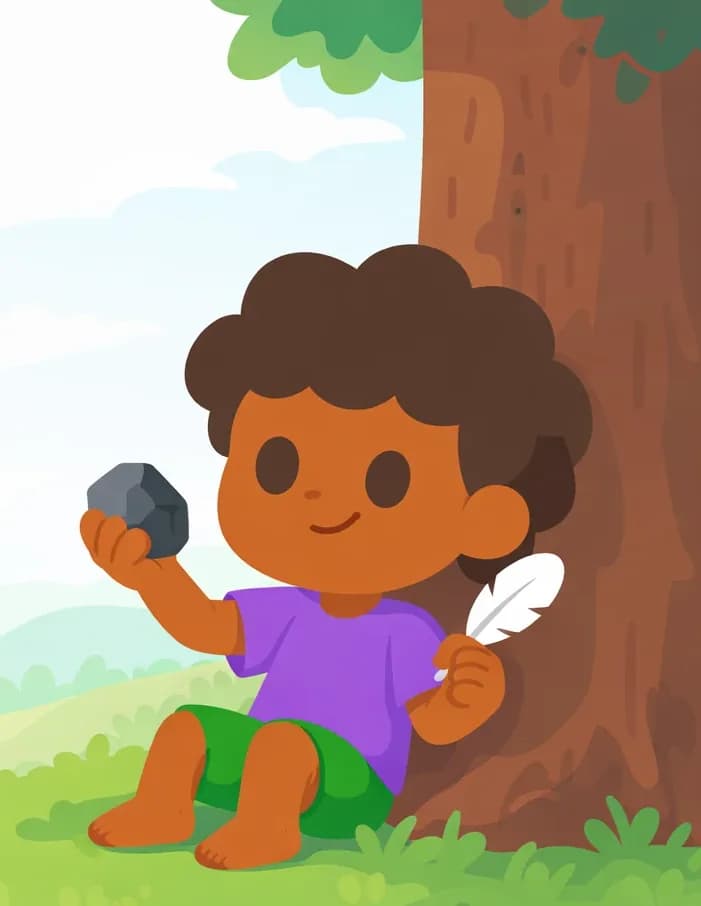
On the right side of the image, The Boy sits on the grass leaning against the trunk of a large tree, holding a rock up in one hand and a white feather in the other. He has a curious, wide-eyed expression as he examines the rock. The scene is set outdoors on a grassy hillside with soft, rolling green hills and a pale cloudy sky in the background, suggesting daytime with gentle overcast lighting. The left side of the image is open sky and hillside, clear of characters or objects.

Max sits on a hill, holding a rock and a soft white feather. 'I will drop them both,' he says. 'The rock will hit the grass before the feather.' But does it have a lot more mass, or just a bit?
Page 2
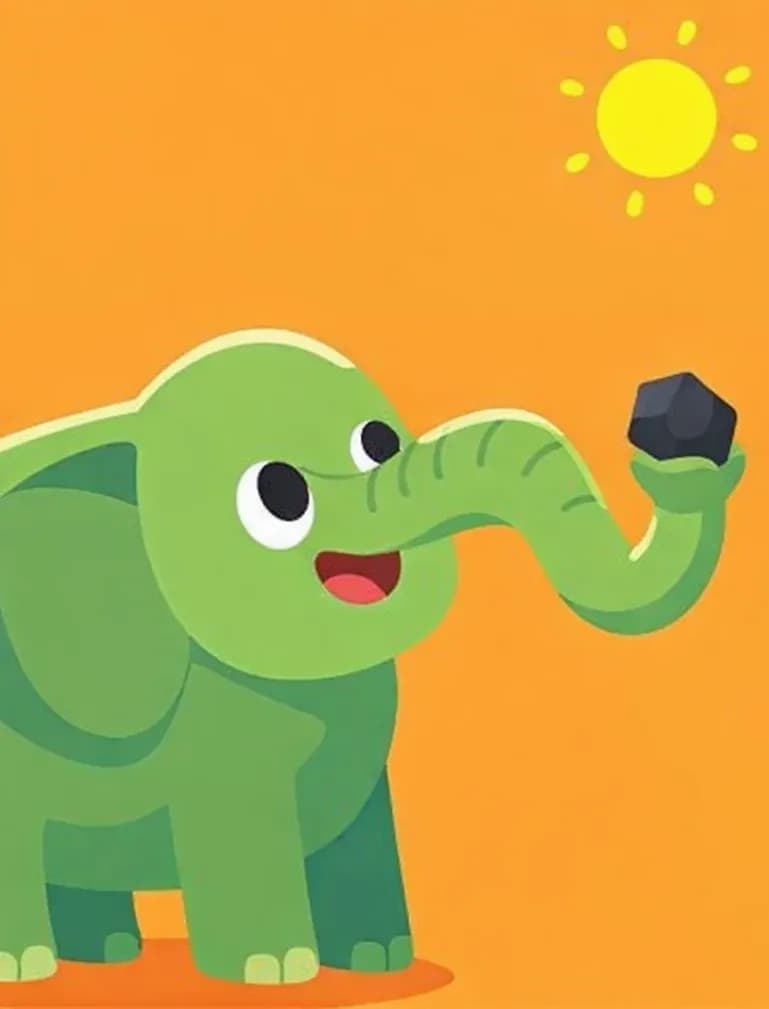
On the left side of the image, an elephant stands gripping a small dark rock tightly in the curled tip of its trunk, holding it up as if examining it. The elephant has its mouth slightly open and appears curious or contemplative. The scene is set outdoors against a warm orange sky with a bright yellow sun near the top centre, suggesting a hot, sunny day. The right side of the image is plain orange-toned background.

The rock is dark, solid, and sharp. Even the strong grip of the elephant can not chip it. In the harsh sun, the rock is hard, just as strong as before. Try biting one. No. Do not do that.
Page 3
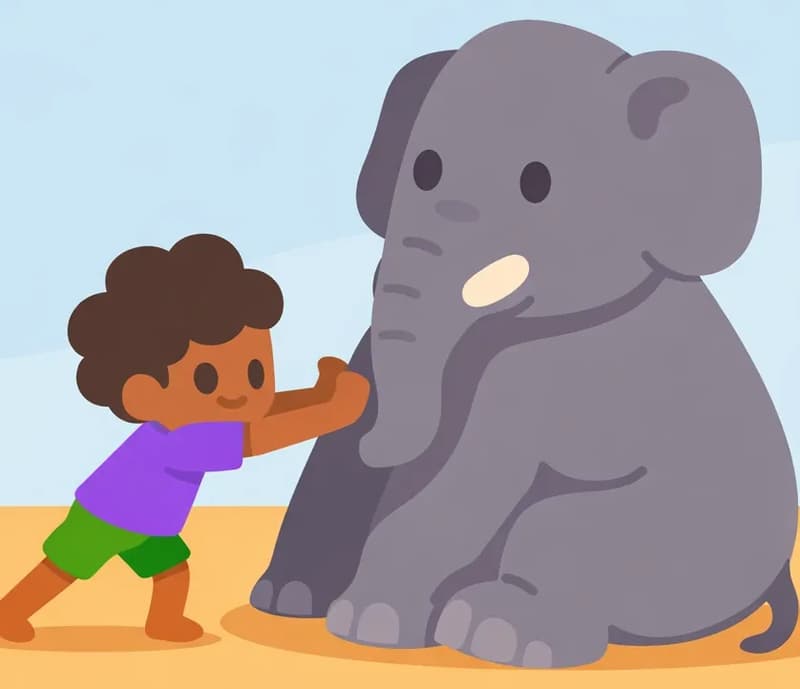
On the right side of the image, The Boy is leaning forward with both arms outstretched, pushing against a massive elephant that is sitting stubbornly on the ground. His body is braced low with legs bent, showing a determined effort, but the elephant remains completely unmoved, sitting calmly with a placid expression. The scene is set outdoors on flat, sandy ground under a pale blue sky, with the left side left as open background.

'A rock is a lot like an elephant,' says Max. 'Both are hard to move.' Max shoves hard at the elephant with both arms. He shoves and shoves, but the elephant does not budge at all. 'It wins,' Max puffs.
Page 4
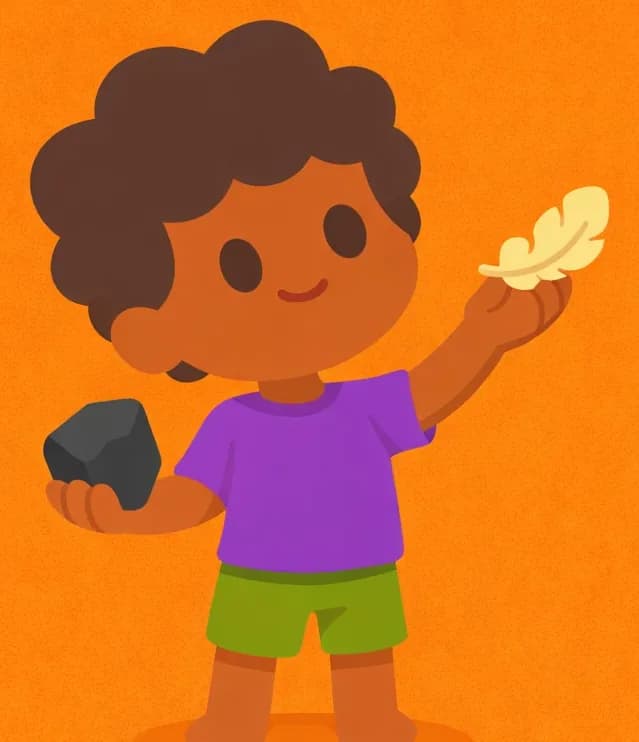
On the left side of the image, The Boy stands facing the viewer, holding a dark rock in his right hand (lowered slightly) and a light feather in his raised left hand. He looks up toward the feather with a curious, contemplative expression, as if comparing the weight of the two objects. The background is a warm, plain orange with no other objects or characters.

The elephant walks off. Max holds up the rock and the feather. The rock pulls his arm, but the soft feather would drift off in a gust. 'One of you is a grumpy lump,' Max says.
Page 5
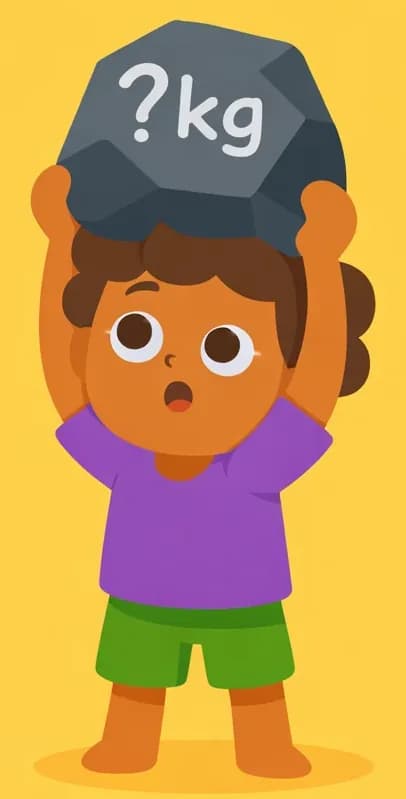
On the right side of the image, The Boy stands holding a large dark rock above his head with both hands. The rock has "?kg" written on it in white chalk-like text. The Boy has a curious, slightly strained expression with wide eyes and an open mouth, as if wondering how heavy the rock is. The background is a warm, plain yellow-orange tone with no other objects or characters.

Max lifts the rock and gazes hard at it. That dark stone has a secret mass locked inside. 'What is your mass?' he asks. 'Five? Ten? Forty?' The rock says nothing. You can not tell the mass just by picking it up. Max must get help.
Page 6
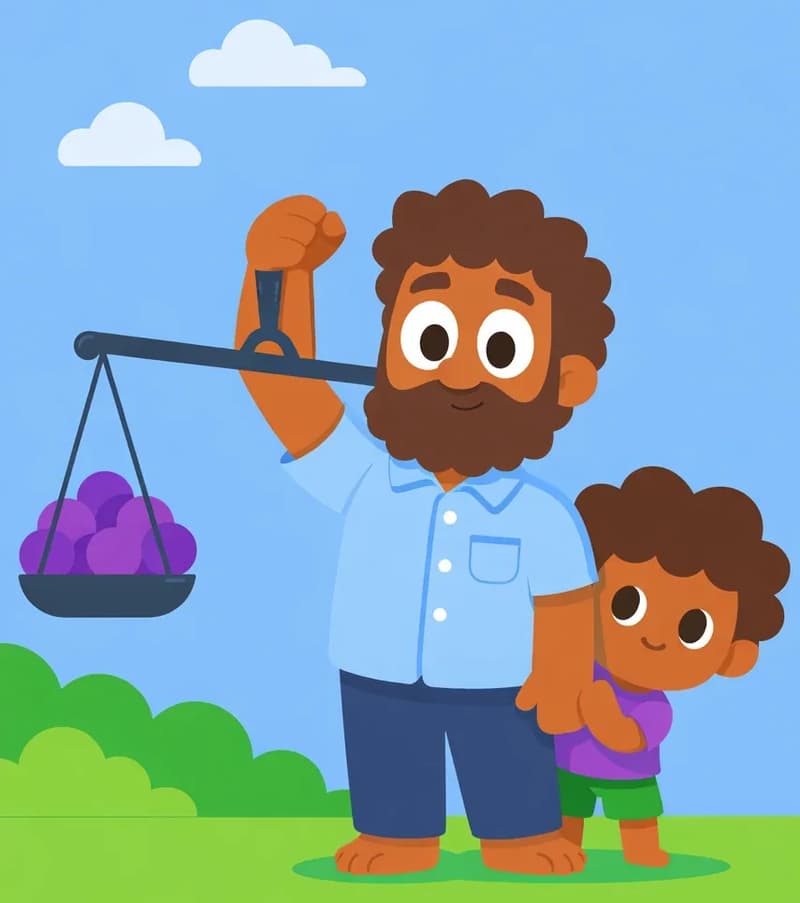
On the left side of the image, Dad stands holding up a traditional balance scale with his right arm raised, looking confident and helpful with a slight smile. The Boy stands beside him at a lower height, peeking out from behind Dad with wide, curious eyes, watching the scale. One pan of the scale holds a cluster of round purple objects (used as counterweights), while the other pan sits empty, ready for the rock. The scene is set outdoors in a suburban American yard on a clear day, with green bushes and a blue sky with a few white clouds in the background. The right side of the image is open sky, clear for text.

'Dad!' Max yells. 'I must find the mass of this rock!' Dad comes up the drive with his scale and a big grin. 'A scale is just the thing for this job!' he says. At last they can find the mass.
Page 7
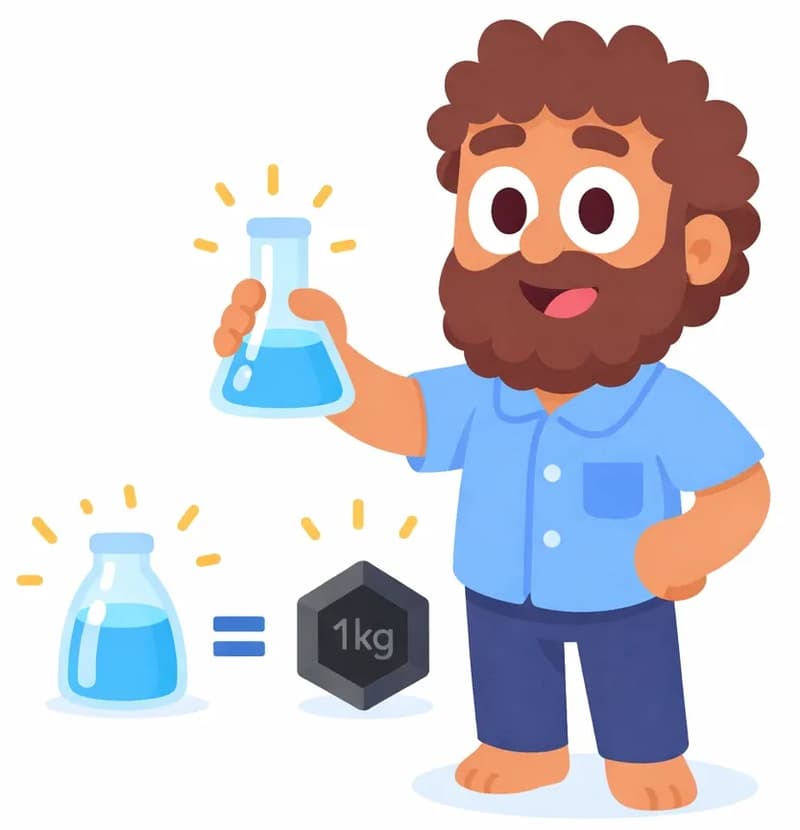
On the right side of the image, Dad stands at a three-quarter angle holding a clear flask filled with water in one hand, presenting it proudly with a confident smile. Next to him, a simple diagram shows the filled water flask next to an equals sign and a 1kg weight, illustrating the concept that the water-filled flask weighs exactly one kilogram. Small radiating lines surround the diagram for emphasis. The background is plain white. The left side of the image is clear for text.

Dad holds up a flask of water. 'This flask, full to the top, is one,' he says. 'One flask, one mass.' He marks it on his chart with a grin.
Page 8
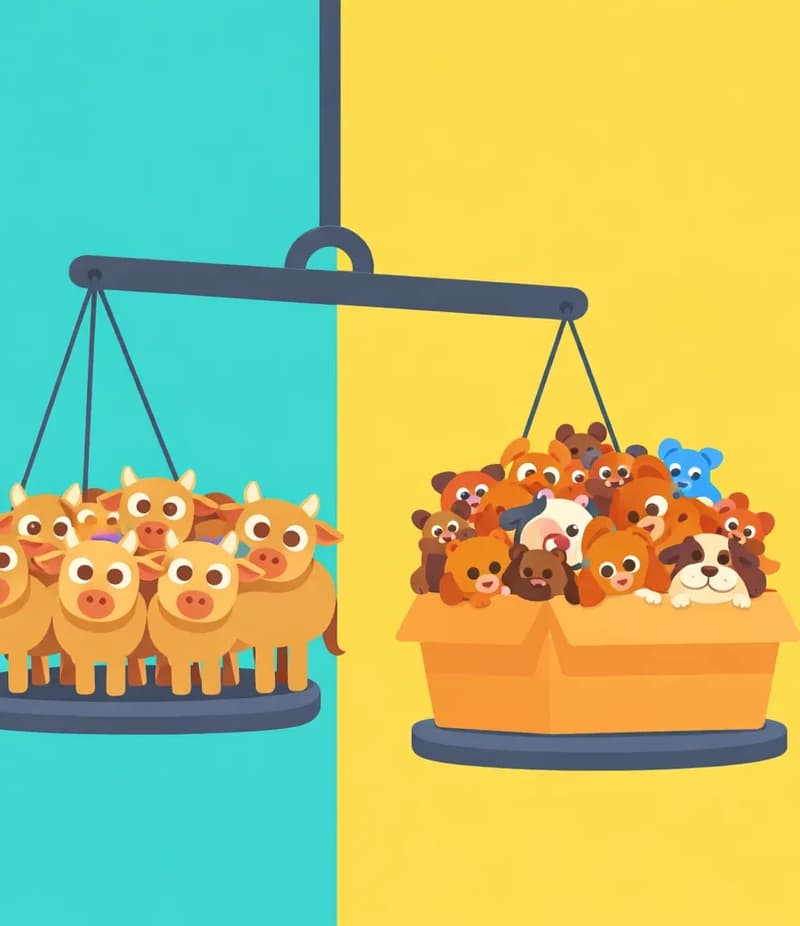
On the left side of the image, a large balance scale dominates the scene. On the left pan, ten cows stand huddled together, looking wide-eyed and slightly bewildered, their combined weight pulling that side of the scale down lower. On the right pan, 200 dogs of various sizes and breeds are crammed into a large cardboard box labelled "200," sitting higher up as the scale tips in the cows' favour. The background is split with a bright turquoise colour on the left and yellow on the right, with the right portion remaining as plain background space.

'Dad, does more of something give more mass?' Max asks. 'Not at all!' says Dad. 'Ten cattle on this side of a large scale. Two hundred dogs on that side. Which side falls?' 'The dogs!' says Max. 'Wrong!' says Dad. 'The cattle win. It is not the sum that sets mass. It is what is packed inside.'
Page 9
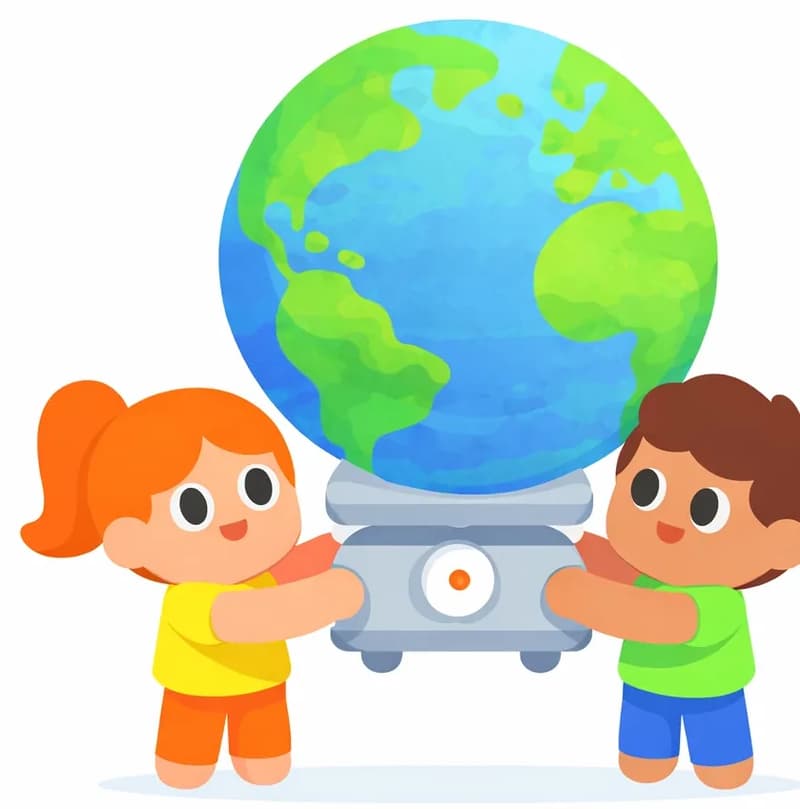
On the right side of the image, a large painted Earth globe floats against a plain white background, showing blue oceans and green continents in a loose, watercolour-style illustration. The left side of the image is entirely clear white space. The composition is simple and conceptual, emphasising the vastness of the world in relation to the page's theme of weighing the Earth.

Max looks at the hills, the sky, the vast planet under him. 'Can we find the mass of the planet?' he asks. Dad smiles. 'No scale is that large. But maths can find it.' Max blinks. Maths can find the mass of it all?
Page 10
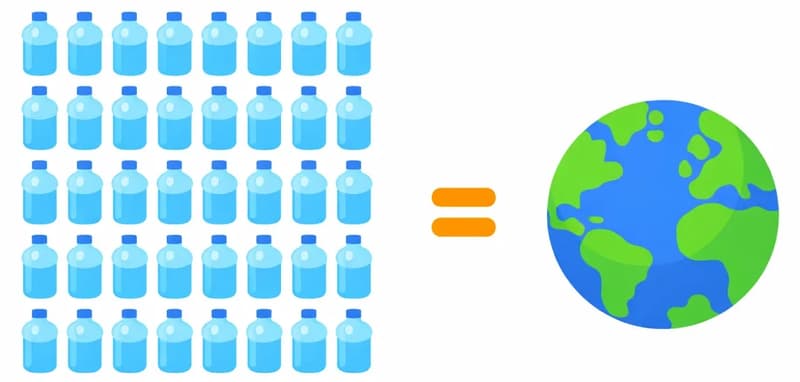
On the left side of the image, a large grid of many identical blue water jugs or gallon containers fills the space, with the number "5,974,000,000,000,000,000,000" written below them. An equals sign sits in the centre, and to its right is a colourful illustration of Earth shown as a globe with blue oceans and green landmasses. The right portion of the image is plain white background. The composition is a simple infographic-style visual comparing the massive number of containers to the weight of the Earth.

'The mass of this planet is the same as jugs and jugs of water,' says Dad. 'More jugs than we can count!' Max can not take it all in. The sum is so big it can not fit on one chart.
Page 11
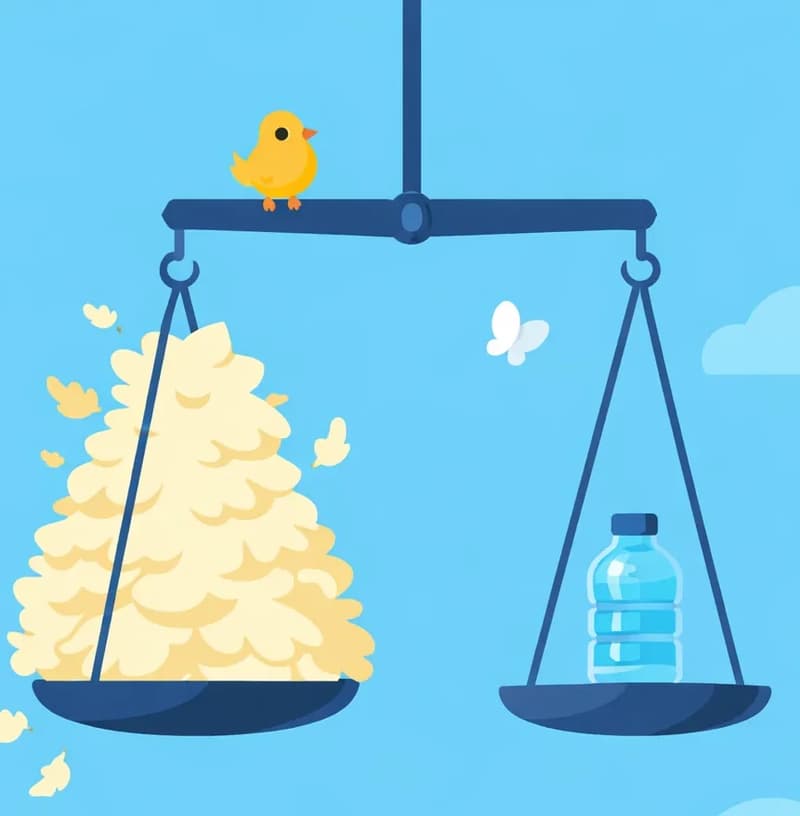
On the right side of the image, a large balance scale hangs from above against a bright blue sky with soft clouds. The left pan of the scale holds an enormous, overflowing pile of feathers that towers upward, while the right pan holds a small water flask (one kilogram), with both sides balanced evenly. A tiny bird perches on the top beam of the scale, and a white butterfly flutters nearby. The dramatic size contrast between the massive mound of feathers and the compact flask visually emphasises the difference in volume for the same weight.

'Can my feather match the flask?' Max asks. They pile up feathers until the stack rises far past the top of the scale. Then both pans sit still. The same mass. But one side is huge and one side is tiny.
Page 12
On the left side of the image, large blue-outlined raindrops fall from a soft watercolour sky filled with white clouds, against a turquoise and green-tinted background. The scene is an outdoor daytime sky view with scattered raindrop illustrations drifting downward, evoking a gentle rain shower. No characters are present — the composition is purely atmospheric, showing the rain referenced in the page text.

Small drops start to fall from the sky. One lands on Max's arm, so tiny he can hardly feel it. 'But more and more drops form a large dark pond,' he says. Tiny things add up. Even a soft thing has mass.
Page 13
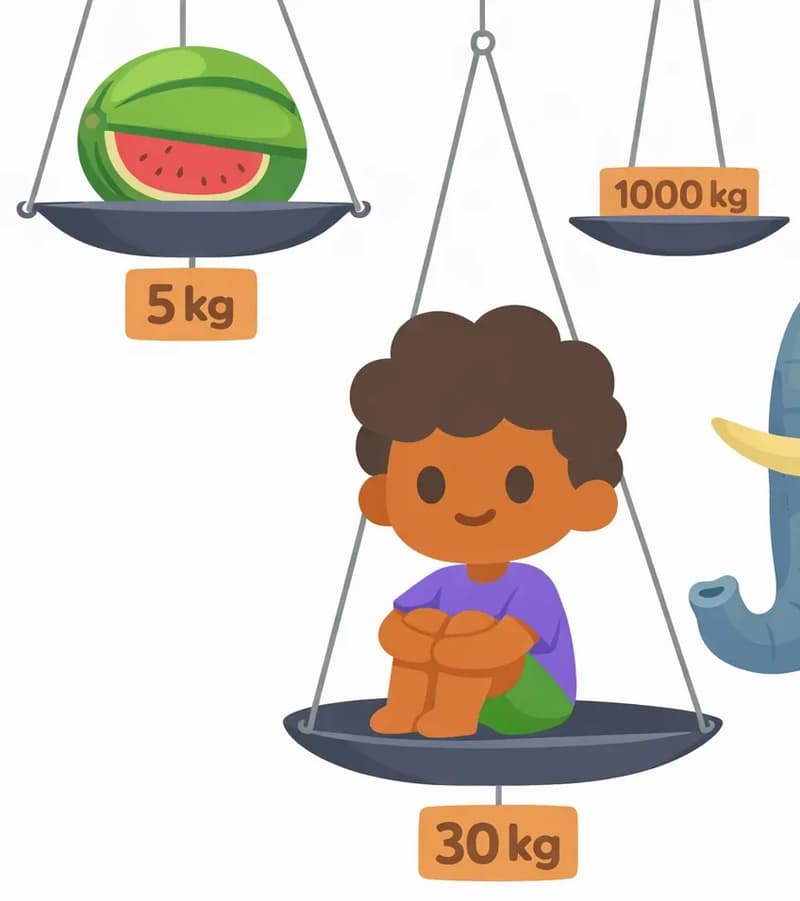
On the right side of the image, The Boy sits cross-legged on the pan of a large hanging balance scale, smiling contentedly with his arms wrapped around his knees. His pan is labelled "30 kg." Above him to the upper left, another pan holds a halved watermelon with a label reading "5 kg." To the far right, the tip of an elephant's trunk is visible, connected to a pan labelled "1000 kg." The left side of the image is plain white background.

Max gets on the scale. He is not as big as an elephant, but not as small as a melon. He sits with the rock and the feather beside him, just like before on the hill. 'One, two, drop!' he says. Which one do you think lands last? Go and try it!

Page 1 of 13

Bookbot is not endorsed by or affiliated with UFLI (the University of Florida Literacy Institute) or Jolly Learning Ltd. UFLI Foundations and Jolly Phonics are trademarks of their respective owners.

Download Bookbot now to
GET STARTED