




If your child struggles with reading, you’ve probably noticed more than just difficulty with books. Maybe they avoid homework, get upset before school, or say things like “I’m dumb.” What looks like frustration on the surface might actually run deeper than you think.
A growing body of research is uncovering a pattern that many parents sense but rarely see named: children who find reading difficult are at significantly higher risk for anxiety and depression. The data, drawn from tens of thousands of children across dozens of studies, shows a consistent link between reading struggles and wellbeing.
I’ve spent a lot of time reviewing this research as part of my work with Bookbot and Flinders University. The findings are concerning but ultimately encouraging, because once we understand the connection, we can act on it.
What the Research Tells Us
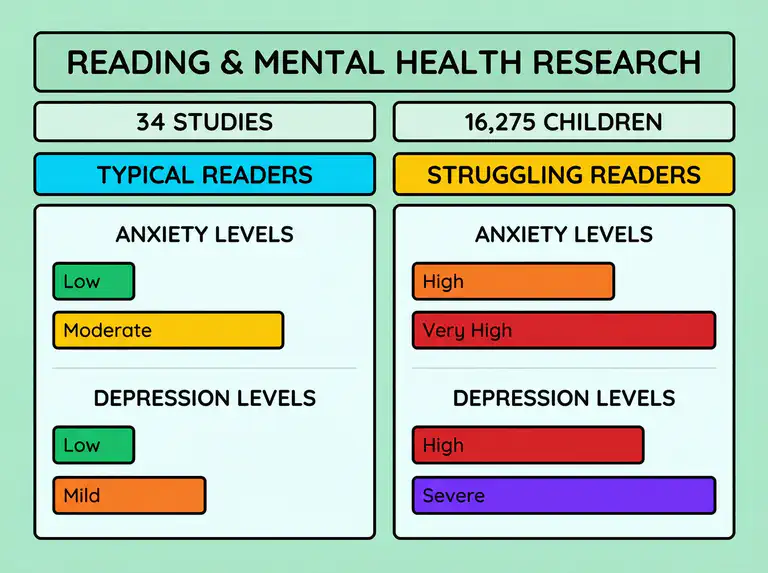
The clearest picture comes from a meta-analysis (a study that pools results from many individual studies) by Francis et al. (2019) in the Clinical Psychology Review. They analysed 34 studies covering 16,275 participants and found that children with reading difficulties scored significantly higher on anxiety (effect size d = 0.41, meaning a meaningful gap between struggling and typical readers) and moderately higher on depression (d = 0.23).
That finding has since been reinforced. Vieira et al. (2024) published an even larger meta-analysis in Annals of Dyslexia, drawing on 96 studies and over 83,000 participants. They found a moderate effect size (Hedge’s g = 0.54) for internalising (inward-turning emotional) problems like anxiety, depression, and withdrawal in individuals with learning difficulties.
Across different countries, age groups, and methods, the pattern holds: children who struggle to read carry a heavier emotional load.
Why Reading Struggles Get Under the Skin
Think about what reading difficulty means in a child’s daily life. Reading isn’t a quiet, private skill. Children read aloud in class. They’re grouped by ability. They see peers moving ahead while they fall behind. Every school day carries small moments of exposure and comparison.
Kargiotidis and Manolitsis (2024) tracked 121 children from Grade 2 through Grade 5 and found that those with early literacy difficulties developed significantly more social anxiety by upper elementary. The children who struggled with both reading and spelling were especially affected. It was the sustained experience of struggling in a social environment where reading is visible that predicted anxiety.
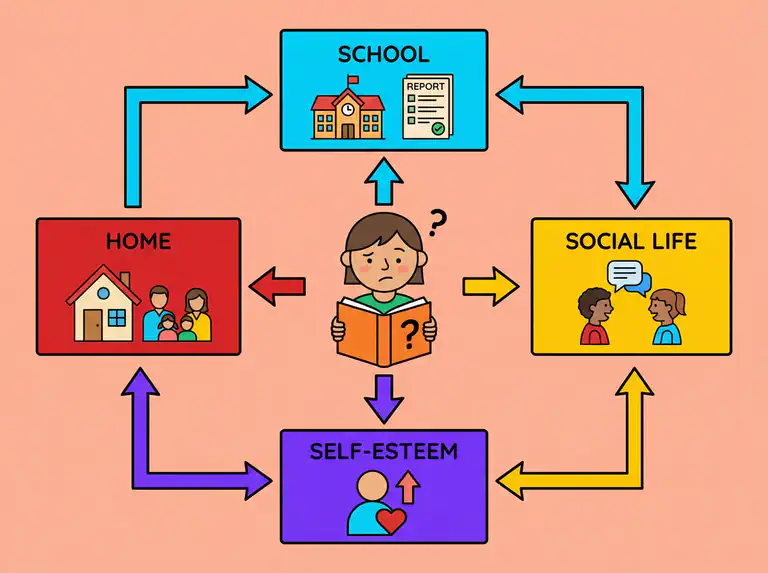
Lievore, Cardillo, and Mammarella (2025) found that approximately 70% of young people with specific learning disorders experience elevated anxiety. Their research showed that school difficulties don’t stay at school. They generalise to other areas of daily life, feeding a broader pattern of worry and avoidance.
What This Means for Your Child
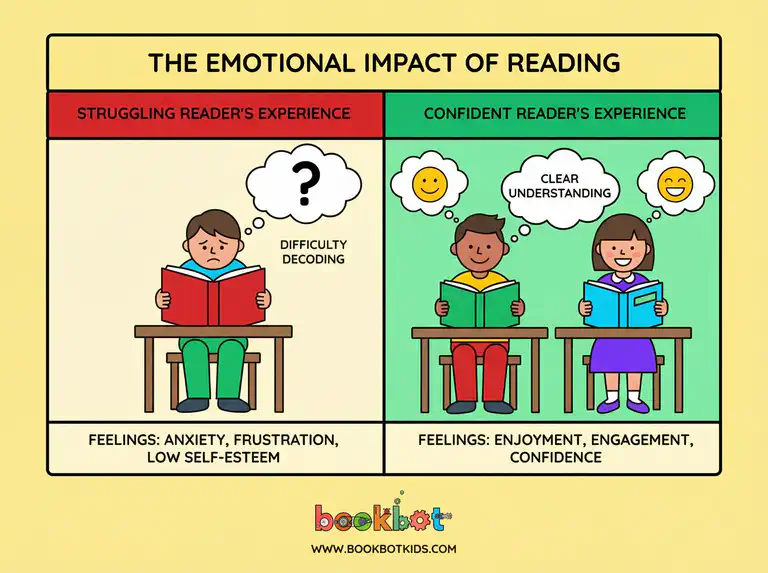
If your child is a struggling reader, you may already be seeing signs of this emotional weight: reluctance to try, frustration that seems out of proportion, or quiet withdrawal. These aren’t character flaws. They’re predictable responses to a situation that feels overwhelming.
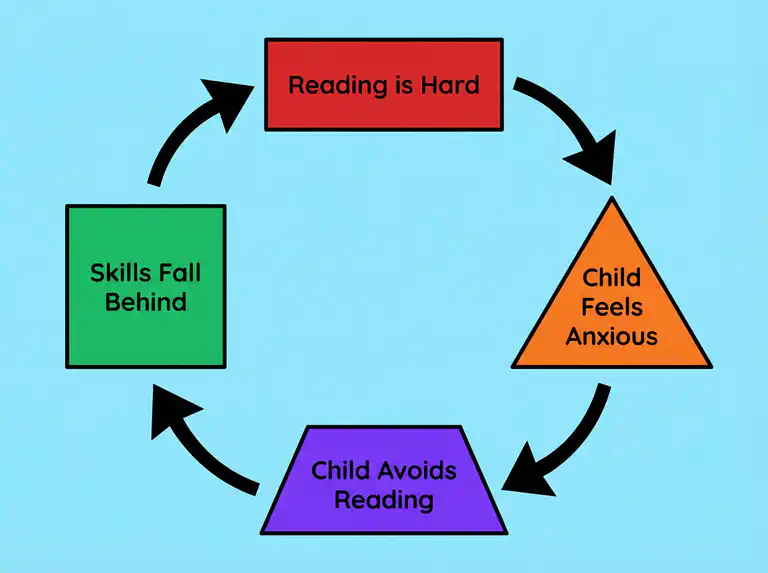
Anxiety and reading difficulties often reinforce each other. A child who is anxious about reading avoids practice, which means they fall further behind, which increases the anxiety. Breaking that cycle is key.
This is exactly what we focus on at Bookbot. When I analyse reading data from thousands of children using the app, one of the clearest patterns is that children who practise consistently, even in small amounts, build confidence alongside skills. The app provides immediate feedback privately, so children can practise without the social pressure of a classroom.
Practical Strategies That Help
-
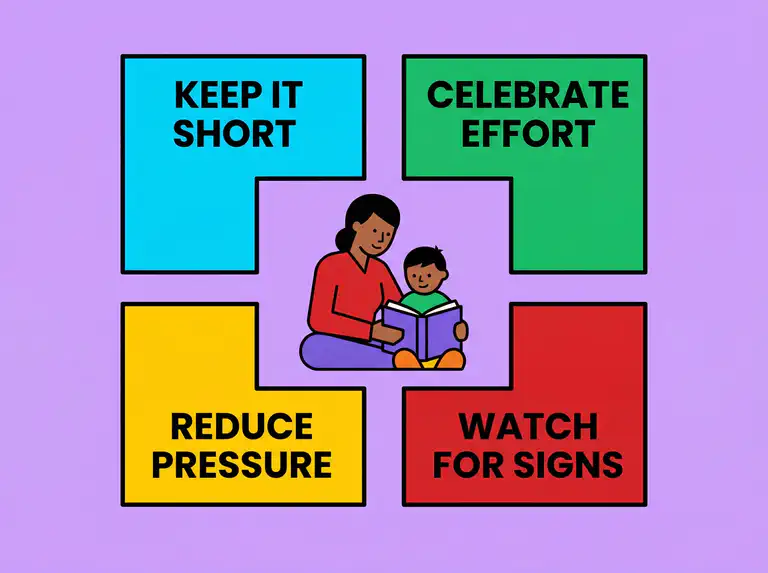
Keep reading sessions short and positive. Ten minutes of relaxed, supported reading is more effective than thirty minutes of struggle. Quality of practice matters more than quantity, and short, successful sessions are one of the most effective reading strategies for struggling readers.
-
Separate reading ability from intelligence. Children with reading difficulties often conclude they’re “not smart.” Remind your child that reading is a skill, not a measure of how clever they are.
-
Reduce the social pressure. The link between reading difficulties and social anxiety (Kargiotidis & Manolitsis, 2024) suggests that public reading situations can be especially stressful. Let your child build confidence privately first. This is one reason we built Bookbot: to give children a space to practise reading aloud with real-time support, but without an audience.
-
Watch for emotional signs, not just academic ones. Avoidance, irritability, stomachaches before school, and negative self-talk (“I hate reading,” “I can’t do it”) can all be signs that reading difficulty is affecting your child’s mental health.
-
Ask about combined approaches. Grills et al. (2024) found that integrating brief anxiety management techniques into reading instruction significantly reduced social anxiety in struggling readers over two years. Ask your child’s school whether they address the emotional side of reading struggles, not just the academic side.
-
Celebrate effort and progress, not perfection. When your child sounds out a tricky word, name what they did: “You stuck with that word even though it was tough.” This builds self-efficacy, the belief that effort leads to improvement.
The Encouraging Part
Here’s what I find most encouraging when I review this research: the link between reading and mental health runs both ways. Just as reading difficulties can contribute to anxiety, improving reading skills can help lift the emotional burden. That’s one of the real mental health benefits of reading support done well.
The Grills et al. (2024) trial showed that when reading support is paired with even brief emotional coaching, children’s anxiety drops meaningfully. And at Bookbot, we see this in the data every day. Children who use the app regularly don’t just become better readers. They become more willing to try and more confident in themselves.
If your child is struggling, act early and act gently. Reading difficulties don’t have to define a child’s emotional experience, but they need to be taken seriously, both as an academic challenge and as something that touches how your child feels about themselves.
References