




If your child has been diagnosed with dyslexia, or if their teacher has flagged them as a struggling reader, you have probably spent hours searching for the right kind of help. The options can feel overwhelming: phonics programmes, tutoring centres, multisensory methods, apps, workbooks. How do you know what actually works?
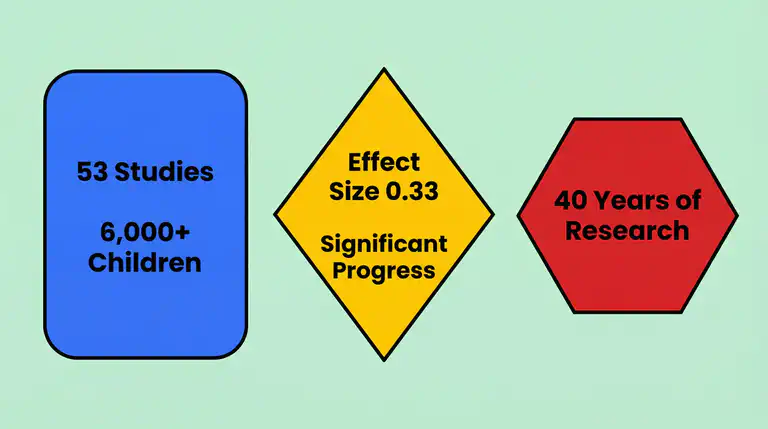
A team of researchers recently answered that question with unusual rigour. Hall and colleagues at the University of Virginia conducted a meta-analysis (a study that combines results from many individual studies to find overall patterns) of 53 high-quality studies spanning four decades, covering more than 6,000 elementary-age children with or at risk for dyslexia (Hall et al., 2022). Their findings offer some of the clearest evidence we have about which reading interventions for dyslexia make a real difference, and they have practical implications for anyone teaching dyslexic students to read.
The Research: What 53 Studies Tell Us
When I review the research on dyslexia interventions, this meta-analysis stands out for a few reasons. It focused specifically on children who scored at or below the 25th percentile on standardised word reading or spelling tests, meaning these were kids with genuine foundational reading difficulties, not a broad mix of struggling readers. And it only counted results from standardised, norm-referenced measures, which are harder to game than researcher-designed tests.
The headline finding: reading interventions that include instruction in foundational skills produce a significant positive effect on reading outcomes, with an average effect size of 0.33 (Hall et al., 2022). In plain terms, that means children who received these interventions made meaningfully more progress than children who did not. That is consistent with what other major reviews have found. Gersten et al. (2020) reported a mean effect of 0.39 for reading interventions in Grades 1 to 3, and Neitzel et al. (2022) found an effect of 0.26 across Grades K to 6.
What made interventions stronger? Two things stood out: dosage and spelling instruction.
More Practice, Better Results
Dosage, meaning the total number of hours of intervention, was the only intervention characteristic that significantly predicted outcomes after controlling for everything else (Hall et al., 2022). For each additional hour of instruction, the effect size increased by 0.002. That might sound small, but it adds up. A child receiving 100 hours of intervention would be expected to gain an additional 0.20 in effect size compared to a child receiving just one session.
This is an important finding for parents. It tells us that consistency matters. Short bursts of support are less likely to move the needle than sustained, regular practice over time. At Bookbot, this is one of the reasons we built the app around daily reading practice: the research consistently shows that children with dyslexia need more opportunities to practise foundational skills, not fewer.
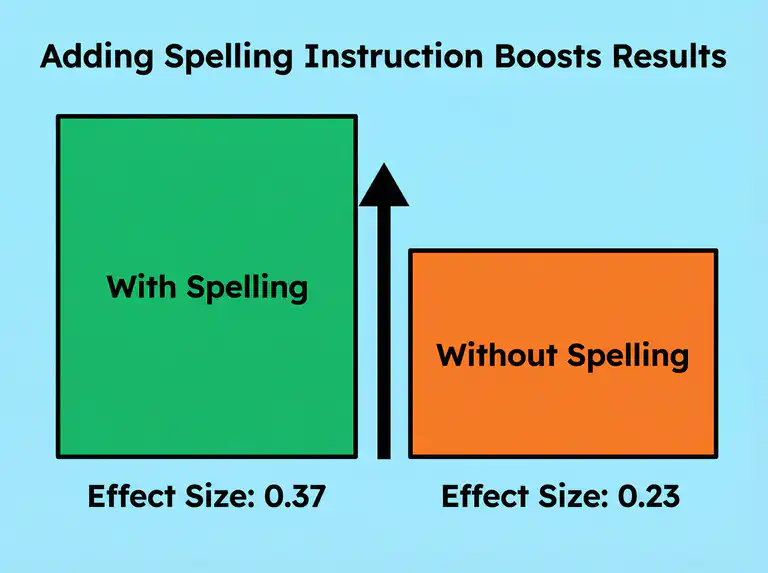
The meta-analysis also found that interventions with a spelling component produced larger effects (g = 0.37) than those without one (g = 0.23), a statistically significant difference (Hall et al., 2022). Spelling and reading draw on the same underlying knowledge of how sounds map to letters. When children practise spelling alongside reading, they are strengthening the same neural pathways from two directions.
What This Means for Your Child
If your child is struggling with reading, the research points to a few clear priorities.
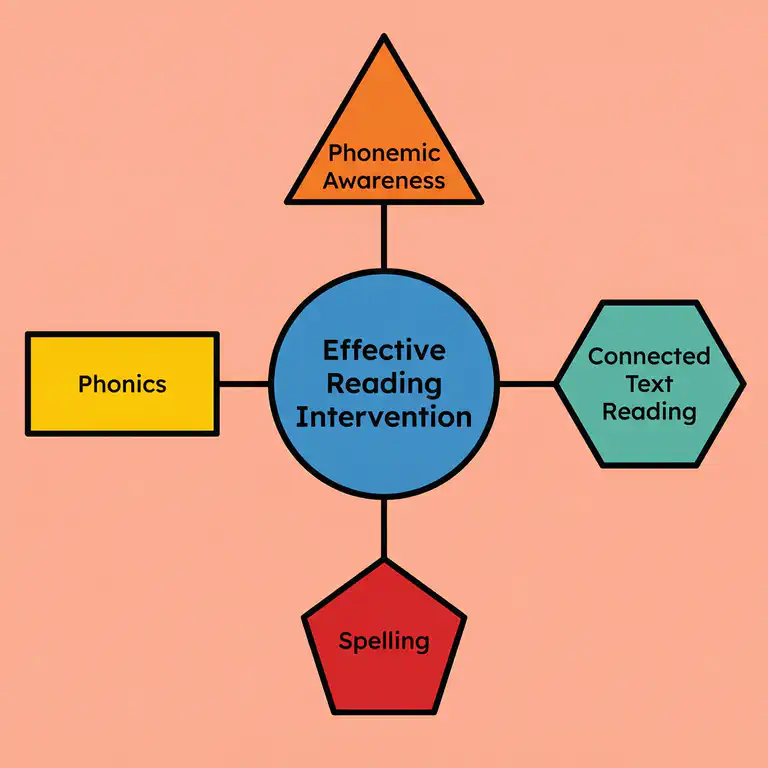
First, the intervention should explicitly teach foundational skills: phonemic awareness (the ability to hear and manipulate individual sounds in words), phonics (connecting those sounds to letters), and decoding (sounding out words). All 53 studies in the meta-analysis included word reading instruction, and 71% also included a phonemic awareness component (Hall et al., 2022). These are not optional extras; they are the core of what works for evidence based dyslexia interventions.
Second, do not overlook spelling. Many reading programmes treat spelling as a separate subject, but the evidence suggests integrating it into reading instruction produces better outcomes. When I analyse reading data from thousands of children, I see the same pattern the researchers found: kids who practise encoding (spelling) alongside decoding (reading) tend to make faster progress.
Third, when considering dyslexia strategies for reading, the type of instructor matters less than you might expect. In the meta-analysis, 46% of interventions were delivered by school personnel, 33% by researchers, and 9% were computer-delivered or technology-supported (Hall et al., 2022). All produced positive effects. What mattered was the quality and structure of the instruction itself.
Practical Strategies for Parents
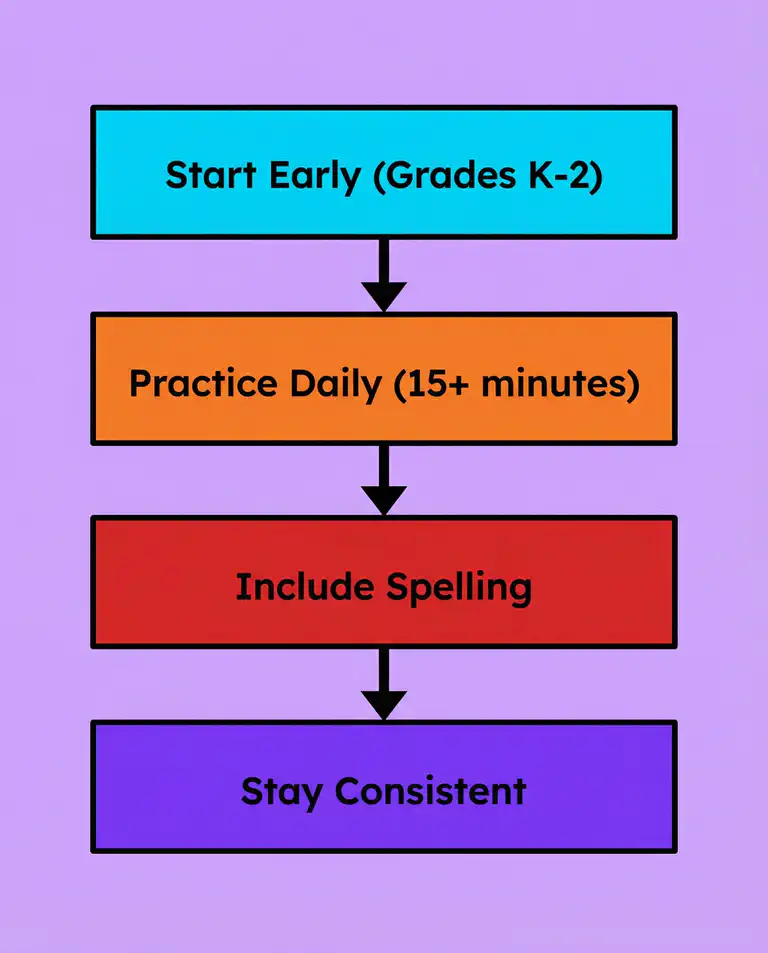
Start early if you can. Studies with K-2 students showed larger effects (g = 0.36) than those with students in Grades 3 to 5 (g = 0.16), though the difference was not statistically significant (Hall et al., 2022). While older children still benefit, the gap between struggling readers and their peers tends to widen with time (Francis et al., 1996), making early intervention more efficient.
Prioritise consistency over intensity. A child who reads for 15 minutes every day will likely make more progress than one who does an hour-long session once a week. The dosage finding from this meta-analysis reinforces what we work on at Bookbot and Flinders University: building daily reading habits that accumulate into meaningful practice hours.
Look for programmes that teach phonics and spelling together. The research clearly favours multicomponent interventions. A programme that only addresses one skill in isolation is likely leaving gains on the table.
Do not assume your child needs one-on-one tutoring. The meta-analysis found no statistically significant difference between one-on-one (g = 0.30) and small group instruction (g = 0.20) for helping students with dyslexia (Hall et al., 2022). Small group settings can be effective, more affordable, and easier to access.
Ask about evidence. When evaluating a programme or tutor, ask what research supports their approach. The interventions in this meta-analysis that worked shared common features: explicit, systematic instruction in foundational reading skills. Programmes that lack this structured foundation are less likely to help.
Be cautious about “multisensory” labels. The meta-analysis found that interventions explicitly described as multisensory (g = 0.20) did not outperform those that were not (g = 0.34) (Hall et al., 2022). The label alone is not a guarantee of effectiveness when choosing among dyslexia intervention programmes. What matters is what the programme actually teaches, not the branding.
The Encouraging Takeaway
Here is what I find most encouraging about this research. Across four decades of studies, the evidence is consistent: structured reading interventions that focus on foundational skills genuinely help children with or at risk for dyslexia. The effect is real, measurable, and meaningful.
Your child’s reading difficulties are not a fixed sentence. With the right kind of support, delivered consistently over time, children with dyslexia can and do make significant progress. That is what my research at Bookbot and Flinders University focuses on: making sure every child has access to the kind of evidence-based practice that this research shows works.
The most important step is the next one. Whether it is finding a structured literacy programme, building a daily reading routine, or simply reading aloud together, every session counts.
References